













A recruitment merry-go-round is providing opportunities for search firms and reshaping the landscape of India’s legal market
Vandana Chatlani reports
“If you do not change direction, you may end up where you are heading.” These words from Chinese philosopher and writer Lao Tzu might help explain the shuffles, fractures and rumbles within India’s legal market today.
It would be false to claim that these are new phenomena. Lawyers have always jumped from firm to firm, clinched in-house roles or pursued litigation work as a means to further their career prospects. The difference today is the escalation of such moves and the swiftness with which they are occurring.
The break-up of Amarchand Mangaldas propelled these shifts to a large extent. The idea that loyalists such as Akshay Chudasama of J Sagar Associates (JSA) and Shuva Mandal of AZB & Partners could leave to join Shardul Amarchand Mangaldas & Co (SAM) was unheard of. And these are only two examples of high profile partner exits. The market also saw Ravindra Bandhakavi exit the erstwhile Amarchand for Trilegal; Harry Chawla and Manishi Pathak leave Kochhar & Co for Cyril Amarchand Mangaldas (CAM); Kaushik Mukherjee move from JSA to BMR Legal; Avirup Nag and Navin Syiem move from HSA Advocates to IndusLaw; Ashwath Rau depart CAM and Aparna Mittal leave Luthra & Luthra for AZB; Rahul Ray and Vikram Bajaj go from Kochhar & Co to Lakshmikumaran & Sridharan; and Amitabh Sharma exit Khaitan & Co to become HSA’s managing partner.
[ihc-hide-content ihc_mb_type=”show” ihc_mb_who=”3″ ihc_mb_template=”2″ ]
“We’ve never seen this kind of turmoil in the industry,” says Bithika Anand, the founder and CEO of Legal League Consulting. “When Amarchand separated, everything around it shook … that triggered a process where everyone else also wanted to look for a change. We’ve seen disintegration among the top firms and that process won’t stop now.”

Anand says the moves by Chudasama, Mandal and Abhijit Joshi (who left AZB & Partners to set up Veritas Legal) have encouraged other senior lawyers to consider opportunities that would have been unthinkable in the past. These were long-term partners and their departures “have given many more the courage to take a leap of faith and try something new,” she says. “When you’re at a large law firm, you get money, clients, status and fame. But you will never be a founder – even if you helped build the firm from an early stage. Some lawyers are now keen to have a real sense of ownership and control, and setting up their own outfits has been one way to achieve this.”
Indeed, a new breed of law firms is emerging as lawyers give up their roles at firms of all sizes. Vinayak Burman along with two colleagues recently left Economic Laws Practice to set up Vertices Partners while Salman Waris exited Seth Dua & Associates to form TechLegis with some of his friends and former colleagues.
Jostling for position
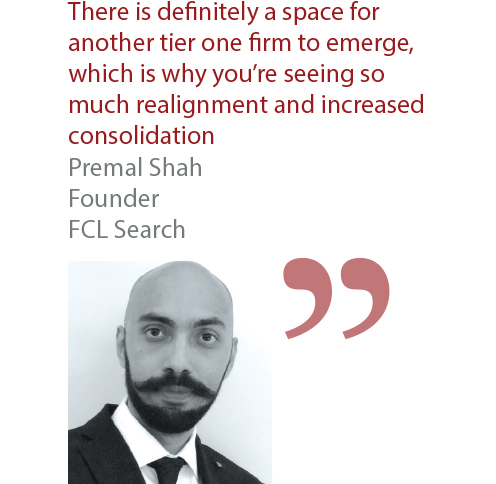
Premal Shah, the founder of FCL Search, believes fissures in the market and the willingness of senior professionals to leave their firms could lead to new contenders among the top tier. “Mid-sized firms that have built strong systems are ambitious about competing with the top firms and entering that league, he says. “They can only do this by adding lateral partners in different practice areas.” However, he says this is only possible if such firms “properly institutionalize their practices”.
Lee Ignatius, the co-founder of Vahura and head of the company’s law firm group, agrees with this sentiment. “The challenge for medium and large firms is the ability for the managing or senior partnership to engage and harness these entrepreneurial abilities at the institutional level. Higher level motives of legacy, respect and differentiation are other key aspects that firms need to address aside from monetary or equity considerations.”

FCL had the exclusive mandate to set up SAM’s Mumbai and south India operations last year and has also been used by firms such as Trilegal, BMR Legal, IndusLaw, Link Legal India Law Services and S&R Associates. Shah foresees a wave of activity in the large and mid-market segment over the coming months, with exciting senior hires and consolidation exercises that FCL is in the process of closing.
“The market urgently needs another alternative,” says Shah. “We are witnessing a number of mergers because you only have a few firms at the top. There is only so much talent they can absorb. There is definitely a space for another tier one firm to emerge, which is why you’re seeing so much realignment and increased consolidation. These new options will not only benefit clients, but the existing talent pool that is eyeing the next stage of career growth.”
Shah says a few Delhi-based firms are looking at mergers in Mumbai. Pointing out instances where such partnerships have derailed, he blames managing and senior partners who viewed their Mumbai practices as secondary to Delhi. “No one will stick around if they feel their office is not a priority,” he says. “It’s not just about providing a brand name in Mumbai. You need to provide equity and treat it like your true partner. Those who failed did so because their approach was too narrow there.”
Firms that aren’t looking at consolidating are contacting agencies for specialist hires in areas such as infrastructure, capital markets, competition law, litigation and international commercial arbitration. According to Shah, firms that earlier sought to focus on their core competencies are now thinking of ways to enhance their client offerings. “Commercial litigation and international commercial arbitration has always been very lucrative,” he says. “A number of companies are ramping up their in-house teams, but many will still have to engage outside counsel for litigation. This is one very important driver for law firms.”
He is quick, however, to note that not all companies will farm out litigation work. “Uber hired Mohit Abraham from Khaitan & Co to head its in-house legal team and an Indian e-commerce giant is looking at hiring a lawyer with dispute resolution skills. It’s not that companies can’t hire talent for those needs, but not every company will do it.”
Hiring practices
While much junior hiring is aggressively conducted on campus or through internships, managing partners often seek the help of legal recruitment agencies when scouting out senior candidates.
“Recruiters can charge in excess of 30% of the first year’s CTC [cost to company] so wherever possible clients will attempt to utilize their internal HR [human resources] team or explore their own network before instructing a specialist recruiter,” says an experienced legal recruitment specialist who wishes to remain anonymous.
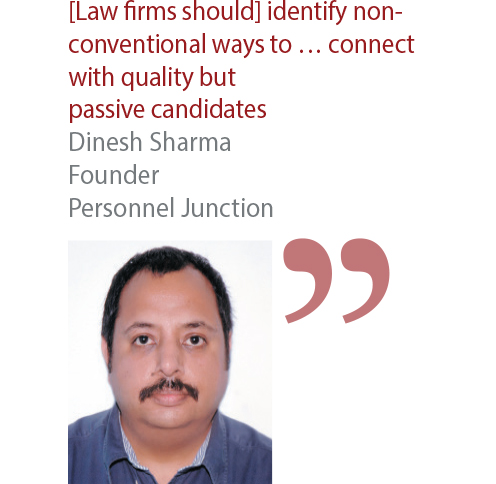
Dinesh Sharma, the founder of Personnel Junction, says he usually receives very specific requirements from large firms that want lawyers who excel both academically and technically. “Because they have deep pockets and brand value, they are generally successful,” says Sharma. “Medium and small-sized firms also want that level of quality, but they are more flexible and may compromise to a certain extent.”
Ignatius at Vahura shares a similar view and distinguishes between the needs of different firms. “As a general observation, high engagement platforms irrespective of the size of the firm, look to get lawyers who are technically sharp, have the right ‘spit and polish’ to deal with institutional clients like large private equity funds, and handle multibillion-dollar deals. The needs of some smaller or mid-sized firms would be to have generalists that can advise on broad range of issues facing a client, unlike larger firms that are more practice-line focused.”
While organic growth is a preference for many firms, some take the route of lateral hires to bring in missing specialization or add weight to an existing practice. Although prominent hires often improve market perception of a firm, Anand says partners should tread carefully when recruiting in this manner. “Lateral hires always come at a higher price,” she says. “Firms should think about using their existing resources because when people find out a new entrant is getting more money and perhaps a superior designation, this can create conflict.”
Common mistakes
All the recruitment specialists who spoke to India Business Law Journal agreed that law firms and companies could improve their hiring practices. One common problem cited was the propensity of partners to rely on their own networks and internal recommendations when searching for talent. “The Indian legal recruitment market is still relatively immature and in its infancy,” says our anonymous source. Hiring through personal or social networks may save costs, but it “does not necessarily mean you have secured the best available talent in the market at that particular point in time”, he says. “Fees are often at minimal levels and firms will regularly instruct multiple recruiters which means it is a rat race to send over as many CVs as possible in the hope that one of them sticks.”
A mistake often made during in-house recruitment, says Karlstein Fernandes, head of in-house search at Vahura, is “an increased reliance on designations and titles over scrutinizing resumés”. He adds that in some cases, companies are not open to understanding that “titles differ from organization to organization”.
Recruiters say the interview process could also be improved. Anand at Legal League Consulting calls for attention to emotional quotient and the “softer aspects of a lawyer’s personality”, while Sharma at Personnel Junction advocates sending out “a detailed questionnaire or a video call before scheduling a face-to-face meeting”, to save time. In addition, Sharma says firms should “identify non-conventional ways to … connect with quality but passive candidates”. HR executives, he says, should play a more active role in this. “Sometimes, because of a managing partner’s workload, good profiles are missed resulting in a loss of quality lawyers in an already competitive legal industry.”
“There is no innovation in recruitment,” states Anand flatly. “Although many firms now claim to have manpower planning in place, I still find that this is missing. A lot of hires are part of a ‘replacement’ exercise, not a recruitment one. Firms need to think beyond replacing people. They need to integrate manpower planning into their business plans.”
The unnamed recruiter echoes this statement. “Firms and companies need to partner with a recruiter and make them an extension of their own HR department,” he says. “They need to retain the recruiter exclusively, enthuse them with the organization’s vision, strategy and growth plans so that the very same message goes out to the candidate market – consistently. Firms need to have clear briefs and job descriptions that outline the organization itself in detail, the role on offer, the reason for the role and the prospects available down the line for the successful candidate. The recruitment process needs to be structured with clear dates set in advance for a shortlist presentation, followed by first, second and third rounds of interviews so that assessments and comparison of candidates can be made with ease.”
And what now that the informal poaching arrangement between SAM and CAM has come to an end? Sharma says this will only create friction between the two. “They will now start hunting for stars on each other’s turf,” he says. “The damage to other firms has already been done.”
[/ihc-hide-content]