






An uptick in cross-borders deals emanating from China has coincided with a surge in M&A insurance activity mainly channelled via Hong Kong, writes James Kelly
With private equity (PE) funds divesting mature assets and cashed-up Chinese conglomerates looking to diversify their portfolios, insurance firms offering risk protection for mergers and acquisitions (M&A) and cross-border transactions will be kept busy in 2016.
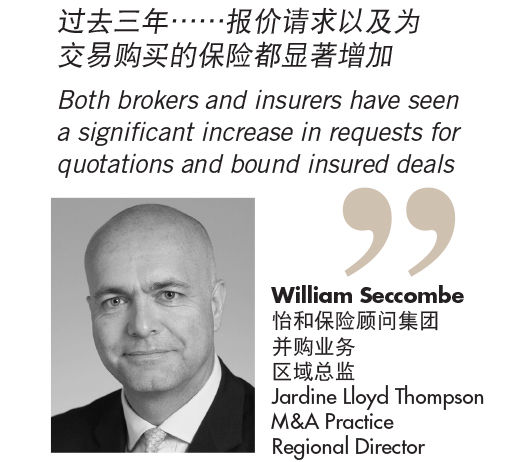
While countries in the region are at different levels of maturity, the consensus is that transaction risk insurance is increasingly part of the mix in M&A deals. “Both brokers and insurers have seen a significant increase in both requests for quotations and bound insured deals over the past three years,” says William Seccombe, who leads Jardine Lloyd Thompson’s M&A Transaction Risk Insurance business in Asia.
“Part of the reason for this is following a general global trend, but the investment made by the insurance industry in Asia in terms of people, marketing and training has also led to greater awareness of the products and their application by both clients and their advisers.”
According to Thomson Reuters, China cross-border activity accrued US$161.9 billion in 2015, a 61% increase from the US$100.8 billion accumulated in the previous year. However, despite this level of activity, few mainland China firms offer specialized M&A insurance, leaving it instead to international advisers and insurers based in Hong Kong to advise on and provide transaction risk insurance.
[ihc-hide-content ihc_mb_type=”show” ihc_mb_who=”1″ ihc_mb_template=”2″ ]
Due in large part to the high level of China-related M&A activity, international insurance firms are looking to move their specialist underwriters away from the traditional hubs of London and North America to Asia to boost their regional operations. AIG is one of the leaders in the region and is looking to expand after witnessing its premium business double in the past 12 months, and increase of 300% since 2013.
“We’ve seen a lot of investment into China in the past 12 months, particularly in the real estate sector, and I don’t see that slowing down,” says AIG’s Hong Kong-based regional manager of M&A, Michael Turnbull. “Hong Kong is very much a gateway to China and we’ve seen a fairly significant increase in the deal flow in Hong Kong in the past 12 to 18 months.”
Competitor Ironshore, which was acquired by China giant Fosun International last year, is also expanding, spreading its team across the region from its regional Sydney base to cover Japan, Hong Kong and Singapore. Its client portfolio includes private equity houses, and Australian and US corporates looking for opportunities in the region. The regional team works closely with independent specialist M&A insurance brokers on deals, says Ironshore’s head of M&A, Asia-Pacific, William Lewis.
“They go out and market the product, then present their submission to insurers, we have a look at it, we feed back to them and then they broke it between us and the insured,” says Lewis. This usually happens late in the deal, in the last 10 to 14 days. “What we need to have is a reasonably developed sale and purchase agreement and also pretty well progressed due diligence material and the written response to the RFI [request for information] etc. It then usually takes five days to underwrite once we’ve got all the information.”
Turnbull says: “One of the things we are seeing is people looking to acquire a target company in a jurisdiction or sector where they haven’t been before and that gives them an increased level of the unknown. But what they do have experience in doing is getting an insurance policy issued in their local jurisdiction that covers their normal day-to-day business risks.
“It’s quite a nice solution in terms of having an insurance product written by underwriters who understand the jurisdiction they are going into, so for example for China, you may have a policy written out of Hong Kong together with your cyber risk policy or property policy, or whatever other policies you have. So it’s something people are pretty comfortable with because they understand how those policies work.”

Turnbull says M&A insurance can prove useful when navigating through things like concern around enforcement risk in overseas jurisdictions. “When parties enter into corporate M&A transactions there comes with that an element of the unknown and of risk. So when they complete the purchase of the company they are looking to buy, they can sometimes find out that despite their best efforts, and following what is quite a rigorous process, there are some unknown issues and some problems they hadn’t foreseen.”
Adds Lewis: “Another reason is that they are usually able to get a better position under the insurance policy than they otherwise get under the SPA [sale and purchase agreement]. And it does provide a clean exit to the vendor.”
Given the unique nature of each M&A transaction, the pricing of these bespoke policies is more art than science. “Trying to price things on an actuarial basis is a bit more tricky,” says Turnbull. “So if you think about a transaction where you’ve got a Chinese target being sold by a Hong Kong seller to a Singaporean buyer you get some quite complicated dynamics. There are a number of things that we look at that would include what sector the target is operating in, is it one that we would consider more high-risk, and what’s the size of the deal, because there is an argument that on the larger-sized transactions your likelihood of getting a client can be higher.
“We would also look at who are the parties involved. We do have insureds who use this product as their way of doing deals, so if we’ve got repeat clients and we are familiar with the way they work their transactions and the way their advisers work then it will give us a good level of comfort as well. There are a whole load of factors we take into account outside the normal traditional insurance sense, and then there the other insurance factors that would come into play on any policy, like your excess or deductible level and policy periods as well.”
As the number of policies issued has increased, so too have claims, typically relating to financial statements and tax-related issues. “Confidentiality stops us talking about deal specific claims, but I can certainly confirm we are paying out millions of dollars each year on claims and in many ways it’s a good thing as it demonstrates the policies are working and that the products the insured are buying have real value,” says Turnbull.
Ironshore reports a similar trend. “We are seeing an increase in claims and also an increase in the severity of claims – low frequency but high in severity,” says Lewis. While the number of premiums issued is rising, so far this isn’t impacting pricing, according to Seccombe.
[/ihc-hide-content]