





A package of reforms aimed at whetting investors’ appetites may be too little too late
“Please remember, when the [foreign] investment was not there, we did not eat lizards,” the former finance minister, Pranab Mukherjee, growled in May. Less than six months later, with Mukherjee booted out of the Finance Ministry and ushered politely into the presidential seat, investors saw a sea change. Foreign capital was suddenly welcomed in multi-brand retail and power trading exchanges, and restrictions were eased in civil aviation, broadcasting and single-brand retail. These bold moves, according to prime minister Manmohan Singh, were designed in part to stimulate India’s economy, revive investor confidence and generate “productive jobs for the youth of our country”.
Interestingly, enthusiasm has been muted. Some say this is because investors are waiting for clarifications following an initial teething period. However, others express doubts about foreign interest, arguing that the government has dragged its feet for too long and that any liberalization in India today is anti-climactic.
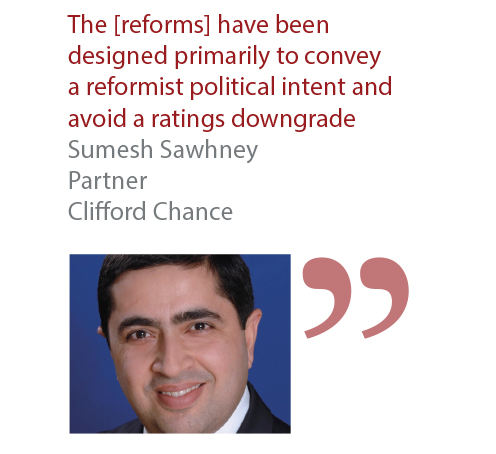
Some believe the changes were prompted by India’s slipping global economic standing. “The [reforms] have been designed primarily to convey a reformist political intent and avoid a ratings downgrade,” says Sumesh Sawhney, a partner at Clifford Chance in London.
Others think the government always had the resolve to encourage inflows of foreign capital, but an onslaught of bad press spurred it to action in the face of stiff political opposition. “There was a lot of hallagulla [hullabaloo] about policy paralysis and negativities from the US and Western media,” says Bhumesh Verma, a partner at Paras Kuhad & Associates. “I think the government decided to take them on once and for all and shed this image.
“The economy cannot survive the global pressures and recession,” adds Verma. “Drastic times require drastic measures.”
[ihc-hide-content ihc_mb_type=”show” ihc_mb_who=”3″ ihc_mb_template=”2″ ]
Devil in the detail
For now, potential investors, lawyers and analysts are scrutinizing the reform provisions and, in some cases, highlighting holes, ambiguities and a lack of due process. Among the lawyers is ML Sharma, an advocate who has filed a public-interest litigation against the government, flagging up clashes between the reforms and the Foreign Exchange Management (Transfer or Issue of Security by a Person Resident outside India) Regulations, 2000 (FEMA Regulations).
The FEMA Regulations specify foreign investment limits in various sectors and thus must be amended to ensure consistency with the new foreign direct investment (FDI) caps. The Supreme Court of India has directed the Reserve Bank of India to revise the regulations by the end of this month to enable 51% FDI in multi-brand retail.
Although investors have waited for the reforms in multi-brand retail with bated breath, many are holding off on India entry, carefully assessing several provisions that appear riddled with problems. One such provision is the requirement to invest 50% of the total amount in “back-end infrastructure”. With US$100 million as the minimum foreign investment amount stipulated, the trouble is not with investing US$50 million in manufacturing, warehousing, processing, packaging, etc., but rather that “back-end infrastructure” excludes land costs and rentals, which are oppressively high in India.
“The reforms have been positively taken,” explains Sumes Dewan, a partner at Desai & Diwanji. “But when you go into the nitty-gritty, it’s a different story.”
Another question is whether investment is only permitted in new businesses. Sawhney believes the intention is that foreign investment be used to set up a greenfield business or create greenfield assets. “It would have been helpful though if the regulations would have clarified it clearly,” he says.
Geographical restrictions create another hurdle. Multi-brand retailers can only set up stores in cities with a population of 1 million or more and must obtain approval from the state or union territory government concerned in order to do so. Aside from the cumbersome procedural hassles, foreign companies could find themselves trapped in a logistical quagmire.
“Let’s say you get approval in Delhi and you’re going to Gurgaon,” suggests Dewan. “If you’re denied permission by the Haryana state government, you could break your supply chain. You may have a gap of 10,000 kilometres before you are granted permission again.”
State and territory governments have the power to reject FDI in multi-brand retail if they choose to do so. At present, the governments of Andhra Pradesh, Assam, Delhi, Haryana, Jammu and Kashmir, Maharashtra, Manipur, Rajasthan and Uttarakhand, and the territories of Dadra and Nagar Haveli, and Daman and Diu have expressed approval for such investment. Lawyers believe other governments will follow suit once they see evidence of the benefits.
“It may be on a case-to-case basis,” says Diljeet Titus, the managing partner at Titus & Co, who has advised Ikea on its planned retail venture in India. “You can negotiate an MOU [memorandum of understanding] with the state and open a store … this is something states have privately agreed to, not now, but perhaps in a year’s time.”
Survival of the fittest
Experts say the multi-brand route may produce fewer than anticipated rewards for India. “You have companies like Walmart, Tesco and other multi-brand retail houses that are very keen,” says Dewan. But there are certain constraints, which means you won’t see 200 or 300 companies coming in tomorrow.”
Even local organized retailers, such as Future Bazaar, Food Bazaar, Big Bazaar and Reliance Retail, weighed down by soaring real estate and labour costs, have closed stores in their struggle to make profits. “This industry is capital intensive and it has a long gestation period, says Verma, dismissing fears about the threat to India’s unorganized retail sector. “I have not seen any small retailers being uprooted so far.”
The promoters of first-generation businesses such as Reliance have thrived in oil and exploration projects but encountered hurdles in retail due to a lack of experience. Partnering with a foreign investor such as Carrefour, which has extensive global retail expertise, is one solution.
Gautam Khurana, the managing partner of India Law Offices, believes the potential influx of low-quality goods is a bigger threat than the extinction of kirana shops. “I don’t see the risk in small shops getting wiped out because overall I think [foreign retailers] will improve efficiency,” he says. He is more worried about foreign retailers flooding the Indian market with a barrage of cheap goods from neighbouring countries such as Bangladesh, Pakistan, Sri Lanka, Nepal and China. Khurana says the inflow of these goods would otherwise attract anti-dumping measures, but if they come in through the retail route, there could be leniency, which could kill domestic industries.
Procurement dilemmas
Policy relaxations in single-brand retail trading (where 100% FDI is permitted) aim to resolve concerns expressed by investors. For example, while 30% of the value of goods purchased must be goods from India, it is now “preferred”, rather than mandatory, that the local goods come from micro, small and medium enterprises, village and cottage industries, artisans and craftsmen, and investors have five years to fulfil this obligation.
But single-brand entities say the new norms have not resolved their problems. These retailers build their brands around technology, design and intellectual property – some of which would have to be transferred to an Indian company in order to comply with the local sourcing requirement.
Dewan has discussed India entry with a jewellery manufacturer in Italy, which deals in high-end silver items. For the past 150 years, it has manufactured silver items in Europe and sold them worldwide. “They have special patented designs,” explains Dewan. “I suggested they set up a manufacturing hub in India, but they have concerns about sharing these designs, technology and other confidential matters. For them, it’s a big no.”
The government has said it will assess each application on a case-to-case basis, leaving the door open for policy inconsistencies and ambiguities, which is frustrating for both investors and lawyers.
“We as lawyers try and play a proactive role to bridge the gap between policy interpretation and commercial practice,” says Aparna Mittal, a partner at Luthra & Luthra. “We don’t want policy misinterpretation to lead to apprehension or hesitance in coming to India. If a client says, ‘I manufacture crystals, I can’t source anything from India. Can I source packaging material?’ I can’t say yes or no.”
A 30% local sourcing requirement also applies to multi-brand retailers. However, these entities can meet the requirement only by sourcing from Indian “small industries”, i.e. those which have invested a total of US$1 million or less in plant and machinery.
“The problem is, what is considered a small enterprise today, may not be considered small in the future if a foreign retailer gives it increasing amounts of business,” says Dewan. “So if Walmart starts using a small-scale store to source its stuff and tells the store to manufacture 1 million units, it will become a big manufacturing unit in two years.”
Once a manufacturing unit crosses this threshold, the multi-brand retailer would have to remove the unit from its supply chain and replace it with a new one. “That’s very worrisome and we’ve been discussing this with clients,” says Dewan.
Titus dismisses this concern, saying that the government will allow multi-brand retailers to continue sourcing from enterprises that have grown over time, so long as the enterprise did not exceed the US$1 million threshold to begin with.
Singled out
Foreign companies may also be deterred by the condition in the single-brand retail policy that an Indian investor entity must be created for each brand. This means that a company which, for example, has a diversified portfolio that includes watches, clothing, food and home decor products, could find it difficult to structure its business in India.
Mittal argues that companies should be entitled to set up structures that are beneficial from both a commercial and tax standpoint. “We went back and told the government, this doesn’t make sense,” she says. “Sometimes it’s an individual or a trust owning a brand – that entity will never invest directly. If they want to use an investment vehicle in Mauritius to consolidate their Asia investment, you have to allow that. They won’t change their global model just because of India.”
While investors wait for the dust to settle and lawyers examine ways to adhere to the new rules, Mittal advises potential clients to study the policies. “For both single and multi-brand, clients need to understand what the policy seems to indicate and have a clear sense of what they can do to align with the policy,” she says. “They need to do the initial commercial analysis and then approach the government with an application to see whether it’s a 10% ambiguity that needs to be resolved, or a 90% issue with compliance which needs addressing.”
Waiting in the wings
Cash-strapped and drowning in debt, India’s domestic airlines have widely welcomed the government’s move to allow foreign airlines to invest up to 49% in scheduled and non-scheduled air transport services. But with Kingfisher Airlines, SpiceJet, Jet Airways and Air India having accumulated and still incurring billions of rupees in losses, how attractive is the sector to a foreign player?
Abu Dhabi-based Etihad Airways, Dubai-based Emirates and Qatar Airways have shown an interest, but as yet no sign of any concrete intentions. Poor balance sheets are not the only concern. Management control is an equally sticky issue. The current policy states that at least two-thirds of the company’s board of directors must be Indian citizens. This plus a maximum stake of 49% effectively restricts a foreign investor’s role at an operational and management level.
“Liberalization has created opportunities for new technology to be brought in and new management principles to be followed,” says Saroj Datta, the former executive director at Jet Airways. “I think unless the foreign investor gets some sort of control, the objective of his investment could be lost.”
For foreign airlines, returns may not be as important as winning a share of the Indian market through the use of an Indian carrier. Those that are interested may want to use a local airline operator to direct domestic traffic onto the international services of their carriers flying to and from India. But according to Datta, this may be hard to achieve because of limitations, including prohibitions on marketing activities, stipulated in aeronautical information circulars from the Directorate General of Civil Aviation. “If the Indian government is permitting foreign airline investment, it will in all probability remove these restrictions, otherwise it would be a pointless exercise,” he says.
Whether investments by non-resident Indian (NRI) entities will be treated on par with Indian investments is another contentious issue and one that has plagued Jet Airways for years. Jet Airways, founded by NRI Naresh Goyal, is owned by Goyal through Tailwinds, a company based in the Isle of Man.
“When the government brought in the regulation of foreign carriers not being allowed to invest in Indian domestic airlines, that’s when Mr Goyal had to persuade Kuwait Airways and Gulf Air to sell their investment in Jet Airways, and his company Tailwinds became a 100% owner,” says Datta.
But even then, Datta says there was constant conflict as to how to treat the company: “At the time of the company’s IPO, it was officially treated by the government as an Indian investment, but not when it decided to try and raise more capital through other measures such as a rights issue or issuance of new shares.”
Jet Airways had always been told that an NRI investment was considered an Indian investment. However, Datta says the Reserve Bank of India changed this policy without issuing a public statement. “An analyst was telling me he thinks Mr Goyal will be asked to reduce his stake to 49% before FDI is allowed in his company,” says Datta. “But then he won’t be entitled to foreign capital because 49% is the maximum permitted.”
Insurance next?
Although the Cabinet Committee on Economic Affairs has given the green signal to raise FDI limits in the insurance sector from 26% to 49%, any change in policy will take time. Unlike retail, where FDI is simply a policy issue, any modification to investment caps in the insurance sector requires an amendment to the Insurance Act, 1938, and so any euphoria at this stage would be premature. Only when both the Rajya Sabha and Lok Sabha approve the Insurance Laws (Amendment) Bill, can a 49% cap be introduced.
As with the civil aviation sector, foreign investors must be prepared to partner with an Indian company and to forgo majority control. “In terms of control you’re not changing anything by increasing the cap,” says Mrinal Ojha, a partner at Khaitan Sud & Partners. “You don’t have less control with 26% – it’s just about returns and dividends.”
Ojha says the decision to relax the limits sounds correct economically but not politically. “There has been stiff opposition,” he says. “The bill was introduced in 2011. There have been about 200 amendments to the Insurance Act. The only objection the Bharatiya Janata Party had was to increase the cap to 49%. They agreed to open the reinsurance sector and reduce the capital requirement for health insurance companies, but they opposed an FDI increase.”
[INSERT QUOTES OF MRINAL OJHA]
If, however, the bill is passed, it could spur activity by new players and restructuring and IPOs by existing insurance joint ventures. The competition could be tough. There are roughly 40 insurance companies in operation – 20 or so on the life side and a similar number on the general insurance side. A new entity would most likely need to demonstrate to the Insurance Regulatory and Development Authority (IRDA) where it can add value. New competitors may also have to consider alternative geographical locations since the majority of existing players are concentrated in Mumbai with a select few in Chennai, Bangalore and New Delhi.
Potential investors are likely to be cautious. “New investors won’t look at the sector just from the perspective of a 49% interest, but with respect to the entire sector as a whole, how regulated it is, what’s the mindset of the regulator, has it matured enough or is it still a regulator going hammer and tongs after the entity,” says Ojha. “Frankly, the IRDA is a hard regulator.”
Only the beginning
India’s reform agenda offers tantalizing opportunities – particularly in the retail and aviation sectors – for international companies vying for a young and increasingly prosperous consumer market. However, investments may only trickle in unless further easing is announced and issues of management control are addressed. “In addition, investors are waiting to see what the final rules on GAAR [general anti-avoidance rules] will look like,” says Manoj Bhargava, a partner at Jones Day in Singapore.
Sawhney appreciates the government’s steps towards liberalization, but argues that much more must be done to sell the India story today. “India requires structural reforms beyond FDI relaxations,” he says. “That includes the long overdue introduction of GST [goods and services tax], infrastructure reforms as well as a more transparent regime for land acquisition for projects and timely grant of environmental clearances. Some of these do not require any change in law today.”
[/ihc-hide-content]
Screen revolution
Should international investors forget the telecom sector’s corruption saga and seize new opportunities in India’s broadcasting sector? Kosturi Ghosh, a partner at Trilegal, offers her view
The increase in the foreign investment limit from 49% to 74% in broadcasting carriage services invites further participation by foreign investors in Indian broadcasting companies.
A digital future
The mandatory digitization of cable television presents huge opportunities for both financial and strategic investors. India is the third-largest cable television market and one of the most fragmented cable markets in the world. Acquisitions and consolidations will be the future of this sector. Customer acquisitions will give strategic investors the ability to sell their bouquet of services – video-on-demand, time shift TV, broadband, interactive gaming – the possibilities are endless in a true convergence reality.
Moreover, Indian direct-to-home (DTH) players and multiple system operators (MSOs) will require capital to fund the digitization process – back-end infrastructure (digital head-end and networks), back-end operations (billing solutions, customer and maintenance service) and front-end (set-top box installations) – all of which will require varying degrees of investment. Reports suggest US$4 billion-5 billion will be required to complete the digitization process.
A new addition to broadcasting carriage services is mobile TV, where foreign investment of up to 49% is allowed under the automatic route and up to 74% is permitted with government approval. This will mean that delivery of content on a mobile will not require controversial spectrum as mobile TV services can be provided using terrestrial technologies.
The Telecom Regulatory Authority of India has recommended that a separate licence be issued through a closed tender system on the basis of a one-time entry fee.
Strategy and suspicion
Euphoria aside, new entrants may find investing difficult due to the highly fragmented nature of the market and the multi-tiered nature of the broadcasting industry. A strategic player would certainly want to take on the roles of an MSO, distributor and local cable operator in order to have optimal control over the delivery or carriage of content. This would be no mean feat in the Indian context.
Also, specific to cable television, it has always been difficult to implement network expansion given the “right of way” complexities in the Indian system.
Another point of worry comes from the recent turmoil in the telecom sector coupled with the present unstable political scenario. Sectors where licences are required to operate are being viewed with suspicion and distrust for justifiable reasons.
However, it is only a matter of time before strategic players start making their move. A billion people of whom 60% are below the age of 30 with disposable incomes would be hard to ignore.
Restrictions and security concerns
The present regulatory framework imposes certain cross-holding restrictions. In accordance with the DTH Guidelines, broadcasting and cable network companies are not allowed to hold more than 20% of the total equity in a DTH service provider. Similarly, a DTH service provider is not allowed to hold more than 20% of the equity shares in a broadcasting or cable network company.
For instance, Rupert Murdoch’s News Corp, which has a stake in the DTH operator Tata Sky, may not be able to benefit from the higher foreign investment limit and increase its stake in Tata Sky as it runs a broadcasting business in India through Star.
The issue of security is a major concern. Foreign investment is subject to stringent conditions such as obtaining security clearances for directors, key management personnel and foreign personnel engaged by an Indian company. Indian authorities have the power to periodically inspect an Indian company’s services and access its records.
In addition, Indian companies with foreign capital in the sector must ensure that the majority of their board members are Indian citizens. Key executives of such companies must be resident Indian citizens.
The changing tax regime is another point to note. The general anti-avoidance rules (GAAR), which are expected to come into effect on 1 April 2013, in essence will authorize the tax authorities to go beyond corporate forms and structures and determine whether transactions have been structured for the purpose of avoiding or evading tax. Given the wide ambit of the GAAR, investors will be apprehensive of the indiscriminate invocation and inconsistent application of GAAR provisions by the authorities.
Preparatory steps and risk mitigation
Investors should conduct due diligence checks from not only a legal but also a technical perspective to safeguard their investments. But this is far from adequate in the wake of the recent telecom licence disputes. We would advise clients to conduct detailed forensic investigations of the target company and, if possible, the promoters. Increasingly, related-party transactions and “unexplained transactions” are being heavily scrutinized by income tax and enforcement directorates. So such transactions must be thoroughly understood before foreign players make their investment decisions.
While executing transaction documents, investors should seek suitable indemnity-backed representations and warranties from promoters and targets, especially on compliance and licensing issues.
Considering that a breach of licence terms could lead to huge penalties or a potential revocation of the licence, investors, even with a minority shareholding, should retain rights to conduct periodic audits or set up governance committees to monitor compliance with licence conditions. Suitable exit options and ring-fencing structures may need to be devised to protect the investor in such cases.