





The redevelopment of Delhi airport offers insights into the structuring of public-private-partnerships in the infrastructure sector
India’s infrastructure sector is on the move. Nothing epitomizes its progress more than the privatization and redevelopment of Indira Gandhi International Airport (IGI). Along with Chhatrapati Shivaji International Airport in Mumbai, IGI was the country’s first experiment with the privatization of brown-field airports. The two projects established clear precedents for future revenue-sharing public-private-partnership (PPP) projects in India’s infrastructure sector. They also shaped many of the current regulations for the airport sector, including policies on passenger service fees, the airport development fund, the development of green-field airports and the establishment of the Airport Economic Regulatory Authority.
Bidding controversy
In April 2006, following a competitive bidding process, concessions were awarded to consortiums led by the GMR Group and the GVK Group for the operation and development of Delhi and Mumbai airports respectively. The awards triggered a legal challenge from one of the unsuccessful bidders, Anil Ambani-controlled Reliance Airport Developers, which alleged that there had been irregularities in the evaluation and award process. Delhi-based law firm Link Legal, which was a key adviser to GMR throughout the project, teamed up with Mumbai-based Wadia Ghandy & Co to advise GMR on bidding for the airport concession and on the subsequent litigation that resulted from Reliance’s challenge. The legal dispute created a great deal of uncertainty for all parties, but was subsequently resolved, first by Delhi High Court, and then in November 2006 by the Supreme Court, which upheld the validity of the bidding process and the awarding of concessions to GMR and GVK.
The draft concession agreements were prepared with the assistance of government-appointed legal, financial and technical consultants. The legal consultant was Amarchand Mangaldas, while ABN AMRO Asia Corporate Finance and Airport Planning were the financial and technical advisers respectively. These consultant firms also evaluated the bids, but with the stakes being so high their work was reviewed by an evaluation committee. The final agreement – the operation, management and development agreement (OMDA) – had input from Delhi-based law firm Hemant Sahai Associates, which was called upon to address concerns over the potential for unfettered real estate development on airport land and ensure that the deal met the government’s criteria (see Laying the foundations, below).
[ihc-hide-content ihc_mb_type=”show” ihc_mb_who=”3″ ihc_mb_template=”2″ ]
Joint-venture companies were set up to operate, manage and develop the two airports. For Delhi, this company was Delhi International Airport Private Limited (DIAL), a special purpose vehicle 74% owned by the GMR Group-led consortium (which includes the GMR Group, Fraport AG Frankfurt Services Worldwide, Malaysia Airports and the India Development Fund) and 26% owned by the Airports Authority of India (AAI).
With the Commonwealth Games looming on the horizon, DIAL was given a tight timeframe in which to complete the project. Work commenced immediately after the concession agreement was signed in April 2006.
Employees’ anxieties assuaged
When DIAL took over the operation of Delhi airport, the AAI had more than 2,000 employees. Many were naturally apprehensive about the security of their jobs.
DIAL wasted no time in winning the confidence of the AAI employees. It launched large-scale PR and human resources initiatives, and even staged street shows to instil confidence in its workforce and demonstrate its credentials as a good employer.
Under the terms of the OMDA, DIAL was obliged to offer to absorb at least 60% of the airport’s existing employees for the first three-year period. However, within six months of taking over the operation of the airport, it offered to absorb 100% of the workforce. At the same time, it initiated a range of training programmes, including the secondment of staff to airports in other countries to equip them with the skills and experience necessary to operate a world-class airport. These measures were largely successful in alleviating the anxieties of employees and developing an efficient and valuable pool of human resources.
Land rights legacy
In addition to developing its human resources, an immediate challenge facing DIAL was to settle a number of land acquisition and land encroachment disputes that were threatening the future of the project.

In the 1970s the government had acquired land around Delhi airport in anticipation of its expansion. Occupants of the land were to have been resettled in nearby Rangpuri, but when DIAL took over the airport in 2006, the process of resettling people had not been completed. Furthermore, the resettlement programme was mired in a number of disputes on issues ranging from the compensation package for displaced people to concerns over the lack of infrastructure and facilities in Rangpuri.
As a new entity, DIAL was not a party to any of these disputes. However, it had a very high stake in the outcomes. In order to gain influence over the process, it sought to implead itself in each of the pending cases. It was also able to combine all of the compensation-related disputes into a single case so as to facilitate a faster resolution.
These proactive steps, coupled with cooperation of the AAI and the judiciary, enabled the outstanding disputes to be fast-tracked and ultimately resolved. At the same time, DIAL pushed civic authorities to speed up the development of Rangpuri to make it more palatable to the displaced residents who were being resettled there.
In addition to the legitimate residents of the airport land, some 10 acres was occupied by squatters. DIAL paid a considerable sum to resettle the squatters. It also introduced a number of corporate social responsibility initiatives to look after the displaced people in the resettlement area.
The swift resolution of all land-related issues was one of DIAL’s most important achievements. As illustrated by the Tata Nano saga, in which Tata Motors was forced to relocate the production facility for its Nano car as a result of real estate protests, land issues have the potential to cause considerable delays, and even to derail projects entirely.
Financial woes
Arranging finance for the development was a tough task which demanded hard negotiation with the lenders. Under the OMDA, the entire plot of land and assets of the airport, including its future assets, were reverse mortgaged in favour of the AAI. This meant that DIAL could not charge any part of the land or assets, including the assets it was to create, in favour of any of its lenders.
In addition, DIAL was only allowed to create a charge on the portion of total revenue to which it was entitled. Revenue that would be deducted for statutory payments and payments to the AAI could not be offered as security to lenders. DIAL was therefore forced to arrange finance at high interest rates after securitizing its future earnings from the airport.
More favourable financing could have been arranged had DIAL been allowed to create charges on the assets of the airport or if the government had offered the lenders a guarantee. Allowing insurance companies and provident funds to invest in projects of this nature would have also eased the fundraising pressure on DIAL.
Cost overruns
But DIAL’s financial woes were not confined to unfavourable interest rates. It was originally estimated that the redevelopment of the airport would cost Rs45 billion (US$1 billion), but the final figure was almost three times that amount. To cover the sharp increase in costs, DIAL and the AAI proposed the introduction of an airport development fee that would be paid by departing passengers. Two writ petitions were filed challenging the new charge, but Delhi High Court ultimately ruled in DIAL’s favour.
Another financial difficulty resulted from the revenue split between the AAI and DIAL. Under the terms of the OMDA, DIAL has to pay 45.99% of its top-line revenue to the AAI. This figure was proposed by the GMR-led consortium in its bid to operate and develop the airport. In return, it receives around 5,000 acres of prime land from the AAI at a nominal rent of Rs100 per year. But in spite of the cheap rent, operating and developing an airport while only retaining 54.01% of the revenue would have been extremely challenging. DIAL therefore turned to innovative new revenue streams, such as joint ventures in ground-handling and airport retail, to make the project viable.
‘Inconvenience caused is deeply regretted’
The development of the airport involved two distinct activities: building new terminals and renovating the existing ones. DIAL created different teams for each of these projects. The renovation of the existing terminals was carried out in stages to minimize disruption to existing operations. However, a sudden and unexpected rise in passenger numbers while the renovations were underway resulted in severe delays which were heavily criticized by passengers. Unperturbed, DIAL continued with the renovations in the belief that once they were completed passengers would enjoy a better service and the number of complaints would fall.
The new terminals posed challenges of their own. Construction projects of the magnitude of IGI’s new Terminal-3 usually take four to five years to complete. However, under the terms of the OMDA, DIAL was given just three years to finish the project.

The engineering, procurement and construction (EPC) contract for the new terminal was awarded to Larson & Toubro in December 2006. Mumbai-based law firm Economic Laws Practice advised Larson & Toubro on the EPC contract, the total value of which exceeded US$1 billion (Economic Laws Practice also advised DIAL on certain taxation issues relating to the project). DIAL was represented on the EPC contract by UK-based Pinsent Masons. Owing to difficulties in preparing a bill of quantities for a project of this size and complexity – combined with the realization that design changes might be necessary – the EPC contract was awarded on a cost-plus basis.
Sixteen major sub-contract packages (MSPs) were included in the EPC and various contractors work packages were also awarded. The number of MSPs working under Larson & Toubro was later scaled back to 14 in a bid to speed up the development. DIAL took direct responsibility for the remaining two MSPs, which related to information technology and interior finishes.
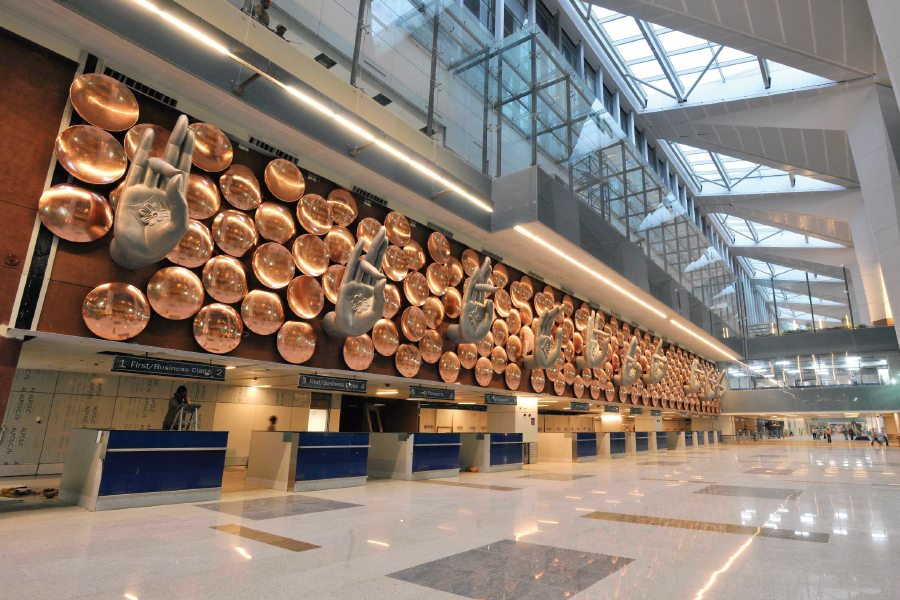
The efforts paid off. The new domestic terminal opened in February 2009 and the showcase international terminal – Terminal-3 – was inaugurated in July this year. It took just 37 months to build (Beijing’s new airport, by way of contrast, took 45 months) and opened in time for the Commonwealth Games – and well ahead of much of the city’s other Commonwealth Games infrastructure.
Building a regional hub
While the construction work was underway, DIAL initiated efforts to promote IGI as an international hub competing with Dubai, Bangkok, Singapore and Hong Kong, rather than simply a destination airport for passengers travelling to Delhi. To achieve this, a specialist marketing team was assembled to showcase the airport at international forums and study and promote the development of new routes.
DIAL also sought to tap into high-revenue activities such as cargo, ground-handling and retail. For cargo and ground-handling, both of which are highly regulated, DIAL invited tenders from global players to set up joint ventures in which the partners would retain management control.
These joint ventures gave DIAL a foothold in several lucrative non-core businesses that it would not have had the expertise to pursue alone. The partner companies, in turn, enjoyed a higher chance of receiving the necessary regulatory approvals on account of their associations with DIAL.
Many of these partnership arrangements were unique and had not been tried before in the airport sector. Law firms including Amarchand Mangaldas and Link Legal worked with DIAL’s team of in-house lawyers to structure the deals and bring them to fruition.
Similarly, for retail activities such as shopping and advertising, DIAL invited tenders from global players to establish joint ventures. Once again, this model enabled DIAL to diversify into new business sectors – and generate supplementary revenue streams – even though it did not possess the relevant industry expertise.
Turbulence ahead?
DIAL has so far succeeded in all that it set out to do, but challenges are looming. Foremost among them is the Airport Economic Regulatory Authority Act, 2008, which established a regulatory process for setting aeronautic tariffs at airports.
At the time of bidding, the consortium was aware that a regulatory authority would be set up with the mandate to regulate airport tariffs. However, the method of fixing the tariffs was not known, and still isn’t. DIAL must wait and see how future decisions on airport tariffs impact the profitability of the airport. Jacobs Consultancy and Amarchand Mangaldas are advising DIAL on tariff issues. The first tariff application is expected to be filed in 2011.
Another concern relates to uncertainties over the legal status of PPP entities such as DIAL. Do they come under the classification of “state” in article 12 of the Indian constitution, and if so, are they bound by the Right to Information Act? If DIAL was deemed to fall within the definition of “state”, it would be subject to the same public scrutiny and restrictions that apply to public sector enterprises. Such an outcome would affect the workings of the company and may even call into question the rationale for involving the private sector in infrastructure projects of this nature.
[/ihc-hide-content]
Priyabrat Tripathy was a member of the in-house legal team at Delhi International Airport Private Limited from May 2006 until January 2010. He is now the head of legal at Isolux Corsan India Engineering and Construction, part of the Spanish infrastructure company Grupo Isolux Corsan.