






At the beginning of a landmark visit to India, the British Virgin Islands’ Premier and Minister of Financial Services spoke with India Business Law Journal’s Manokamana about the jurisdiction’s ambitions to become a financial services powerhouse for India
There are two pillars to the British Virgin Islands (BVI) economy: beaches and business. Clear turquoise waters and white sands provide one pillar for this British overseas territory with more than 60 islands in the sunny Caribbean. The second is as a crucial centre of international finance.
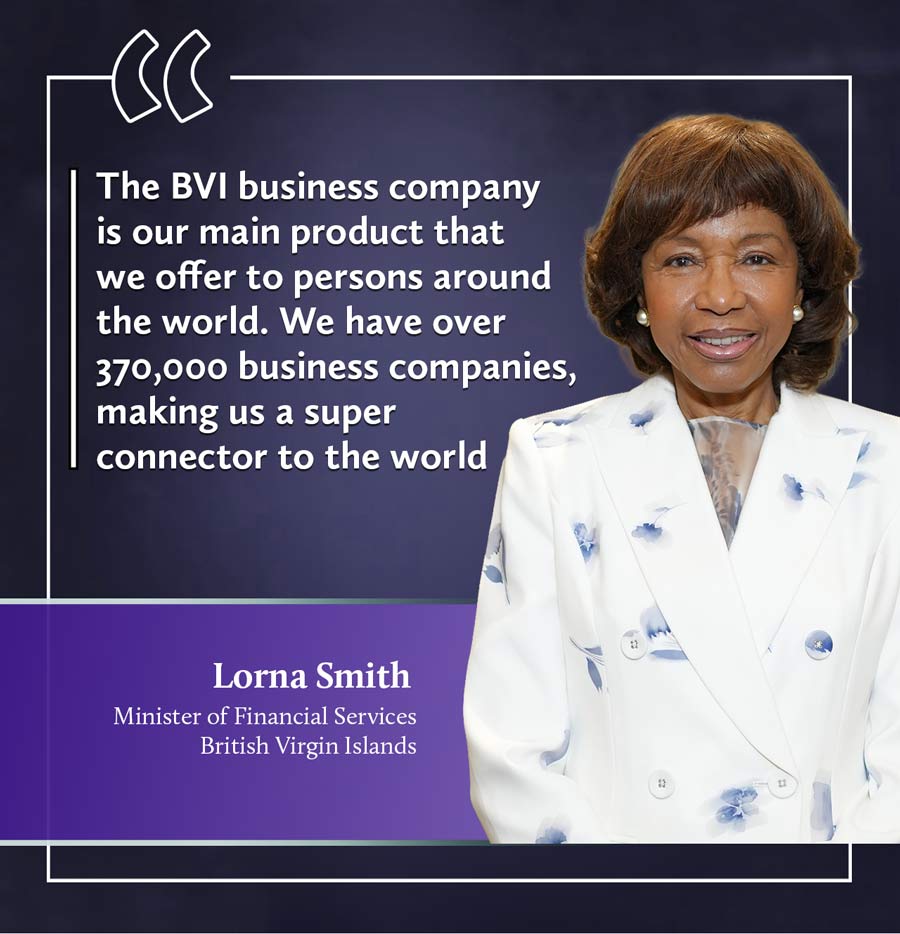
“Everyone in the BVI [works] either in the tourism industry or in finance,” says Lorna Smith, Minister of Financial Services. Seated next to her, Premier Natalio Wheatley, also the Minister of Finance gets down to business: “The BVI business company is our main product that we offer to persons around the world. We have over 370,000 business companies, making us a super connector to the world.”
The BVI’s international investment activities support the operations of businesses listed on the London, New York and Hong Kong stock exchanges, facilitated by BVI business companies operating worldwide.
These companies assist businesses with services such as holding companies for various assets, corporate group structuring, investment business, joint ventures, listings, real estate, family trust and estate and succession planning.
The BVI is also home to about one-quarter of the world’s hedge funds, making it the second-largest offshore jurisdiction for hedge fund formation and domicile. This powerful ecosystem was the focus of BVI’s top delegation in India, meeting with representatives from government, regulators and the private sector.
The tour
The tour marks the first official visit by the premier to India, and follows a pathfinding visit by BVI officials last year, where they met with Indian finance ministry officials and regulators, setting the wheels in motion for strengthening bilateral ties.
“The fact that this delegation is led by the premier is very significant as it indicates how serious we are about our relationship with India,” says Smith. “We want to strengthen and develop greater trust and you can only do that by being here firsthand in the country.”
Much like the previous delegation, the premier’s visit is focused on finance, only on a larger scale. The delegation will make four major stops: Delhi, GIFT City in Gujarat, Mumbai and finally Bangalore. In each city, the delegation has events and meetings planned to exchange, promote and explain the benefits of a symbiotic relationship.
Wheatley and Smith will meet the Finance Minister of India, Nirmala Sitharaman, and other officials from the finance ministry in Delhi. The tour also includes meeting finance sector regulators, key players in the private sector and private companies.
“We are meeting with the IFSCA [International Financial Services Centres Authority], the National Stock Exchange of India, a number of banks and family offices and private companies,” says Wheatley. The IFSCA is the regulator of all financial services, products and institutions operating in India’s international financial zones, including GIFT City.
The delegation will also meet companies that have long been engaged in business with the BVI. “On this roadshow, we have participating companies [that] have been in a longstanding relationship with the BVI and sell BVI business,” says Wheatley.
“We have the opportunity to interact and have discussions about the benefits and opportunities to increase the internationalisation of Indian business.
“This will also drive foreign direct investment into India through BVI products, and I’m very excited to see how the Indian business community responds to these opportunities.”
Smith says that many businesses operating in the BVI have both an Indian and international presence. “There are a couple of companies that are in [the] BVI, and also in Dubai, and in Mauritius, and Panama, that are here in India,” she says.
Smith also has her sights set on India’s tech industry and is scheduled to address a trade show in Bengaluru, the city often dubbed the “silicon valley” of India. “[Being in Bengaluru] is very exciting to me because innovation is very important, and I’m looking forward to the trade show that we will be attending,” she says.

Government and regulatory officials from the finance industry, technology innovators and business partners are not the only ones on the list for this tour. Smith says the delegation will “also be meeting with senior persons from different law associations and chambers in India”.
Wheatley observes: “We want more Indian businesses to be aware of the benefits of using BVI companies. We find that once people are aware of the benefits, they realise that this is the perfect product for their global ambitions to fuel economic growth.”
The message
The high-powered delegation has an ambitious agenda for its week in India. “Our goal is to be able to increase the awareness of the BVI business in India and to have more Indian firms sell our BVI products because of the benefits to the Indian economy,” says Wheatley.
Business between the two jurisdictions is nothing new for either economy. The two jurisdictions share a longstanding relationship. “We’ve had a long relationship with India where we have companies that have been in [the] BVI and India for a long time,” says Smith.
But it’s expanding into India’s growth market that the dignitaries are chasing, and Wheatley is on point with his message.
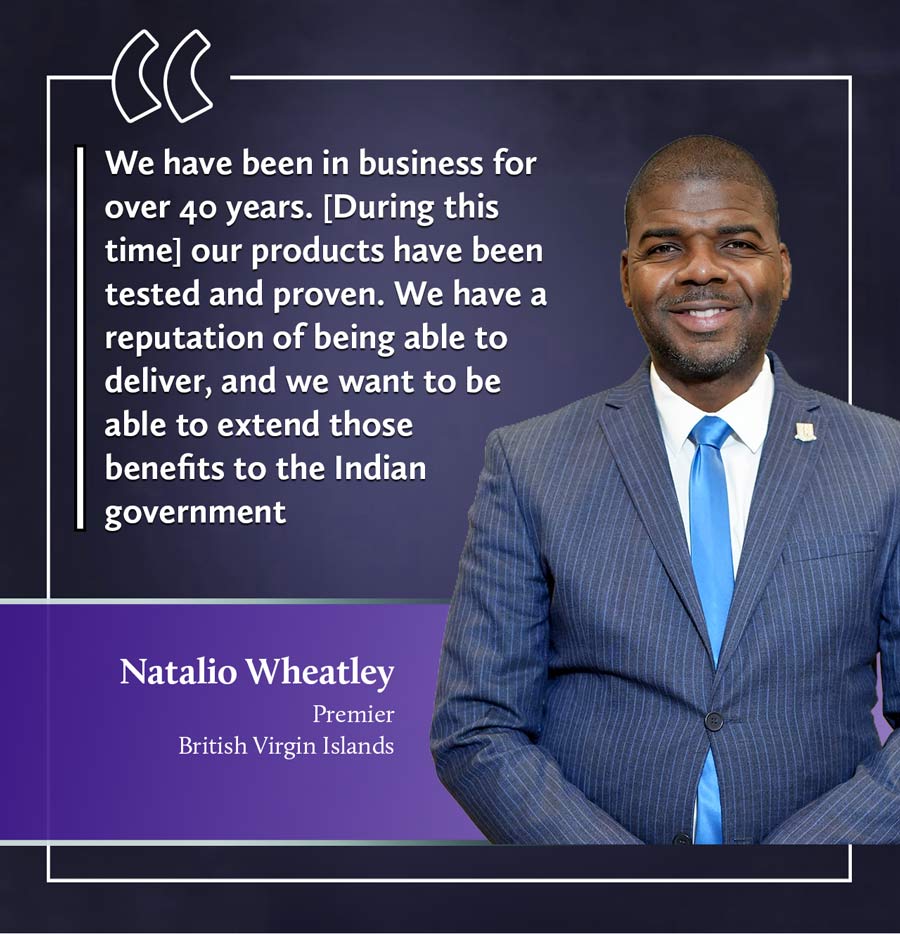
“We have been in business for over 40 years. [During this time], our products have been tested and proven. We have a reputation of being able to deliver and we want to be able to extend those benefits to the Indian government,” he says.
“We are certainly pushing very strongly on [our] investment funds regime as assisting in driving foreign direct investment into India. The investment fund regime is unique, in Asia and the world, and it represents niche offerings.”
Wheatley expands on the uniqueness of his investment funds regime. “These funds can be managed both in and outside of Asia, and we have specific funds [that] include incubator and approved funds, which target startups, family offices and single asset transactions.
“[BVI’s investment funds regime] can assist the Indian government in acquisitions … [and] in raising capital in joint ventures.”
Investment funds is not the only offering the BVI intends to promote this time. “In addition, we have the most accessible fund management qualification in the world, and this has allowed our fund managers to be able to get a start and an entrance into fund management,” the premier says.
“We do great business with all of India’s major partners. We are top 10 in foreign direct investment in a number of the countries [that] are India’s main partners,” he says, listing the EU, Dubai, Mauritius and Singapore as among the active participants in the BVI financial services ecosystem.
On legal commonalities he continues: “We function under English common law. We have a court system where persons have confidence and legal certainty that if there are any disputes or any challenges, the matters would be adjudicated in a way [that] is responsible and will lead to a very fair result.
“We have a wonderful commercial court to settle any type of disputes. Our final court of appeal being at the Privy Council … we have neutrality, which makes it very easy for different jurisdictions to have joint ventures, etc.”
In a digital economy, Smith also points to sound regulation via the Virtual Assets Service Providers Act, 2022 (VASP Act) to ensure such disputes are fairly decided. “The VASP Act ensures that the financial services industry, in terms of digital assets, is very well regulated.”
Versatile India
So, why so much effort for India and Indian businesses? For Wheatley, it’s simple maths and the time-tested principles of economics.
“We can’t ignore the fact that India is one of the fastest-growing economies in the world,” he says. “We know that India is growing at a rate of about 7% at the moment, and has ambitions to grow more. We also take note of the ambition of India achieving its developed country status by 2047.
“We applaud and commend Prime Minister [Narendra] Modi for that ambitious goal, and we present ourselves as strategic partners, helping to achieve it.”
Smith cites good historical relations, and similar economic growth and ambitions, as reasons for the BVI’s focus on India as its growth partner. “In a way, it’s kind of a historical relationship,” she says. “We’ve been very familiar with India for a long time.
“The BVI has also grown very quickly in the field of both financial services and tourism. And the fact that we, like you, in India, are very keen on innovation, combined with regulation, is another area of excitement for us. We see great potential between the two countries.”
How high, then, is India in the BVI’s broader international finance strategy?
“Very high,” says Wheatley. “The reason why I say that is because it’s always important for us to be able to diversify the markets in which we serve. We have done very well in a number of jurisdictions in the world. Some of the same principles that allowed us to do very well in many other regions will allow us to fuel more growth in India.
“We see India as a leader of the Global South. We’re especially pleased and proud of the leadership that India is displaying, and ourselves, as a developing jurisdiction, we are inspired by that growth and leadership. We believe it’s important as developing countries that we co-operate and work together to achieve our own development objectives.”
The premier points specifically to GIFT City. “We see what is happening … and let me just congratulate Prime Minister Modi for that brilliant move of establishing it. We see GIFT City as being something that is extremely complementary to the BVI’s offerings because it offers innovations that would make investment into India easier and more efficient.
“[The] BVI can assist GIFT City with internationalisation of Indian business and serve as a super connector and attract foreign direct investment into India.”
Harmonious soft powers
India and the BVI share many commonalities that make their relationship easier to sustain. Both jurisdictions have female leadership driving financial growth and development in their respective countries.
“It’s interesting that India’s finance minister is also a female of long standing. Women do have a prominent and critical role to play in politics,” says Smith.
The two jurisdictions also share a common driver of economic growth: tourism. The two jurisdictions contribute significantly to each other’s tourism industry. “People come from [the] BVI to India for all kinds of things, for health reasons or spirituality, and so on,” says Smith.
“I would really have loved to see the Ganges,” she says, recalling how a friend who visited India years earlier told her that witnessing the sunrise on the riverside was a “must-have” experience.

“You have to visit The Baths,” Wheatley says of his own jurisdiction’s major attraction. “Thousands of volcanic rocks, which have formed caves on the beach, so persons walk through the caves on the beach, and when the light comes through all the boulders and reflects on the sea, it’s just a beautiful sight that you can never even imagine until you really see it.
“We want to promote more tourism between our countries,” he adds. “I would have liked to have been able to experience more of India, but that just means I have to come back.” He emphasises his desire to return, both for personal reasons and in the pursuit of the BVI’s interests. “I’ve seen enough to know that I must come back because we want this partnership to be lasting, where each party recognises the mutual benefits,” he says.