













How a temple prevailed in the battle over a geographical indication for its famous confection, Tirupati laddus. Rebecca Abraham reports
In February, a four-page order by a single judge of Madras High Court provided closure in a little known, albeit significant, dispute between a trust that manages one of India’s most visited temples, at Tirupati in the Tirumala hills of Andhra Pradesh, and a restaurant in Chennai, Ganga Sweets.
The dispute centred on the intellectual property rights for an item of food that India had awarded geographical indication (GI) status in September 2009: a ball-shaped sweet, a laddu, that is available only at the temple in Tirupati and so is called a Tirupati laddu. Around 125,000 of these laddus are produced every day within the temple compound as an offering to the temple deities and distributed – some at no cost – to the people who worship there. Ganga Sweets had been making and selling a version of these laddus that it labelled Tirupati Type laddu.
[ihc-hide-content ihc_mb_type=”show” ihc_mb_who=”3″ ihc_mb_template=”2″ ]
Calculated moves
The court order restrains Ganga Sweets from dealing in any goods with a name or indication that is identical or similar to Tirupati laddu, but it is essentially a settlement reached between the Tirumala Tirupati Devasthanam (TTD), which is the trust that manages the temple and its assets, and Ganga Sweets.
The TTD had successfully argued that it was “entitled to initiate action for passing off against any person selling under a name or indication deceptively similar” to Tirupati laddu. Ganga Sweets in turn had readily “undertaken not to sell any laddu under the name of Tirupati Type laddu”.
“The idea was to get rid of the misuse rather than go after the costing or damages,” says MS Bharath, a Chennai-based partner at Anand and Anand, one of India’s best known intellectual property firms, which acted for the TTD. “To expedite the whole matter we convinced the court to pass the final decree based on [Ganga Sweets’] own undertaking and claims in the written statement”.

Bharath explains that in order to enter into a compromise or settlement of any kind the TTD, which is a statutory body under the Andhra Pradesh Charitable and Religious Endowments Act, 1987, would have needed to obtain prior sanction. This would have been a lengthy process.
A controversial right?
Disputes following the grant of geographical indication status in at least two cases suggest rights holders may face challenges
The awarding of geographical indication (GI) status in September 2009 for the Tirupati laddu, a ball-shaped sweet, was undoubtedly greeted with applause within the temple complex that holds the exclusive right to its production and sale. Yet the award triggered considerable controversy, including criticism from the then minister of state for commerce, Jairam Ramesh.
An October 2010 article in Frontline states that while explaining the need for greater sensitization on GIs, Ramesh had told India’s upper house of parliament, the Rajya Sabha, that the lack of understanding had led to people filing applications for articles such as Tirupati laddu, among others.
In its March 2008 application for GI status for the Tirupati laddu, the trust that manages the temple at Tirupati, the Tirumala Tirupati Devasthanam (TTD), said the sweet was unique in that it “is a divine offering … a unique combination of natural ingredients … blended to impart a distinctive aroma, appearance and taste”.
Single or several producers
Be that as it may, commentators argued that awarding GI registration to a single private producer – the TTD – went against the spirit of GI protection, which is aimed at protecting collective community rights.
In October 2010, a rectification petition was filed against the Tirupati laddu GI. The GI registry dismissed the petition in a July 2012 order, which among other things states that lawyers for the TTD had successfully made the case for a single producer to be the registered proprietor of a GI by citing a GI registered in the EU in similar circumstances. The GI in question was for Karlovarský suchar – a bread produced by a single producer in the Czech Republic that has used “a traditional, immutable production method for decades” as stated in a summary of its application for GI status.
The rectification petition also put forward the argument that GI status for the Tirupati laddu was prohibited under section 9(a) and (d) of the Geographical Indications of Goods (Registration and Protection) Act, 1999. Section 9(a) prohibits registration of a GI that “would be likely to deceive or cause confusion” and 9(d) prohibits a GI that “comprises or contains any matter likely to hurt the religious susceptibilities of any class or section of the citizens of India”. Other grounds for the rectification included that it would be difficult to revoke the intellectual property protection granted to a religious institution once it was granted.
A clear way forward?
The petition was eventually dismissed after the petitioner – RS Praveen Raj, who had failed to show up for the hearing – was found to not be a person “aggrieved” by the GI, which is a requirement under the act. Raj was said to have wasted “precious time” of the tribunal by filing a “frivolous, frolicsome and playful application” and ordered to pay costs of ₹10,000 (US$165).
The GI for Darjeeling tea was similarly challenged in December 2008, on the grounds that section 11 of the act requires the applicant for GI status to represent the interests of the producers. The petition was dismissed after the petitioner unsuccessfully argued that the Tea Board of India was not a producer and that as a mere representative of producers of Darjeeling tea it could not be the registered proprietor of the GI.
Meanwhile, Raj has been keeping a close watch on the Tirupati laddu infringement case in Madras High Court. “The case has been decided in favour of TTD based on the principles of passing off after Ganga Sweets gave up the defence,” Raj told India Business Law Journal. “In fact it was a great opportunity for Ganga Sweets to win this case.”
Scoring a first
Even though the court did not go into whether an infringement had occurred, this case could be a first for India.
“To my knowledge this is the first time a registered proprietor of a GI has fought for its rights against an infringer in a court of law in India,” says Gowri Tirumurti, a former senior associate at Anand and Anand, who acted for the TTD at the high court.
 Tirumurti points out the Geographical Indications of Goods (Registration and Protection) Act, 1999, is unique among laws for the protection of intellectual property in India as it provides that the passing off of a registered GI, where it amounts to unfair competition, is an infringement of the GI. “This is an extremely salient feature in the act, which was useful for this particular case.”
–
Using the right
India has seen a rush of applications since the act came into effect in September 2003 and has awarded GI status for 195 products. Yet owners of GI rights have been slow to resort to the act to protect their interests.
“They are very enthusiastic when it comes to seeking registration,” says Bharath, who adds that not much has been done to use GI status to add value to a product or to ensure that the exclusivity is retained by going after misusers.
“Filing and prosecution of a GI is one aspect, you get a legal right, but how do you enforce your right and brand your product?” asks Subhajit Saha, head of IP activities at Andhra Pradesh Technology Development and Promotion Centre (APTDC), which manages the Tirupati laddu GI for the TTD.

Funding the fight
One reason for the lack of action to protect GIs could lie in the lack of financial capabilities of the vast majority of GI owners, as many GIs are for distinctive yet low-margin agricultural or handcrafted products.
“There is a problem because very few parties can afford to go to court,” says Saha.
Bharath disagrees. “According to me the cost is not a factor at all because we are looking at a few thousands of rupees as against an association which has several hundred members,” he says. “Most of us work on reduced fees especially for GI because it does not make a great profit for IP firms and it is more to do with helping the community.”
Indeed Pravin Anand, managing partner at Anand and Anand, reports that the firm took on the Tirupati laddu case “on highly reduced fees”, even though the TTD is not likely to face a shortage of funds anytime soon.
The Tirupati temple is one of the richest in India. The board of the TTD recently approved a budget of ₹24 billion (US$395 million) for 2014-15 and it expects to earn ₹9 billion by way of offerings from devotees over the same period.
Disparate voices
Another problem generally faced in the protection of GIs is that while the rights are owned by an association or federation – the registered proprietor of the GI – the users of GIs are the many artisans or producers who are the members of the association. These members often find it difficult to act as a single entity, sometimes even at the stage of registering a GI.
“You spend a lot of time trying to get information from several people, because when they come they don’t all speak with the same voice,” remarks Tirumurti, who has considerable experience in the area having had “the opportunity to do five GIs from scratch to end”.
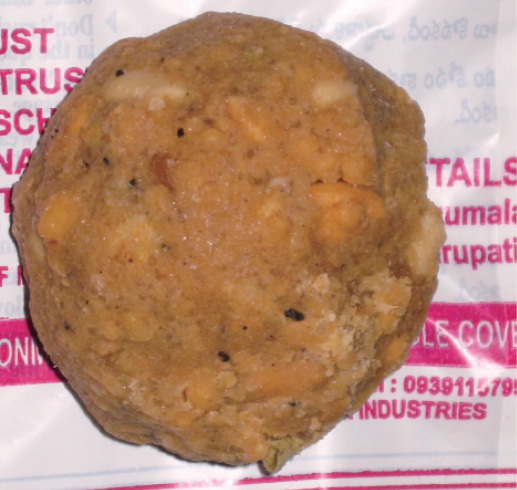
The Tirupati laddu is the only GI awarded in India to an item produced by a single producer. While this has made it a controversial GI (see A controversial right on page 16) it has also allowed the owner to act swiftly against an alleged infringer.
This is an advantage arguably shared by Darjeeling tea, which in April 2004 became the first product to be awarded GI status in India. In November 2011, Darjeeling tea went on to become the first product from India to be protected as a GI in the European Union.
Observers attribute this success to the role played by the Tea Board of India, a statutory body under the Ministry of Commerce, which has spearheaded efforts for the protection of the Darjeeling tea label.
It is the lack of similar backing for entities that are the registered proprietors of other GIs that is proving to be a challenge. The APTDC takes pride in having filed 19 of the 24 successful GI registrations from Andhra Pradesh, and recognizes there is more to do. Saha reports that the organization is in the process of putting in place an effective system for the protection for GI holders.
“We have graduated from filing to a post-GI regime, which is how we zeroed in on the Tirupati laddu case,” says Saha. “The objective was not to make any money out of the damages … we are only trying to set a precedent through this case and create a story.”
[/ihc-hide-content]