












A proposal to widen the ambit of the UK Bribery Act could spell trouble for Indian companies. Vandana Chatlani reports
In August 2013, the UK’s Serious Fraud Office (SFO) began investigating a £23 million (US$38 million) fraud at Sustainable AgroEnergy, a company selling biofuel investment products involving jatropha tree plantations in Southeast Asia. This was the SFO’s first investigation under the UK’s Bribery Act 2010, which came into force in July 2011. Since then, the SFO has launched inquiries into several companies including Gyrus Group, a UK subsidiary of Olympus Corporation, and its parent, for “misleading, false or deceptive” accounts; Rolls-Royce, for alleged acts of bribery and corruption; and Eurasian Natural Resources Corporation and its subsidiaries in Africa and Kazakhstan for alleged fraud and corruption. No one denies the SFO’s determination in probing and stamping out corrupt practices, but many have questioned its relative quietness since the introduction of the Bribery Act, especially given the act’s extraterritorial reach. Section 7 makes UK companies with a presence overseas, and international companies with a UK presence, liable for a failure to prevent bribery.
“The current section 7 offence – which creates a form of ‘strict’ corporate liability for bribery which never existed prior to the enactment of the Bribery Act 2010 – is a powerful weapon in the SFO’s arsenal,” says Aaron Stephens, a partner in the corporate crime and investigations department at Berwin Leighton Paisner.
[ihc-hide-content ihc_mb_type=”show” ihc_mb_who=”3″ ihc_mb_template=”2″ ]
Prosecution for fraud, in contrast, rests on proving that the “controlling mind” or board of directors of a company was aware of corrupt activity within the organization. “Broadly speaking, at the moment prosecutors need to have hard evidence that the board of directors knew what was going on,” says Barry Vitou, a partner in the corporate crime team at Pinsent Masons. “This is often hard to prove, if not impossible.”
“It is a fact that the bar for prosecuting corporates for fraud in the UK is extremely high,” the SFO said in a statement to India Business Law Journal. “If the public require more corporate prosecutions, one way of addressing this would be to bring the law covering fraud in line with the Bribery Act, which places an onus on the company to prove that it has taken steps to prevent bribery on its behalf.
“Extending section 7 of the Bribery Act to fraud would mean that corporates who fail to ensure they have in place adequate measures to prevent fraud would face the same risk of prosecution, and fines upon conviction, as is currently the case in respect of corporates who fail to take adequate steps to prevent bribery,” the SFO said.
A broader section 7
SFO director David Green is the brains behind a proposal to extend the “failure to prevent” concept in section 7 to other financial crimes. “In essence, this would mean that a company could be held criminally liable for a range of wrongful acts of its employees or associated parties, such as agents, even in circumstances in which the board or senior officers of the company had no knowledge of the wrongdoing,” says Robert Amaee, a partner in Covington & Burling’s white collar defence and investigations practice. Amaee represented the SFO on a UK attorney general’s working group tasked with drafting the UK Bribery Act Prosecutors’ Guidance.
The proposal has yet to be presented to parliament. However, if such an amendment is approved, prosecutors would not need to show that senior management was complicit in a financial crime committed by employees. In prosecutions for bribery and financial crimes the defence would be the same – proof that adequate measures had been implemented to prevent bribery or the crime.
Such an amendment would also “extend the jurisdictional reach of the SFO – for the financial crime offences to be specified – to non-UK companies, including those registered in India, that carry on a business or part of a business in the UK,” says Amaee.

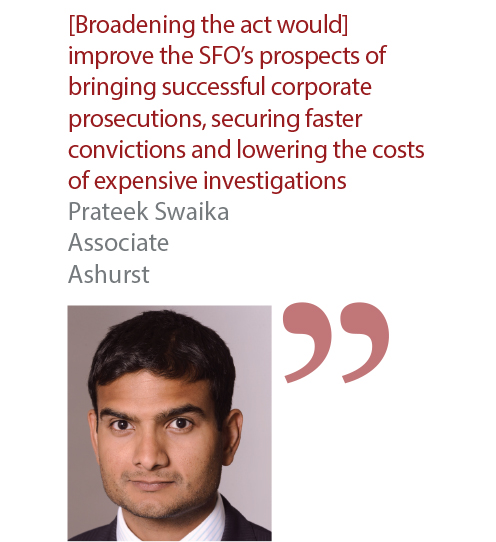
The proposal is “gaining traction”, setting off alarm bells in some financial institutions and corporations, according to Prateek Swaika, an associate at Ashurst. Extending section 7 to include financial crimes would provide “a powerful tool for prosecutions of complex financial crimes in future,” he says. “It will improve the SFO’s prospects of bringing successful corporate prosecutions, securing faster convictions and lowering the costs of expensive investigations at a time of austerity.”
He adds that the amendment would also substantially increase the already considerable compliance burden on companies.
US example
Accepting the proposal would bring the UK’s anti-bribery enforcement machinery more in line with US anti-corruption agencies, which have slapped heavy financial penalties on corporate offenders and are perceived as more aggressive than their UK counterparts.
Stephens believes another motive behind the planned reform is to increase the likelihood of persuading companies under investigation to enter negotiations regarding a deferred prosecution agreement (DPA), which is a common feature of the US system that was only recently introduced in the UK.
However, he says amending section 7 may not be enough to bring about the proposed reforms. “Part 2 of schedule 17 to the Crime and Courts Act 2013 lists all of the common law, statutory and ancillary offences that may be resolved by way of a DPA,” Stephens explains. “In addition to the Bribery Act offences, the list includes the common law offences of conspiracy to defraud and cheating the public revenue, as well as a number of specific offences arising, for example, under the Theft Act 1968, the Companies Acts 1985 and 2006, the Financial Services and Markets Act 2000, the Fraud Act 2006, and the Proceeds of Crime Act 2002. If wholesale reform of corporate criminal liability is to occur, then it may be that new legislation is required instead of a simple amendment to the Bribery Act.”
Facing the consequences
If the proposed amendment is passed and the penalties under section 7 remain the same, companies convicted of financial crimes would be subject to imprisonment, unlimited fines and discretionary debarment from UK public procurement activities. More damaging is the risk of mandatory or discretionary debarment from public procurement activities in other states of the EU, as well as debarment from receiving World Bank or other multilateral development bank funding. A fractured reputation and the stigma associated with fraud and other financial crimes is an added threat.
“Given the increase in international intelligence sharing between enforcement authorities, the recent addition of US-style DPAs, and the mooted additional prosecutorial tools, such as a US-style ‘bounty’ system of paying whistle-blowers a portion of penalties levied on companies and now, the extension of the corporate bribery offence, Indian companies with UK operations should take note of the SFO’s resolve to instil good corporate culture in the UK and abroad,” advises Angela Pearson, head of the international investigations and compliance group at Ashurst.
An uphill battle
Indian companies are under increasing pressure to implement anti-corruption compliance measures, both at home and abroad.
While corporate India adjusts to the stringent provisions of international anti-corruption laws, it may also need to learn new rules at home. The Indian government is considering criminalizing acts of bribery in the private sector through amendments to the Indian Penal Code.
The Prevention of Corruption (Amendment) Bill, 2013, which seeks to expand liability for accepting bribes and to create offences relating to the bribery of public servants by persons and commercial organizations, is under scrutiny.
The new Lokpal and Lokayuktas Act, 2013, for the first time empowered the government to investigate and prosecute those offering a bribe instead of only those taking them.
According to a survey conducted by Ernst & Young in conjunction with the Federation of Indian Chambers of Commerce and Industry between March and May 2013 – titled “Bribery and corruption: ground reality in India” – the sectors perceived as most vulnerable to corruption in India are infrastructure and real estate; metals and mining; aerospace and defence; and power and utilities.
Due perhaps to the deep-rooted cultural acceptance of exchanging bribes in India, a large percentage of respondents seemed comfortable with (or were aware of) unethical business conduct, including irregular accounting to hide bribery and corruption, gifts being given to given to seek favours and third parties being used to pay bribes.
Another finding that may interest international companies with an Indian presence concerns facilitation payments, for example, giving a government official money or goods to perform or speed up a process or duty. Of the 200 respondents, 31% were unaware that making facilitation payments in India is illegal, and 44% were in favour of legalizing them.
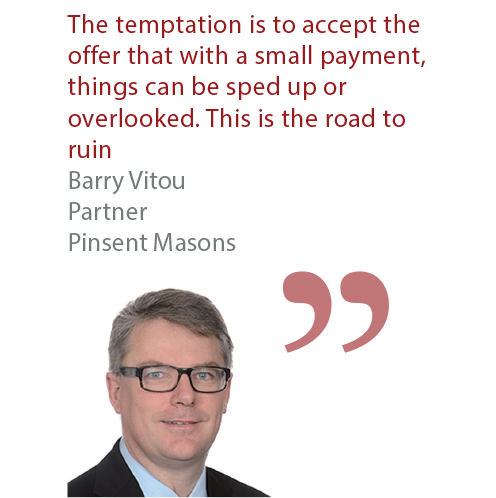
“Sometimes delays can be frustrating and the temptation is to accept the offer that with a small payment, things can be sped up or overlooked,” says Barry Vitou, a partner at Pinsent Masons. “This is the road to ruin.”
In some respects Indian companies are striving to raise standards, battling bribes through an introspective cleansing effort at home and abroad. Two years ago, Infosys, Wipro, Godrej & Boyce, Genpact and Bajaj Auto became members of the Partnering Against Corruption Initiative (PACI), the World Economic Forum’s anti-corruption drive. Through PACI, companies and business leaders attempt to maximize their collective impact in the fight against corruption, improve compliance practices and develop tools and services to tackle and prevent corruption.
But joining a club does not always mean playing by the rules. PACI’s list of members includes Mahindra & Mahindra, which is facing a US lawsuit for large-scale fraud and a conspiracy to steal millions of dollars in cash and trade secrets, and Diageo, which paid hefty fines after violating the US Foreign Corrupt Practices Act through improper payments by its subsidiaries to government officials in India and elsewhere to obtain sales and tax benefits.
“The biggest threat probably comes from third party agents, consultants and intermediaries, particularly where they are operating in high-risk jurisdictions or sectors and are paid high commissions,” says Aaron Stephens, a partner at Berwin Leighton Paisner. “Various companies that have been investigated for bribery have reacted by significantly reducing and rationalizing their use of these third parties.”

Complying with the provisions of the UK’s Bribery Act 2010 begins with the identification of risks within an organization, followed by education and training from the senior to the junior most employee backed by a strong and carefully monitored anti-corruption policy.
“The first step is to take advice to understand the extent to which the UK operations cause the entire corporate group to be subject to the Bribery Act on a global basis,” says Stephens. “This is because the section 7 offence has been deliberately drafted to bite on activities and behaviour that occur wholly outside the UK, provided the group has a ‘demonstrable business presence’ in the UK.”
Vitou strongly suggests implementing a policy that “knits into existing systems and controls so that it becomes properly integrated and therefore used”. In addition, he recommends “removing the ‘dilemma’ of compliance”. For example, employees should not be afraid of losing their jobs because they missed a target through choosing not to pay a bribe. Instead they should be worried about being fired for paying or taking a bribe.

“In our experience, Indian corporates with UK operations are still coming to terms with the very real tenacity required of their senior management to implement compliance programmes that will withstand the scrutiny of the UK enforcement authorities,” says Angela Pearson, the head of the international investigations and compliance group at UK-based law firm Ashurst. “Such companies now have further reason to sharpen their corporate governance and compliance regimes as a failure to implement adequate controls could expose them to vast fines, being blacklisted from bids for public contracts in Europe, and adverse publicity.”
[/ihc-hide-content]