






LinkedIn
Facebook
Twitter
Whatsapp
Telegram
Copy link

Are we entering a new era for IP protection in China? Or are infringement and compliance issues singing the same old song?
Leo Long looks for answers from in-house counsel

Officials are dubbing it China’s “IP era” – a time when enforcement and regulation finally catches up with the rightful needs of innovative enterprises and the nefarious deeds of infringers.

As internet and mobile penetration gain momentum in China, awareness of intellectual property (IP) rights has certainly improved. And developments in the past year have been frequent, in some cases remarkable. A number of high-profile cases has captured the attention of in-house IP managers, top of the pile being a multibillion-renminbi fine following an investigation into multiple patent holder Qualcomm.
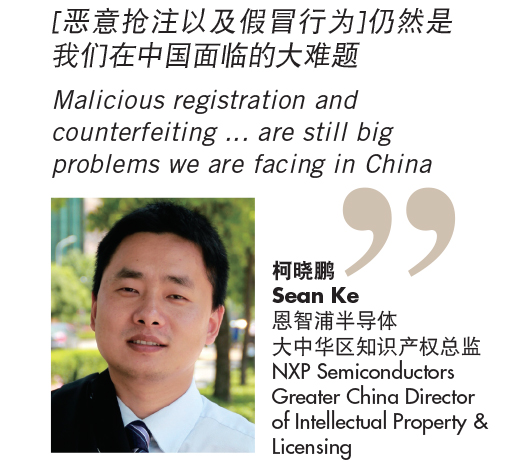
Play it again-Sean Ke

Meanwhile the ongoing battle for IP protection has expanded deep into the internet and virtual domains. Domain name disputes over “quna.com” and “weixin.com” were among the most high-profile cases in the past year.

Add to that new regulation and a number of benchmarks and yes, an “IP era” is perhaps a feasible observation. For instance, the case surrounding John Deere’s colour combination trademark was the first of its kind since colours became a category under the protection of the Trademark Law in 2001.

[ihc-hide-content ihc_mb_type=”show” ihc_mb_who=”1″ ihc_mb_template=”2″ ]

“This case has significant guidance for companies holding distinctive and well recognized unconventional trademarks,” says Joe Shi, Beijing-based IP counsel of Global Intellectual Property Services at John Deere, which manufactures agricultural and construction machinery.

The increase in IP matters has also given momentum for relevant agencies and law firms to grow. Chinese IP agency Chofn IP went public in China’s New Third Board market in August 2015, and became the first IP service provider listed on China’s stock market. In June 2015, its counterpart, Sinofaith IP Group, released its IPO prospectus on ChiNext market, though the listing is still pending.

The central government has been well aware of the trends in the IP sector and has moved to combat infringement, clarify relevant regulations and protect rightful IP. Since 2005, the government has waged a continuous campaign called “Sword Action” to address internet copyright piracy.

Play it again-Sally Wang

In December 2015, the State Council released its Opinions on Accelerating the Building of a Strong Intellectual Property Nation under New Conditions, which escalated the concept of IP to a national policy, to help power its reforms. The strategy was also written into the Report on the Work of the Government of Premier Li Keqiang, in March 2016.

In the past two years, the adoption of the new Trademark Law has had a positive effect on many enterprises in their fight against infringers, and in managing existing and potential IP assets. While awaiting further clarification of the law, in-house IP managers are also paying attention to other new laws and regulations, such as the draft of the Anti-Unfair Competition Law and the revisions of the Patent Law, both of which were put forward for public comment in the past six months. In the draft law on anti-unfair competition, new regulations target the prohibition of brand hijacking and other IP issues, including trade secrets.

Play it again-Iris Chao

Swamped with counterfeits

In our trademark report in March 2015, China Business Law Journal reported that one of the biggest challenges for most trademark managers was rampant trademark squatting and counterfeiting. A year later, the problem has not abated. “In the trademark-related domain, I would say malicious registration and counterfeiting, both online and offline, are still big problems we are facing in China,” says Sean Ke, the Greater China director of intellectual property and licensing at NXP Semiconductors in Shanghai.

There are many reasons why the longstanding problem is hard to tackle. “The fact that trademark infringement acts are always decentralized makes protection costly,” says Joe Shi. Protection is also time-consuming. International companies have to register the marks in multiple ways for complete protection in China.

“For an English-language mark, we often find ourselves in a situation where we have to register the English word, the Chinese translation, if any, and the Chinese transliteration as well,” observes Neha Jain Sinha, Singapore-based legal counsel at Musim Mas Holdings, a global palm oil company.“This results in more time, cost and effort.” There are lessons to be learned from the recently finalized and lengthy case involving trademark CASTEL, which is owned by French winemaker Castel Freres SAS. Before Castel began bottling wine for China, a Chinese businessman applied for the registration of the Chinese trademark Kasite (卡斯特), which is the transliteration of CASTEL.

In early 2016, after years locked in legal battle, the Supreme People’s Court ordered Castel Freres SAS to pay the businessman RMB500,000 (US$77,000) for trademark infringement – which was much smaller than the RMB33.73 million previously ordered by Zhejiang High Court. Meanwhile, during the dispute, the French company announced its new Chinese trademark called Kasidaile (卡思黛乐) in 2013.

Play it again-Gao Min

Domestic companies have faced similar problems. Edwin Yu, Beijing-based legal counsel at Youku Tudou in Beijing, says a major challenge is that “our group has a great deal of IP content, the diversity and specificity of which prevents us from using the registered trademarks to protect all IP content”.

Another concern in registration for IP managers is the adoption of a sub-classification system for goods by the China Trademark Office (CTMO), which is different from most other jurisdictions, and the official fee is charged on a per item basis. “As an in-house counsel, we find it difficult to not only identify the right description for the goods, but also to do it in a cost-effective manner,” says Sinha.

More also needs to be considered and prepared prior to the registration. According to Iris Chao, senior trademark counsel at Johnson & Johnson in Shanghai, the marketing department will design a trademark name that’s easy for consumers to recognize, while in-house counsel need to consider a name that focuses on protection and enforcement against infringements.

While the cost of protection is high, the penalties against counterfeiters are too lenient to scare off infringers. “We think the measure of damages in trademark infringement cases is in practice too low,” says Sally Wang, Asia-Pacific regional trademark counsel at Honeywell, based in Shanghai.

Pursuant to the Trademark Law amendments in May 2014, the statutory measure of damages has been raised to RMB3 million. But cases where the court at its discretion awarded this kind of amount have been rare. In-house counsel expect this may gradually change following the decision of the Moncler case in 2015, which marked the first judgment awarding the maximum statutory damages amount of RMB3 million. Italian high-end jacket company Moncler won against Beijing Nuoyakate Gourmet in China in a case that offered positive signals and was regarded as a landmark victory for multinationals in IP rights protection in China.

“The new Chinese Trademark Law constitutes a significant step ahead in the protection of brand owners’ IP rights in China because it testifies to the increased importance of IP rules in the country and gives brand owners the chance to better protect themselves, ” says one brand manager at Moncler Group. Gao Min, who heads the China trademark team at adidas in Shanghai, agrees. “The Moncler decision gives us greater confidence that we can obtain decisions where the amount of damages acts as a real deterrence.”

In-house IP managers also mention the ongoing case involving US sportswear manufacturer New Balance, in which the amount of damages ordered in the first instance was extremely high. In April 2015, Guangzhou Intermediate Court made its first-instance order in the trademark infringement case concerning Chinese trademark Xinbailun (新百伦) between an individual and a company called Xin Bai Lun Trading (China), which is a subsidiary of New Balance. The latter was ordered to pay RMB98 million to the individual, marking the highest IP damages awarded by the court to date.

“This is an exciting precedent, with the backdrop that in most cases the amounts of damages are relatively low,” says Chao at Johnson & Johnson. “If the amount of damages can be raised radically, or be a great number, then the infringement is no longer profit-making and would be deterred, while the prior trademarks can be protected.” Many in-house counsel also applauded the positive changes on the burden of proof. For example, under the Trademark Law, if the rights owner has presented as much proof of its claims as possible, a court may order the infringer to submit account books and information related to the infringement.

Changes for better and worse

The new law has also for the first time set time limits for the handling of cases by the CTMO and the Trademark Review and Adjudication Board (TRAB). Article 28 provides that the CTMO must complete its examination within nine months from the time of its acceptance of the application.

In contrast, according to David Cosgrave, director of legal services at the University of Southern Queensland, it took more than two years to receive the result of examinations in the past. “This is remarkable progress that will encourage brand owners to be more active in trademark filings in China,” says Cosgrave.

The law also provides that only those interested parties are now eligible for filing opposition, while in the past any third party could file opposition. Cosgrave believes this has substantially reduced the cases where the opposition is filed in bad faith without any substantial grounds. The law also introduces the good faith principle and the responsibilities of trademark agencies in order to prevent some agencies from registering famous brands on behalf of anonymous clients.

But despite the positive changes, uncertainties remain. The new law specifies that even if a seller with no knowledge of its infringing goods can prove the legality of acquiring such goods and identify the provider, the administrative authorities for industry and commerce must order the seller to cease selling its goods. This sounds unreasonable for some in-house managers. “It means the authorities cannot seize the infringing goods, but order it to cease selling. The infringing goods could then flow back into the market through other channels,” says Wang, of Honeywell.

Another change regarding the opposition procedure is that if the CTMO makes a decision to approve the application of the opposed trademark for registration, a certificate of registration of the opposed trademark must be issued by authorities; if the opponent is dissatisfied with the decision, it may file a separate request for invalidation of the registered trademark to the TRAB.

The shift is not considered as favourable for trademark owners. “The prior user cannot apply as the opposing party for re-examination after the opposition failed, while the trademark registration with bad faith is approved and will encourage counterfeiting and infringement,” says Chao.

In-house counsel are hoping the authorities can provide more clarity on the changes. Shi at John Deere believes there are uncertainties in the judging criteria and measure of damages regarding reverse confusion. The ongoing case over the Xinbailun trademark is a typical dispute relating to reverse confusion, where a second user is better known than the first. “I hope the final judgment would have guidance for the determination of infringement and criteria of damages of succeeding cases of similar kind,” he says.

Another case worth noting is the four-year PRETUL trademark infringement lawsuit relating to the original equipment manufacturer (OEM) trademark. In November 2015, the Supreme People’s Court ruled that the OEM manufacturer’s act of using the trademarks didn’t constitute trademark infringement. For the first time the court made clear that the manufacture of products in China for export only does not infringe upon the Chinese registered trademark.

IP right owners are concerned that this might have a big impact on current legislation and practice, such as whether customs have a legal basis to prevent counterfeit goods being exported. “We worked closely with China Customs and have successfully stopped hundreds of thousands of counterfeits at the borders every year. Will this judgment pose any negative impact on this co-operation in future?” asks Gao of adidas.

More questions remain after the decision, including whether local authorities can seize products at production venues if those products are for export only. “This is the most authoritative decision so far on this OEM issue, which has been debated for many years across China,” says Cosgrove. “Although it is believed by many people to be the final conclusion on this issue, it still remains to be seen whether all the local courts, administrations of industry and commerce (AICs) and customs will follow the ruling in the future.”

Play it again-Soon Hee Koh

More support

Despite legislative uncertainties, brand owners are seeking more support from the authorities. Wang says that in criminal cases, the rights to participate of a trademark holder have not been fully guaranteed and sometimes excludes the holder in litigation proceedings. The lack of communication and co-ordination between different government departments also results in oversights and costs enterprises time and money.

“I hope the new anti-unfair competition law, along with its relevant implementation rules, will further clarify the problem and give a clear description about the duties and responsibilities of enforcement authorities,” she says.

Different attitudes from various local authorities only add to the complexity of the situation. “By virtue of its vast geography, the practical application of trademark protection is decentralized to some extent,” says Soon Hee Koh, Singapore-based head legal counsel, Asia & Oceania, at Yara Asia. “The local AICs and courts in different regions sometimes apply the same laws differently, which makes it difficult for us to say to management internally, in advance, what the likelihood of success is.”

Local protectionism is another problem. “Some areas are notorious for counterfeiting problems; however, the local economy relies heavily on that counterfeiting business, which prevents local authorities from taking effective means to tackle the counterfeiting problem. Rights owners have encountered many difficulties in enforcing their rights in these areas,” Gao says.

Play it again-Joe shi

“As in-house counsel, we have been trying to mitigate this problem for years. We have spoken to senior officials in higher-level departments, requested them to pay attention to these local problems, and tried to involve them in specific cases.”

Patent protection

The protection of patents has seen similar problems to those of trademarks. “In patents filed, the unpredictability of patent invalidation proceedings as a patentee, the long timeline and, normally, low damages in patent infringement litigation are really big issues in China’s IP system,” says Ke, of NXP.

Shi mentions other challenges, including: (1) great difficulties in patent investigation, partly due to the massive number of patent applications; and (2) when handling patent litigation, the courts and the State Intellectual Property Office’s (SIPO) Patent Re-examination Board have high requirements for proof of prior use.

Shi says these situations are commonly faced by foreign manufacturers, and increase the risk of patent infringement when introducing foreign product designs into China. He suggests that patent managers should determine their main competitors and prioritize investigations into their patents, and properly publicize the use of their trademarks as a defensive action.

“For example, though a company would think it unnecessary to apply for patents that are developed in foreign countries, it should still publicize the patents appropriately, to eliminate risks in following application of patents,” he says.

Play it again-Patrick Xu

Counsel point to the Draft of the Fourth Amendments to the Chinese Patent Law (for public comment), published by the SIPO in April 2015. “I hope the new Patent Law can make breakthroughs in streamlining the procedures of patent litigation,” Shi says. “The patent administrative enforcement is another key point in the amendment. I hope the new patent law can reconcile both justice and efficiency, by allowing those who are unsatisfied with patent administrative enforcement to resort to judicial remedies.”

Service invention is another focus in the patent field. “The award for service invention has brought huge challenges and risks to all enterprises that invest to develop and research in China,” says Patrick Xu, Shanghai-based patent attorney with Honeywell.

The 3M case is such an example. In 2012, a former employee sued 3M China and its affiliated company, 3M Innovative Property, to claim reward and remuneration of RMB4.4 million for his service invention. The court of first instance ordered the remuneration of RMB200,000. After the judgment, both parties appealed, but the original judgment was upheld.

Several key arguments in the case need to be settled, for instance, the application of China law and the calculation of the reward for service invention.

Xu is worried that the passage of the draft Regulations on Service Invention, which raises the statutory standard for reward for service invention, will encourage employees to challenge the award schemes of their companies and claim higher rewards, giving rise to disputes and litigation.

Play it again-Chen Yaodong

“If the risks and burden grow, the enterprises will not boost investment in research and development in China, and may consider pulling out of the country. This goes against the goal of legislation,” Xu says. “In comparison, the US owns the biggest number of innovations and inventions in the world, without a reward scheme like China’s. We strongly call on legislative bodies to stop or postpone legislation of the regulations, and allow a company to design relevant award schemes for service inventions based on their situations under existing legal frameworks.”

The standard essential patent (SEP) has attracted more and more professionals. Although there are not many SEP cases, most of them involve massive amounts of money and have had far-reaching influence.

The dispute between InterDigital (IDC) and Huawei in 2014 is considered China’s first SEP case. When Huawei sought a technical licence, the company thought IDC had demanded a high and discriminatory price – much higher than its competitors. IDC filed 377 investigations with the US International Trade Commission, while Huawei filed an antitrust investigation application against IDC with the National Development and Reform Commission (NDRC).

Guangdong High Court decided that the rate was contrary to the principle of fair, reasonable and non-discriminatory (FRAND) terms and the loyalty requested by IDC should not be more than 0.019%, much lower than the 2% it originally demanded. IDC voluntarily sought reconciliation and reached a settlement with Huawei.

In the past year, two high-profile SEP cases are the multinational patent litigation between Huawei and ZTE, and the NDRC’s antitrust investigation. The former is the first SEP case to come before the Court of Justice of the European Union (CJEU), the ruling of which makes it vital for both patent owners and standard users to consider competition law implications thoroughly, either during pending patent infringement proceedings or before potential litigation. In the latter case, the NDRC imposed a penalty of RMB6.088 billion on Qualcomm, which holds a great number of SEPs in the wireless communication sector.

Play it again-Jerry Xia

Telling trade secrets

In 2009, US conglomerate DuPont charged its South Korean rival, Konlon Industries, for acquiring information about fibre technology from former DuPont employees. In 2015, both parties settled this six-year-old legal battle for misappropriation of trade secrets and confidential information.

“This case has negative impacts on employers’ trust of employees and research and development in China,” says Chen Yaodong, the IP APAC director of Akzo Nobel (China) Investment in Shanghai. “The protection for technical secrets is one of the key considerations for our company to further invest in China.”

Chen says protection of trade secrets in China involves a balance between the reasonable flow of staff and information protection and sharing, and that protection of technical secrets should be managed in imperative order, or control flow. But Chen notes that there is not a single law targeting protection of technical secrets, with relevant regulations scattered through the Labour Law, the Contract Law and other specific laws on technology transfer.

Play it again-Dejian Dai

Apart from a single law for technical secrets, amendments of the new Anti-Unfair Competition Law on trade secrets are keenly awaited. “I hope the new law will provide more specifications that are favourable to the rights owner of trade secrets,” says Shi.

Better management

In-house IP managers mention other notable IP cases such as the Wells Fargo case, which focuses on the parameters of protection for the disclaimed part of a registered mark, and the trademark case involving weixin (the Chinese name of WeChat), which impacted millions of users and other enterprises.

Reviewing all the above-mentioned cases, in-house lawyers believe Chinese companies still have a long way to go to improve in the management of IP. To begin with, for protection of trademarks, patents or trade secrets, acting earlier is always better.

“For foreign rights holders, it is important to pay attention to the timely registration of their trademarks in China, especially the Chinese trademarks, to prevent malicious registration, the risks of being sued and also protection difficulties,” says Jerry Xia, Asia-Pacific chief IP counsel at Honeywell.

“To register a trademark as early as possible is one way out,” says Shi. “It needs the IP departments and business departments to share [timely] information of products and trademarks. In addition, we should watch the application of trademarks in domestic regions and file oppositions as early as possible.”

Counsel should also stay abreast of protection and management issues. “The IP management level of Chinese enterprises still lags far behind developed countries, giving them a disadvantage in competition,” says Dai Dejian, director of intellectual property division at Sichuan Changhong Electric.

Dai believes the major challenge for in-house counsel is the use of IP, the valuation of efforts in different stages of IP management, and the value and prospect of IP managers. “IP is a kind of competitive asset. The maintenance and increment of value in IP assets is different from legal services and support. Therefore, the management of IP should focus more on commercial benefits and the fulfilment of its value.”

[/ihc-hide-content]

Practitioner’s perspectives
薛敏 Nikita Xue
薛敏 Nikita Xue
Judicial authorities differ on Trademark Law interpretations
Regardless of the different opinions on “made in China”, the “OEM plus export” business model has developed rapidly in China…


LinkedIn
Facebook
Twitter
Whatsapp
Telegram
Copy link