







China’s leading law firms saw revenue slow in 2020, but at a better rate than many predicted as the countercyclical sector swung back with resilience during the pandemic and subsequent global economic shutdown. China Business Law Journal’s annual survey tapped 109 law firms for their views on last year’s rollercoaster of market trends. Avery Chen reports
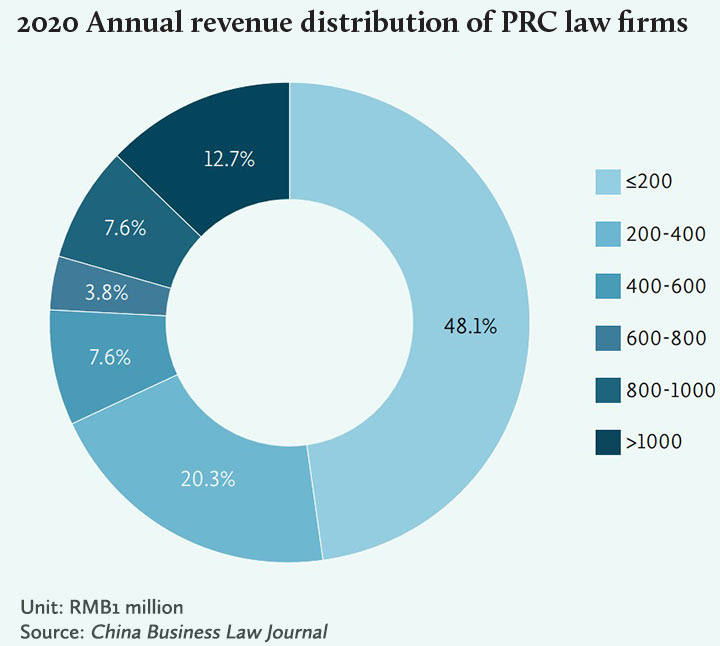
According to China Business Law Journal’s annual legal market survey, a total of 72 law firms recorded a median revenue of RMB205.5 million (USD31.9 million) last year. However, the average growth rate nearly halved to 12.6% in 2020 from 24% in 2019.
“Achieving revenue growth is already better than expected,” says Yu Yongqiang, a Beijing-based partner at JunHe. “Many law firms were worried about decline in revenue at the beginning of last year, when employees worked from home due to the covid-19 pandemic.”
Last year was anything but normal. In the first few months, law firms were asking staff to work remotely when the central government imposed lockdowns on the majority of cities. Even after the pandemic was under control, firms faced fierce competition due to falling demand from clients, which put their investment plans on hold and slashed their budgets for legal services.
“With a double-digit increase, the legal services industry has outperformed many other sectors,” says David Lin, managing partner of Dare & Sure Law Firm in Beijing. “The industry is largely dependent on the real economy, so it’s normal to see a slowing growth last year.” Despite China becoming the first major economy to recover from covid-19, the country’s GDP rose by 2.3% last year, the lowest rate since 1976.
“The pandemic dealt a blow to economic activity, and there is more friction in international trade,” says Lin. “That’s why law firms’ business has been rising but the revenue growth has slowed, and billing rates per case were going down.”
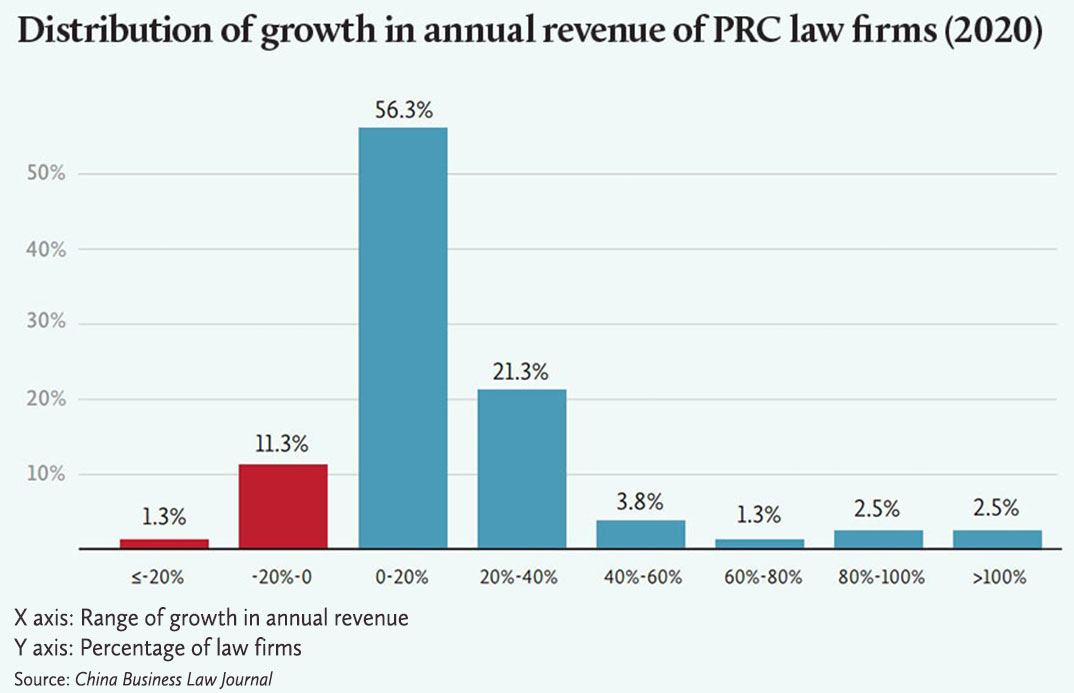
In 2020, more than half of our survey’s participants saw revenue rise by between 0% and 20%, while 12.6% of law firms saw a contraction in earnings.
“The economic cycle has had a small impact on full-service firms, while companies that rely on a single [sector] were more affected,” says Yu.
Among the 72 law firms that disclosed financial data, 10 passed the milestone of RMB1 billion in revenue. The 10 firms posted average revenue growth of 19.8%, 7.2% higher than the average across the industry.
The pandemic brought more opportunities for elite law firms. Downward pressure on the economy gave a boost to countercyclical sectors such as restructuring and insolvency, labour law matters, compliance and M&A, etc.
“The external challenges did take a toll on our financial performance,” says Lin. “We failed to sustain a similar growth rate for business this year, but we saw a significant increase in competition law and due diligence business.”
Yu also notes the pickup in new demand when the economic situation worsens in areas including labour law, compliance and litigation. The central government’s push on the domestic supply chain was also a major boon to the legal marketplace.
“Legal services have been in high demand given such a big economy,” says Yu. “The latest ‘dual circulation’ strategy is also giving a boost to the industry.”
This new strategy was put forward by President Xi Jinping in May 2020, under which domestic production, distribution and consumption would be the key drivers for the economy, supplemented by international trade.
Market data also reflect the trend. China’s M&A value rose 30% to USD733.8 billion in 2020, hitting a five-year high, driven by strong state-owned enterprise (SOE) participation, which offset a steep decline in cross-border deals, according to a report from accounting firm PwC.
Our survey respondents are seeing positive long-term growth. About 55% of participants say they are “very optimistic” about the development of the Chinese legal industry, followed by “somewhat optimistic” (40.7%), “neutral” (2.2%) and “somewhat pessimistic” (2.2%).
[ihc-hide-content ihc_mb_type=”show” ihc_mb_who=”1″ ihc_mb_template=”2″ ]
TIME TO GROW
Despite the economic headwinds, frontier law firms are expanding their businesses. From the beginning of 2020 until August, about half of the surveyed law firms had expanded their domestic footprint, with 54 firms establishing 184 more mainland branches.
Haikou city, in Hainan province, retains the crown for the most popular destination for the second year, attracting 17 law firms to set up new branches. It was followed by Qingdao (11), Shanghai (10), Kunming (8), Guangzhou (8), Hangzhou (8), Guiyang (6), Shenzhen (6), Nanjing (6) and Chengdu (6).
Law firms are still evaluating new opportunities and waiting for more detailed policies after the central government revealed plans for Hainan free trade port in June 2020. The government is aiming to establish a free trade port system, with a focus on trade and investment liberalisation and facilitation, by 2025, which will be “more mature” by 2035, according to the Central Committee of the Communist Party of China and the State Council.
Hylands Law Firm opened a Haikou branch in June last year. Co-operating with offices in Guangzhou, Shenzhen and Hong Kong, the new office will be part of Hylands’ comprehensive legal service platform in South China and the Greater Bay Area (GBA).
The new Haikou branch will put emphasis on infrastructure construction of the free trade port in the early stages, and will shift emphasis to legal services in international trade, processing entrepot trade, foreign investment, and the securities market for energy finance in the later stages, says Zhang Miao, Beijing-based senior partner at Hylands. Meanwhile, the global health crisis and worsening geopolitical tensions did not dampen some law firms’ ambitions to go global. Thirteen of the law firms surveyed opened a total of 28 offices in the past 20 months. The most favoured markets were the US (9), Singapore (3), Thailand (3), Japan (2) and Hong Kong (2).
Yingke Law Firm has set up nine overseas branches since last year, including seven in the US. Yingke has become one of the largest Chinese law firms in the US, with more than 30 lawyers practising US law and a network covering eight cities including New York, Los Angeles, Dallas, Miami and San Francisco.
The Beijing-based company has made inroads into offshore markets since 2010, and its Yingke Global Legal Alliance covers 145 cities in 83 countries in Asia, Europe, South America and North America.
“In the face of the Sino-US trade war, the covid-19 pandemic and bilateral political conflicts, companies in China and the US need more cross-border legal services than before. The market potential is huge as only a few law firms could provide high-quality cross-border services for both judicial systems,” says Los Angeles-based Henry Li, co-managing partner of Yingke’s US branch.
“However, the pandemic disrupted the US legal market and added financial pressure on many law firms,” says Li. “There are few successful precedents for Chinese law firms in the US. It’s still a long way to go for Chinese companies to gain recognition from the mainstream market.”
NEW TALENT
More top-tier players have been scaling up their legal teams. According to the survey, the total number of lawyers at firms rose 20.21% on average in 2020, among which the number of equity lawyers increased by 21.39%. These figures came as more lawyers left second or third-tier firms for the top-tier names.
“Similar to other private sectors, China’s legal marketplace has been more concentrated in recent years,” says Lin. “The trend was much more noticeable last year, because economic activities and structures changed dramatically amid the pandemic, and the top law firms presented a much stronger ability to withstand risks.”
New talent can create revenue streams for law firms. Yingke has opened 31 new branches in the past 18 months, increasing its total lawyer count by 19.6% to 10,596 as of last December – the highest in China. The expansion was a big contributor to Yingke’s 24.7% rise in revenue, to more than RMB6.5 billion.
Another example is Jundu Law Firm, where revenue shot up 400% last year after more partners and lawyers joined Beijing-based Tan Jinghui, director and founding partner of the firm. Tan is an influential expert in engineering construction and real estate, which has become a major business segment for Jundu.
Another notable from the survey is that the gap between famous law firms and smaller players has increased. “The big firms become larger and larger, but small firms are getting harder to develop,” says Lin. “The same thing has happened to lawyers. Income for equity partners keeps rising, but the differences with average lawyers are increasing, with the latter facing sagging incomes.”
As law firms undercut each other amid stiff competition, revenue per lawyer has already lagged behind corporate growth. The median revenue per equity partner has increased 1.5% to RMB4.7 million, however the median income for total lawyers dropped 7.3% to RMB957,700.
Liu Guangchao, founding partner and director of DOCVIT, says the data are not enough to represent the whole industry. “It might reflect the ‘pareto principle’,” says the Beijing-based lawyer. “With increasing demand for more personalised, in-depth and systematised legal services, the concentration of legal business has moved to top partners or equity partners.”
The decline in revenue per lawyer also shows that lawyer numbers are growing too fast, with lower billing prices amid cutthroat competition, says Liu. “That means the legal industry needs to innovate products and services to expand the market, and we should objectively evaluate and take rational guidance on the headcount growth,” he says.
Increasing tie-ups and merger between law firms also indicates a rising demand for large-scale platforms and co-operations, says Liu. “At the same time median-sized law firms, with 20-50 lawyers, have seen insignificant growth in recent years, which also supports the phenomenon.”
In early September, AnJie and Broad & Bright, two prominent mainland law firms, announced merger plans, which is expected to ramp up their annual revenue to more than RMB600 million.
“Some law firms boost their revenue mainly by opening new offices, but some firms are counting more on organic growth,” says Yu. “The Hong Kong IPO market has been booming in the past two years, and many capital market lawyers have been more willing to move to foreign law firms, which offered higher salaries,” he says. “But the salary difference will narrow very quickly, as Chinese law firms are raising pay levels.”
According to the survey, many law firms are undergoing salary hikes and promotions this year. Lin says Dare & Sure gave 20% pay raises and promoted two salary partners. Huang & Huang plans to increase salaries and welfare, adjusting its composition model to attract lawyers, and strengthening co-operation with domestic and foreign law firms, says Huang Hui, a partner in the firm’s Guangzhou office.
GENDER EQUALITY
Although many top-tier law firms have made efforts to improve gender parity, the legal marketplace in China faces an all too common social problem – few women can get into leadership roles.
According to the survey, women accounted for 49.2% of total lawyers in 2020. However, only 29.4% of equity partners were women.
“It’s universal in the Chinese law firms,” says Tan at Jundu. “The major objective dilemma for women lawyers is that they are shouldering more responsibility from marriages and families,” she says. “And subjectively, it’s about whether they have enough resilience and dedication.
“It’s harder for women to focus on their career progression, but this could be minimised by rational plans for their time and career path.”
Zhu Zhigang, a partner at Wanhuida Intellectual Property in Beijing, says the nature of the job is perceived to be not friendly for women lawyers. “Litigators usually have to carry huge amounts of documents to appear in court and take business trips,” he says. “Sometimes they have to work around the clock and juggle courts in different cities.
“In the name of caring for women lawyers, law firms might not assign cases with a heavy workload to them. But at the same time, this drags down their performance and income, making it harder to compete with male lawyers.
“As electronic evidence and the online court become more common, the working environment is becoming better, so female lawyers can play a greater role in the future,” he adds.
Other lawyers in the survey say having more women partners can benefit the management team. “Female partners are more patient and focus on details with a more interactive management style,” says one partner from Jin Mao Law Firm who wished to remain anonymous. “They have greater empathic disposition and are more social than male partners.”
Jin Mao has set up two scholarships, in Shanghai University of Finance and Economics and in East China University of Political Science and Law. “There are more female candidates every year, they perform as good as men, even better in interviews in terms of logical thinking and ability to adapt and react quickly,” says the partner.
“We should keep an open mind and think critically, offering opportunities for women lawyers to develop their career and show their managerial skills. Legal practice is a field of wisdom and expertise, women lawyers have proved their professionalism and excellence. If we would give women lawyers their deserved stage and spotlight, their performance would be no less impressive than their male counterparts.
“We believe Chinese women lawyers will have a larger stage to shine on, to be what they want to be – leading practitioners or managers of law firms,” the partner says.
Wanhuida provides equal career development opportunities with a transparent promotion procedure, says Zhu. Apart from that, the law firm has set up breastfeeding rooms, and provides after-school services for children, so female lawyers can reduce their burden from families and children’s education.
To further reduce gender inequality in the industry, Tan says law firms should encourage female lawyers to become specialists, paying more attention to professional achievement. “Women engaging in legal business must focus on one direction, otherwise it is easy to lose competitiveness,” she says.
INTEGRATED MANAGEMENT
Integrated management was another strategy widely referred to by law firms in the survey, as top-tier law firms have been changing their management style to get closer to their global counterparts.
The pandemic further underlined the importance of the corporate model. The system not only enables law firms to provide one-stop services to lift competitiveness, but largely shortens the decision-making process for long-term projects like digitalisation.
“With the increasing division of law firms and lawyers, clients need partners from across fields,” says Yu. “Law firms with the corporate model are more likely to fulfil the demands. All partners share the compensation cost of lawyers and administrative staff. This reduces the burden for single partners, and we can put money on our common goal.”
According to the survey, 45% of the law firms say they are running businesses under the corporate model, while 53.3% are using the partnership structure.
However, Yu questions whether the data are overstated. “As far as I know, only a few firms could fully adopt corporate models. It’s easier for young law firms, but remarkably difficult for partnered law firms to reform their model.”
JunHe has put a focus on distribution system reform. The 32-year-old company has moved from merit-based compensation to a “modified lockstep” system, under which lawyers will be rewarded by both experience and performance.
Fully implementing merit-based compensation is extremely difficult, and only 20 law firms (22.7%) are adopting the model, the survey shows.
But the merit-based model is not equal to corporation management, and is not appropriate for every law firm, says Liu, and there are some objective limitations for both the merit-based model and corporation management. “The two systems ask someone to sacrifice with more patience,” he says. “It needs strong support by a common culture and belief, requiring a long-time effort to maintain. But at this stage, most law firms cannot do this.
“The Chinese law industry is still in its early stage, shifting from aggressive expansion to an orderly, competitive market. The corporation system is more suitable for mature law firms.”
The demand side is also premature. “The spending power of clients in China’s legal market varies,” says Liu. “There are no large demands or requirements for corporate management-style legal services, so law firms don’t have enough motivation to undergo the reform.”
Integrated management could be considered the first step, as it requires law firms to make the management structure more compact, and helps them move forward to a corporate management model.
“Apart from compact management, a corporate management law firm must set up a product system, talent system and market system with strategies, departments and division of labour,” says Liu.
“Fully implementing a corporate model requires substantial changes in property rights mechanisms, decision-making models, governance structures, distribution models, and even development models,” he adds.
DOCVIT, which was established in 2003, was an early adopter of the corporation model with an integrated management. “At first, the law firm separated its headquarters and its Beijing office,” says Liu. “Second, each office has implemented a management system with an equity partner committee, management committee, executive committee, and a board of supervisors. Third, DOCVIT’s headquarters set up five committees and 10 centres to concentrate public functions that service each office equally. Fourth, the law firm set up a core distribution system to allocate work based on the demands of partners at different stages. And finally, each office has executive directors in charge of management.”
[/ihc-hide-content]
The following firms participated in the survey (in alphabetical order): AllBright Law Offices, An Tian Zhang & Partners, AnJie Law Firm, Anli Partners, Baohua Law Firm, Beshining Law Office, Boss & Young Attorneys at Law, Bridgeon Law Firm, CCPIT Patent and Trademark Law Office, Chance Bridge Partners, Chang Tsi & Partners, Chen & Co Law Firm, China Commercial Law Firm, CM Law Firm, Co-effort Law Firm, Commerce & Finance Law Offices, Corner Stone & Partners, Dare & Sure Law Firm, DeHeng Law Offices, Dentons, DHH Law Firm, DOCVIT Law Firm, East & Concord Partners, ETR Law Firm, Exceedon & Partners, Fangda Partners, Gaopeng & Partners, Gaowo Law Firm, Global Law Office, GoldenGate Lawyers, Gong Cheng Law Firm, Grandall Law Firm, Grandway Law Offices, Guantao Law Firm, Hai Run Law Firm, Haiwen & Partners, Han Kun Law Offices, Hansheng Law Offices, Hengdu Law Offices, HHP Attorneys-At-Law, Hightac PRC Lawyers, Hiways Law Firm, HongFangLaw, Huang & Huang Co Law Firm, Hui Ye Law Firm, Hui Zhong Law Firm, Hylands Law Firm, Jia Yuan Law Offices, JianLingChengDa Law Firm, Jiaxuan Law Firm, Jin Mao Law Firm, Jincheng Tongda & Neal, Jingtian & Gongcheng, Joint-Win Partners, JOIUS Law Firm, Jundu Law Firm, JunHe, JunZeJun Law Offices, K&H Law Firm, KaiRong Law Firm, Kangda Law Firm, King & Wood Mallesons, Lanbai Law Firm, Landing Law Offices, Lantai Partners, Leadvisor Law Firm, Llinks Law Offices, Longan Law Firm, Merits & Tree Law Offices, Ning Ren Law Firm, PacGate Law Group, PW & Partners, Qin Li Law Firm, RICC & Co, River Delta Law Firm, Ronly & Tenwen Partners, S&D Partners, Saelink Law, Sanyou Intellectual Property Agency, SF Lawyers, SG & Co PRC Lawyers, SGLA Law Firm, Shanghai Pacific Legal, Shihui Partners, Shu Jin Law Firm, Silkroad Law Firm, Sloma & Co, Sundy Law Firm, Sunshine Law Firm, T&D Associates, Tahota Law Firm, Tian Yuan Law Firm, Tiantai Law Firm, TianTong Law Firm, Tiger Partners, V&T Law Firm, Wang Jing & GH Law Firm, Wanhuida Intellectual Property, Watson & Band, Winners Law Firm, Wintell & Co, Yinghe Law Firm, Yingke Law Firm, Young-Ben Law Firm, Zhenghan Law Firm, ZHH & Robin, Zhilin Law Firm, Zhong Lun Law Firm, Zhonglun W&D Law Firm.