














When different judicial systems clash on disputes involving foreign commercial judgments recognised and enforced in mainland China the outcomes have always been tricky, even under the confines of bilateral treaties. But recent progress may allow greater certainty, writes Edward Chin
FOLLOWING STELLAR ECONOMIC GROWTH in the past four decades, China’s legal system has been under rapid reformation to keep up with change, not only in order to lockstep with major international trade accomplishments, but to successfully and transparently address the complex area of cross-border commercial disputes. Given that China is a signatory to the New York Convention, the enforcement of arbitral awards has been viewed as the most accessible method for foreign parties to enforce their rights to a contract in Chinese courts – subject to an arbitration agreement.
Yet arbitration is not the only option for resolving commercial disputes in China, and some parties have chosen to take proceedings directly into the Chinese courts. However, unfamiliarity and scepticism have surrounded these experiences for many foreigners, which then leaves the option of litigating the matter in their local courts and then attempting to get this foreign judgment recognised and enforced in Chinese courts.
In the past, this recognition and enforcement approach was seen as too unpredictable, even for countries – or in some cases, special administrative regions within China – that had signed bilateral treaties with China where both jurisdictions mutually agreed to recognise and enforce their judgments subject to satisfying the criteria in the treaty.
 However, recent developments are encouraging. On 31 December 2021, the Supreme People’s Court (SPC) issued the Memorandum of the National Court’s Symposium on Foreign-related Commercial and Maritime Trials 2021 (the memo of meeting 2021), which clarified the practice of recognition and enforcement of foreign judgments (REJ) in China.
[ihc-hide-content ihc_mb_type=”show” ihc_mb_who=”1″ ihc_mb_template=”2″ ]
FOREIGN JUDGMENTS
There are primarily two methods of recognising and enforcing foreign judgments in China, namely:
(1) Under a bilateral treaty between China and the recognising and enforcing state or region on the matter of mutual recognition and enforcement of judgments; and
(2) Under the principle of reciprocity set out by articles 288 and 289 of the Civil Procedure Law (as amended in 2021), where both articles give effect to the REJ mechanism.
According to research by Fangda Partners, from 1 January 2020, 12 foreign judgments were recognised and enforced, of which one US judgment was recognised and enforced based on the principle of reciprocity. The remaining judgments were all recognised and enforced based on treaties.
Two foreign judgments were denied recognition and enforcement. A US judgment was denied because it was being appealed by one of the parties, and an Australian judgment was denied recognition because the court found that the judgment failed to satisfy the statutory requirements on service under PRC law.
Therefore, based on public records, the likelihood of successfully obtaining recognition and/or enforcement of a foreign judgment in China is more than 80%.
 BILATERAL TREATIES
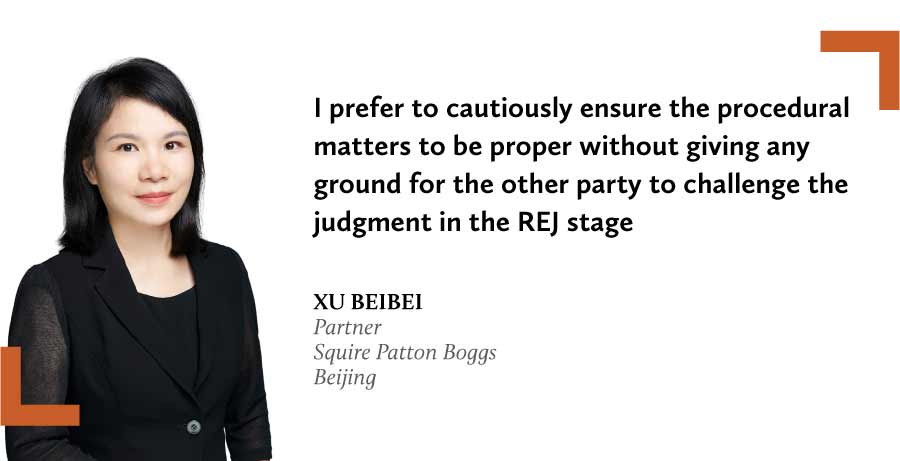
For nations or regions with an existing bilateral treaty with China, the requirements for REJ are in the treaties themselves. However, as Xu Beibei, a Beijing-based partner at Squire Patton Boggs, points out, even for bilateral treaties, the requirements are not completely straightforward.
Xu says that with bilateral treaties, there are three types of requirements:
(1) That the foreign judgment not fall within the exclusive jurisdiction of Chinese courts;
(2) That the judgment-rendering court complies with the jurisdiction requirements of Chinese courts; and
(3) That a list of acceptable jurisdictional bases are set out which, however, are still subject to the exclusive jurisdiction of Chinese courts.
Xu adds the “standard to decide [REJ under a bilateral treaty] is much debated”.
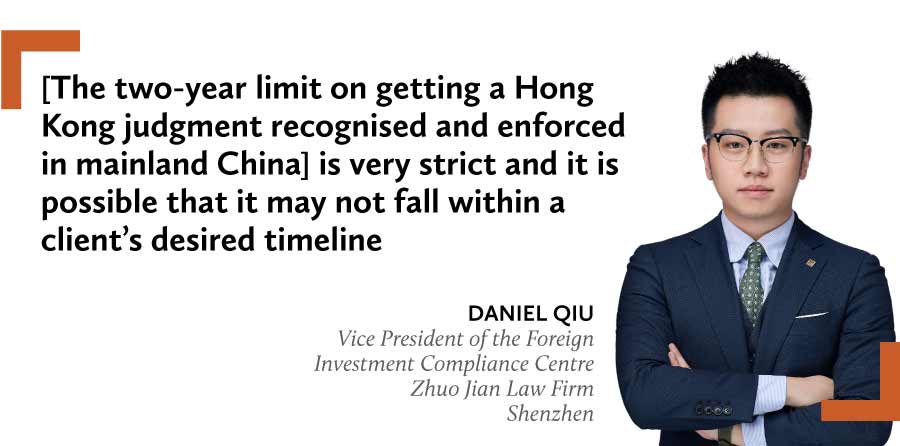
Daniel Qiu, the Shenzhen-based vice president of the foreign investment compliance centre at Zhuo Jian Law Firm, says, “Even with Hong Kong, a special administrative region of China, there may be practical difficulties.”
According to a bilateral treaty between Hong Kong and mainland China – the Arrangement of the Supreme People’s Court on the Mutual Recognition and Enforcement of Judgments in Civil and Commercial Cases Under the Jurisdiction of the Parties Agreed upon by the courts of the Mainland and the Hong Kong Special Administrative Region – there is a two-year limit of when you can apply to get a judgment recognised and enforced in China.
According to Qiu’s own experience, “This requirement is very strict and it is possible that it may not fall within a client’s desired timeline.”
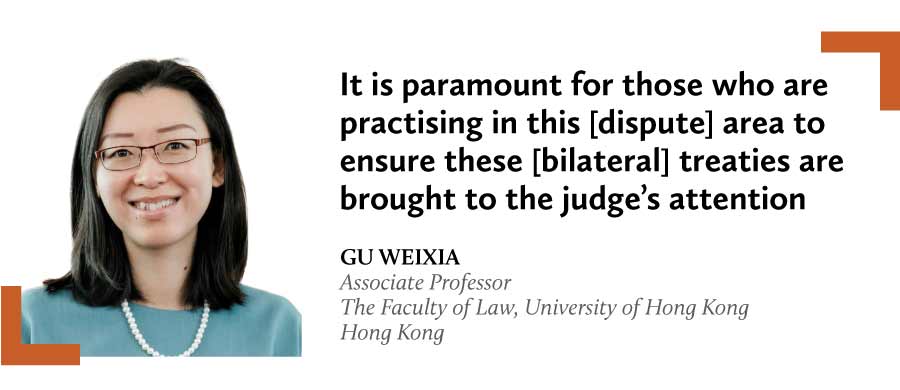
Gu Weixia, an associate professor at the University of Hong Kong’s Faculty of Law with expertise in cross-border dispute resolution, observes that even though there may be a bilateral treaty between the parties’ contracting states, some Chinese judges may not be aware of the treaty’s existence, which has led to judgments not being recognised.
“It is paramount for those who are practising in this area to ensure these treaties are brought to the judge’s attention,” says Gu.
 Further to her point, Richard Keady, a partner at Dentons in Hong Kong, says that in his experience, there is a significant number of judgments arising out of bilateral treaties that do not refer to the relevant treaty, even though the cases were rendered by the court of a country that had a treaty with China. The surprisingly low percentage of cases utilising the bilateral treaty regime suggests that many Chinese courts are not aware of the existence of the relevant bilateral treaty.
Lin Yanhua and Li Sijia, a partner and counsel, respectively, from Fangda Partners in Beijing, disagree. They say that as long as you meet the criteria within the bilateral treaties, it is not difficult for a judgment to be recognised and enforced under this regime.
Currently, there are about 39 countries and regions with which China has concluded a bilateral treaty on judicial assistance covering mutual REJ.
Ulrike Glüeck, the managing partner of CMS in Shanghai, says that among the 39 countries and regions, “22 countries are part of the Belt & Road Initiative, and there are only three Western European countries [France, Italy and Spain]”.
 The lack of REJ treaties, particularly between China and Western European countries, says Glüeck, will force the parties to rely on reciprocity doctrine, which is difficult and unpredictable.
James Wong, a managing associate with Dentons in Hong Kong, says major trading partners such as the US, UK, Germany, Japan, Australia and Canada do not have REJ bilateral treaties (for civil and commercial matters) with China. Mutual recognition and enforcement depend on the principle of reciprocity, which breeds uncertainty.
Although the number of countries concluding bilateral treaties on judicial assistance with China is growing, it is important for those advising their clients to check if they can rely on a bilateral treaty on REJ in China.
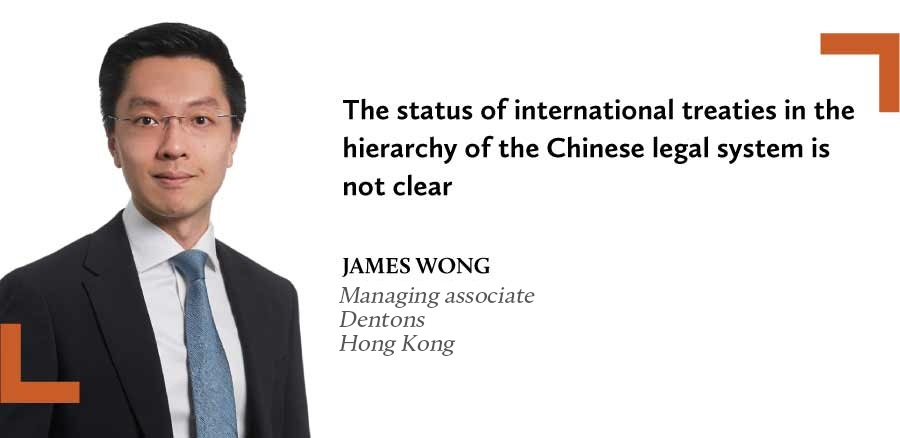
Wong says that one of the practical difficulties in enforcing judgments pursuant to bilateral treaties is that sometimes the treaties contain provisions that are contrary to the general provisions of the Civil Procedure Law. “The status of international treaties in the hierarchy of the Chinese legal system is not clear,” he adds.
But he also points out that treaties should enjoy a higher legal standing than domestic law, and where there are discrepancies between bilateral treaties and the Civil Procedure Law, article 260 states that the provisions of treaties will usually prevail.
RECIPROCITY
Apart from bilateral treaties, China also follows the principle of reciprocity when determining whether to adopt REJ from a foreign jurisdiction. Gu argues that “in the long run, a principled approach may be far better” than considering numerous treaties.
There are, however, challenges with reciprocity, and Glüeck’s claims of unpredictability have rung true in the past. Previously, the Chinese courts would not accept REJ if the foreign court had not previously recognised a Chinese judgment, or what is known as “substantial reciprocity”.
According to Lin of Fangda, this would require REJ applicants to prove that Chinese judgments of a similar nature had previously been enforced in the foreign country in question.
“This is a relatively narrow standard and places a heavy burden of proof on REJ applicants,” she says.
 Lin also observes that China has recently been devoting efforts to expanding the scope of “reciprocity” to promote the enforcement of foreign judgments in the PRC. These efforts are especially evident with the recent memo of meeting 2021, where the scope of reciprocity was greatly expanded, providing more opportunities and possibilities for the recognition and enforcement of foreign court judgments in China. This change may affect the parties to a foreign-related dispute’s choice of jurisdiction by agreement in the future.
In the memo of meeting 2021, Chinese courts will recognise and enforce a foreign judgment under the reciprocity principle in the following scenarios:
(1) The foreign party who wishes REJ is from a country or region:
(i) that has recognised and enforced a judgment rendered by the Chinese courts in that country or region in the past; or
(ii) where a promise was made through diplomatic channels that the foreign country or region will accept REJ from China; or
(iii) where the country or region has not refused REJ made by a Chinese court where no reciprocal relationship exists; or
(2) There is a reciprocal understanding or consensus with the foreign parties’ country or region with regard to REJ.
When dealing with REJ, Xu, of Squire Patton Boggs, advises that it is important to take into account the option of enforcing the judgment when an international commercial litigation starts.
“If it needs to involve the REJ, I prefer to cautiously ensure the procedural matters to be proper without giving any ground for the other party to challenge the judgment in the REJ stage,” she says. Xu is referring to stringent service of document requirements and other formalities that parties should be aware of before they commence the REJ process.
ARBITRATION AND REJ
Opinions differ on whether REJ is more cost-effective than arbitration. Glüeck of CMS says: “We do not consider the cost issue a decisive factor for choosing arbitration or litigation in a foreign country.” She says PRC law – i.e. the Measures on Payment of Litigation Fees – stipulate the same fee standards for recognition and enforcement of both judgments of foreign courts and awards of foreign arbitration institutions.
 Therefore, “at least the litigation costs in both scenarios that will incur in the PRC will not be very different from each other,” she says.
Li of Fangda advises clients engaging in cross-border transactions to choose arbitration if they want to have more certainty in ensuring enforcement in multiple countries.
“In terms of cost, the costs charged by PRC courts for enforcing arbitral awards and for enforcing foreign judgments are both very modest, and there is no substantial difference between the two,” she says.
Li explains that attorney fees for applying for enforcement of a foreign judgment are likely to be higher if the application is made based on the principle of reciprocity, because the attorneys would have to research the cases of the foreign country to identify precedents where PRC court judgments had previously been enforced by the foreign court, and then submit any such precedents to the PRC court.
Keady of Dentons says that in his experience, Chinese courts tend to apply the law strictly. If the parties do not agree on the terms of the transaction, or the agreement is unclear, despite the fact that Chinese law states that agreed terms in a contract shall prevail, the court may not try to interpret the agreement and seek to determine the genuine intentions of the parties, but adopt terms rigidly as stipulated by the law.
“By contrast, arbitrators are not bound by such strict criteria and can weigh the intention of the parties to the agreement,” says Keady. He explains that most arbitrators are familiar with commercial transactions, and the parties can select their own arbitrators who are experienced in a particular industry sector or type of commercial transaction.
“Even if the parties dispute the agreed terms, or there are ambiguities in the agreement, the arbitrator may have a better grasp of the underlying rationale of the agreement and intentions of the parties and, therefore, could make a ruling according to the agreement,” he adds.
 “In light of the above, we do not think cost-effectiveness is the key factor here, principally because China tends not to have bilateral treaties with its major trading partners, and there is still uncertainty regarding substantial reciprocity. Even then, we consider arbitration to be the more cost-effective mechanism: it does not make sense to litigate a dispute in a foreign court and then subsequently be unable to have the judgment recognised and enforced in a Chinese court.”
There seems to be a consensus among most practitioners that arbitration is the more viable option when it comes to commercial dispute resolution in China.
Xu, of Squire Patton Boggs, says REJ cases in commercial matters in China are relatively few. “I do not see that, in the short term, REJ in the PRC will parallel international arbitration,” she says. “In the long run, with more detailed judicial interpretations from the SPC coming out, and more international commercial litigation involving a Chinese party taking place, there will be many more REJ cases in China.”
THE WAY FORWARD
Foreign firms such as CMS would welcome more “relaxation to the principle of reciprocity”, according to Glüeck. However, in general, CMS does not recommend any litigation for international commercial disputes and usually does not recommend litigation with a foreign court, particularly where no reciprocity exists.
As Xu suggests, the SPC is working on a draft Judicial Interpretation of the Recognition and Enforcement of Foreign Judgments, which will clarify the general regime of recognition and enforcement of foreign judgments in more detail.
 Meanwhile, The Hague Judgments Convention of 2019, an international treaty governing the recognition of judgments in civil and commercial matters, is in the works. It aims to facilitate the cross-border recognition and enforcement of civil and commercial judgments emanating from the courts of contracting states along the lines of the New York Convention, which created a system of recognition and enforcement of arbitral awards. The Hague Judgments Convention has six signatories, with the US becoming the latest country to sign the convention in March 2022.
Wong, of Dentons, says that the Hague Judgments Convention on REJ may change the landscape in future. China has participated in the drawing up of the text of the convention. “The convention is not yet in force. If and when it is widely signed and becomes effective, the convention will be a game changer,” he says.
Although the REJ regime is still developing, the central government aims to make it a parallel one to arbitration. China is keen to ensure its legal system does not fall behind, and in a way, not only will this legitimatise its courts, but it will also make commercial dispute resolution easier. However, as the experts indicate, there is still some way to go.
[/ihc-hide-content]
Read more: Overview of Sino-US judicial reciprocity