













As the world acknowledges the real threat of global recession, where and how a company should invest has never been more challenging. General counsel hold the keys to unlocking opportunity, and more than ever are relied upon for sound advice. There are many positives, but market knowledge is paramount in an insecure world. Putro Harnowo sheds light by turning to key trends
Following a significant rebound last year with booming M&A markets and rapid growth in international project finance, the UN Conference on Trade and Development’s (UNCTAD) World Investment Report 2022 highlighted that the war in Ukraine and the lingering effects of the pandemic have caused a triple crisis regarding food, fuel and finance in many countries.
The June report expected global foreign direct investment (FDI) flows in 2022 to move on a downward trajectory or remain flat at best, while signalling an increasing trend in FDI screening among developed countries.
The UNCTAD report notes that the recovery brought growth in all regions last year, mostly caused by M&A transactions and high levels of retained earnings of multinational enterprises. In 2021, multinationals from developed economies more than doubled their investments abroad to USD1.3 trillion from USD408 billion the previous year.
For in-house counsel at companies either investing or considering investment abroad, there are trends to be both welcomed and wary of. Evolutions of regulation to accompany policies surrounding sovereignty and security need constant vigilance from legal teams, and trends outbound and inbound reflect these vigilant times.
“Companies recognise they must make their supply chains resilient, and to do so will require investment abroad,” says Steven Okun, founder and CEO of APAC Advisors and chair of AmChams of Asia-Pacific in Singapore.
Okun says trade agreements provide great flexibility in the region to diversify their supply chains – of which companies are just starting to take advantage. The US-led, 14-nation Indo-Pacific Economic Framework (IPEF) is committed to making supply chains more resilient, robust and integrated, which could include creating an information sharing and crisis response mechanism, strengthening supply chain logistics and transparency, and investing in training and development to ensure enough skilled workers.
“These actions, if taken, will further increase the appetite for Asian companies to invest abroad,” says Okun.
Being the region’s powerhouse, Japan is expected to continue to expand abroad and seek targets of investment. “Japanese companies need to invest abroad since the economic growth rate has been slim domestically,” says Junko Suetomi, a partner at Baker McKenzie’s Tokyo office. “Overall in Asia, life science, artificial intelligence [AI], the IT industry, semiconductor industry as well as energy sectors are the industries in which I anticipate seeing an increase in investment.”
Companies interested in investing in Japan should note the Foreign Exchange and Foreign Trade Act, which requires foreign investors to submit pre-transaction notifications filed through the Bank of Japan before acquiring equity, changing a shareholder in a reorganisation, or taking certain other corporate actions. The 2019 amendment lowered the ownership threshold for foreign investment approval from 10% to 1% in companies regarded as sensitive to national security.
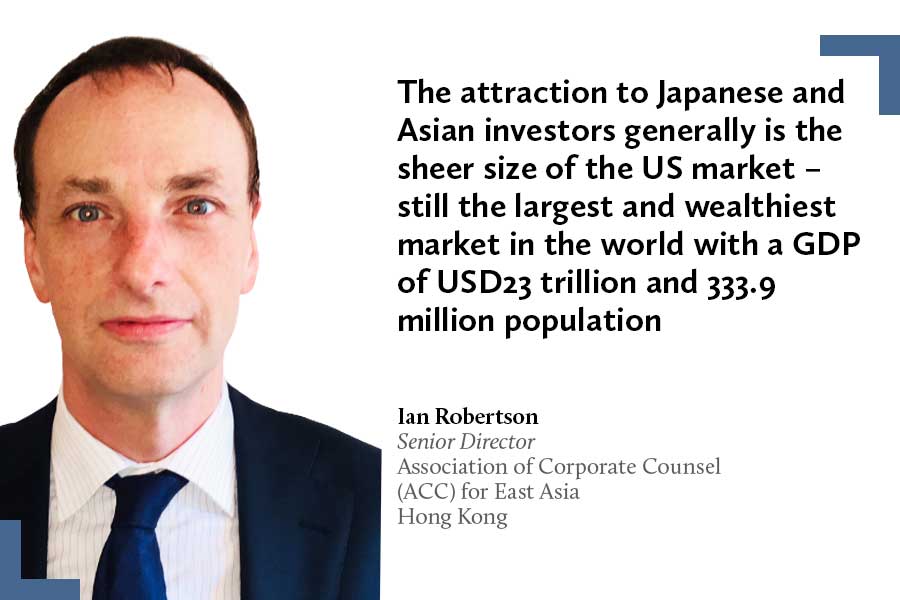
Ian Robertson, senior director of the Association of Corporate Counsel (ACC) for East Asia in Hong Kong, says that the US is still the world’s largest market and is relatively straightforward from a foreign investment point of view.
“The attraction to Japanese and Asian investors generally is the sheer size of the US market – still the largest and wealthiest in the world with a GDP of USD23 trillion and 333.9 million population,” says Robertson. “An added attraction for Asian investors generally is the ability to establish research and development units in the US, which, despite all the rhetoric about China, is still where most of the world’s innovation gets done.”
CHINA’S CHALLENGES
Following a strong year for deals in 2021, China has experienced a modest slowdown in inbound and outbound total transaction value this year. According to data from China’s Ministry of Commerce (MOFCOM), outbound direct investment grew 9% and reached USD145.2 billion in 2021, mainly aimed at the Belt and Road Initiative (BRI) and Asean countries. Meanwhile, investment into the US dropped 30% in 2021 from the previous year, reaching only USD6 billion.
Carl Li, a senior partner at AllBright Law Offices in Shanghai, says the covid-19 situation is restricting travel, and the political tensions are making it very difficult to conduct large-sized transactions in major developed markets.
“Chinese enterprises have found themselves in a progressively complex environment when investing overseas,” says Li. “Regional geopolitical tension continues to bring challenges to global economic momentum.”
Li argues that the pandemic’s resurgence in China has also had an effect on economic growth and the profitability of enterprises. As a result, Chinese enterprises may lean towards caution when investing abroad in the short term. “Nonetheless, overseas markets that have transformational potential are still attractive to Chinese enterprises, such as in the new energy automotive sector,” he says.
In terms of regulation, Li observes that China’s outbound investment policies haven’t changed dramatically in the past 12 months, and the focus continues to be on encouraging companies to do the right outbound transactions in preferred sectors such as healthcare, technology, advanced manufacturing, energy and resources. On the inbound side, stronger GDP growth and the removal of certain investment restrictions have helped sustain and boost FDI.
“To boost FDI amid the crisis, the government of China has revised its negative list, liberalising several more industries for investment, and removing restrictions in others,” says Li. “In addition, the recently released Five-Year Plan and long-term vision for 2035 indicate the government’s intention to ease more restrictions in the near future to boost FDI to pre-pandemic levels.”
Following an easing of regulations as China softens its attitude toward big tech companies, Li anticipates that technology or software and tech-enabled services will continue to lead the way in deal volume.
“Investment and M&A activities related to generic drugs, green energy and data assets are likely to boom, while M&A activity in other sections is likely to slow down or even decrease, especially in highly regulated sectors such as education,” says Li. Beyond global macroeconomic headwinds, Marcia Ellis, partner and global chair of Morrison Foerster’s private equity group in Hong Kong, says China-related transactions are being impacted by the evolving domestic regulatory landscape and the evolution of international regulations and enforcement priorities, with a specific impact on China-related transactions.
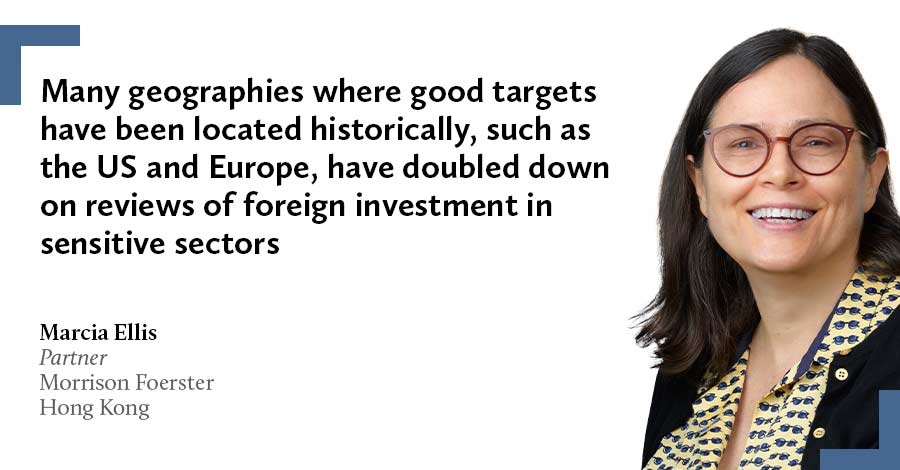
“Looking abroad, geopolitical tensions and the steady rise of national security review regimes around the world have continued to put a damper on outbound activity,” says Ellis. “Many geographies where good targets have been located historically, such as the US and Europe, have doubled down on reviews of foreign investment in sensitive sectors.
“As a consequence, Chinese acquirers are often looking further afield for opportunities in markets like Southeast Asia, the Middle East and Latin America.”
Ellis believes that longer-term investor sentiment across corporate and private equity players active in China remains positive. Strategic M&A transactions in sectors that support China’s national policy directives aimed at decarbonisation, digitalisation and domestic consumption are attractive, as well as investments that can be linked to the general theme of common prosperity.
[ihc-hide-content ihc_mb_type=”show” ihc_mb_who=”3″ ihc_mb_template=”2″ ]
“We have observed significant deals in technology, media and telecoms, healthcare and life sciences, and alternative energy reach completion this year as investors look to enhance market share and deepen capabilities in targeted areas,” says Ellis.
THE SOUTHEAST
Southeast Asia is hailed as an FDI growth engine with inflows up 44% in 2021 compared to the previous year, according to the UNCTAD report. In general, FDI inflow to developing Asia increased by 19% to reach a new high of USD619 billion, driven mostly by East and Southeast Asia. The rise of Southeast Asia was underpinned by strong investment in manufacturing, the digital economy and infrastructure.
Global FDI inflow and outflow had shown improvement in 2021. In Southeast Asia, only outflow from Singapore and Malaysia increased.
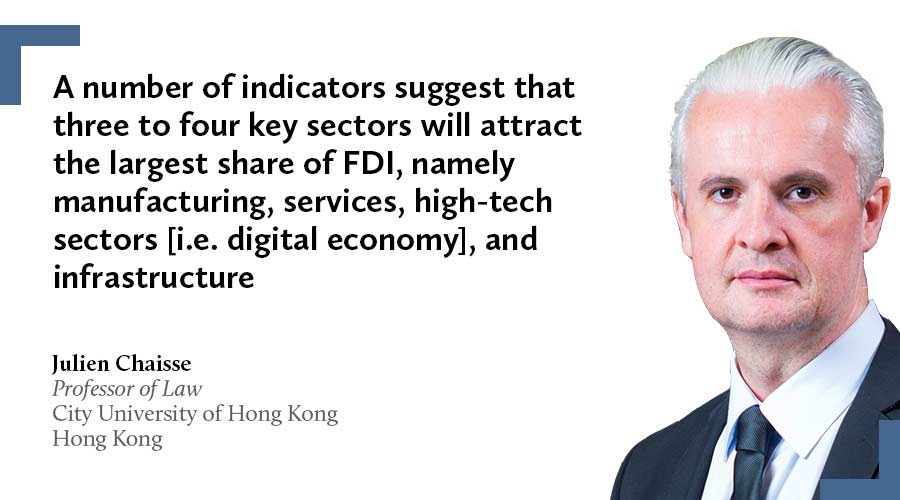
As Asian multinationals represent a good amount of outward FDI and will continue to access more profitable markets in North America, the EU, and within Asia, the City University of Hong Kong’s professor of law, Julien Chaisse, observes that the share of investment coming from developing Asia keeps increasing and will further rise in the next year.
“A number of indicators suggest that three to four key sectors will attract the largest share of FDI, namely manufacturing, services, high-tech sectors [i.e. digital economy] and infrastructure,” says Chaisse. “As for decline, I think two sectors emerge: extractive industries and transportation.”
When it comes to inbound investment, Chaisse sees that Southeast Asia has shown a considerable increase in the past three years, especially Malaysia. “Malaysia has attracted a significant volume of FDI, as have Vietnam and Singapore, but it could attract FDI in semiconductors, which is going to be of considerable importance in the coming years with a significant potential for further expansion,” says Chaisse.
Morrison Foerster Singapore-based partner, Ang Lip Kian, also sees keen interest in acquisition and investment transactions in the technology, payments and data centre sectors in Southeast Asia. However, he notes that deals are taking longer to complete as acquirers and investors grow more cautious due to tightening liquidity and broader macro conditions.
As Southeast Asia is a heterogeneous market, Ang suggests an acquirer or investor should have access to legal advisers with strong local expertise and awareness of on-the-ground developments in relevant markets.
“Deal terms will likely turn more buyer-friendly if current market conditions persist or worsen,” says Ang. “For example, we have seen investors asking for more aggressive liquidation preferences or, in the case of convertible note financing, more information and governance rights and higher discount rates upon conversion.”
Ceferino Rodolfo, vice chairman and managing head of the Philippine Board of Investments (BOI) in Manila, is optimistic that the Philippines will breach its pre-pandemic FDI inflow this year. The consistently strong macroeconomic fundamentals of the country, coupled with recent liberalisation reforms through amendments in the Retail Trade Liberalisation Act, Public Service Act and Foreign Investments Act, are the key drivers.
The central bank, Bangko Sentral ng Pilipinas, recently released its final FDI inflow of the Philippines for 2021, which was USD12.41 billion, up from 2020 at USD6.8 billion.
“The bulk of the equity capital placements in 2022 was sourced from Singapore, Japan, the US, Hong Kong and Germany,” says Rodolfo. “These were channelled mainly to manufacturing, electricity, gas, steam and air-conditioning, financial and insurance, and real estate industries.”
In the past five years, the top country sources of BOI-approved foreign investment were Singapore, China, Malaysia, the Netherlands and South Korea.
INDIA’S WALLS
Rapid growth in investment from China accompanied by a deteriorating political relationship in the past few years has brought about the formalisation of the national security screening process in India. Press Note 3 was issued by the Indian government in 2020 to restrict FDI from neighbouring countries.
“Earlier foreign investments were scrutinised from a national security perspective on a selective basis,” notes Santosh Pai, a partner at Link Legal in New Delhi. “Direct or indirect investment in Indian companies from countries sharing a land border with India will require approval under Press Note 3.”
Following the ban placed on more than 200 internet applications from China, it is likely that Chinese investment in the digital economy will attract more scrutiny. However, Pai believes that investment from private companies in China in the manufacturing sector, especially with significant employment generation potential, are unlikely to be impacted. Joint ventures with Indian companies accompanied by a transfer of essential technical know-how will also be welcome.
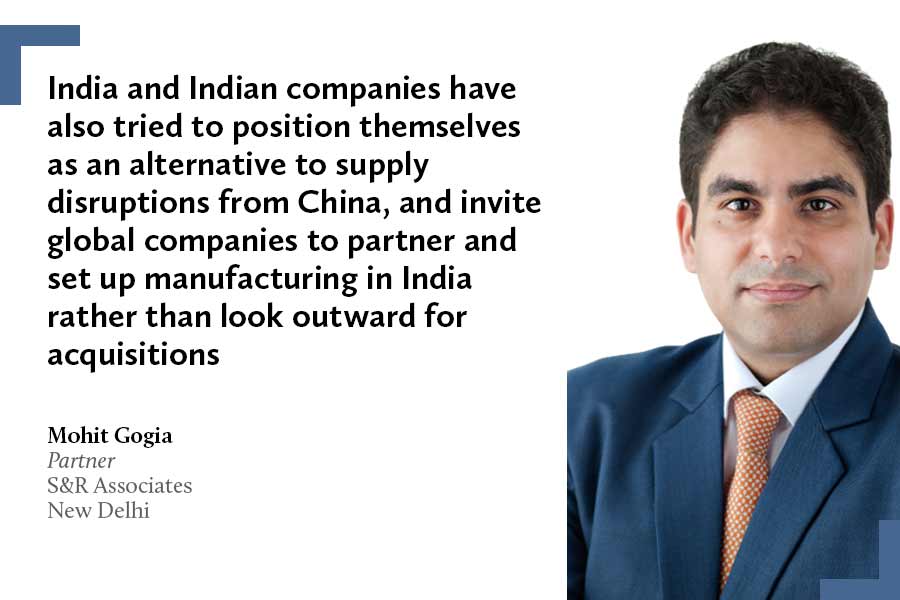
While Press Note 3 covers investment in India where the beneficial owner is situated in, or is a citizen of, a bordering country, Mohit Gogia, a partner at S&R Associates in New Delhi, notes that it does not elaborate on how the beneficial ownership test is to be calculated and applied, and no clarity has been issued to date.
“India and Indian companies have also tried to position themselves as an alternative to supply disruption from China, and invite global companies to partner and set up manufacturing in India rather than look outward for acquisitions,” says Gogia.
“At the same time, big Indian conglomerates have always been interested in good overseas assets, but the impact of interest rates on global debt markets has impacted some of these transactions.”
In terms of regulatory development, one of the most significant changes, according to Gogia, is the new overseas investment rules for cross-border transactions that have liberalised Indian companies from investing in overseas companies with underlying Indian operations. Previously, no Indian company was allowed to make a financial commitment to a foreign entity that has invested in India. The rule now means that such commitment does not require approval from the Reserve Bank of India if the investee involves less than two levels of subsidiaries.
Pai, of Link Legal, agrees that the liberalisation of the overseas investment rules will certainly encourage outbound investment, and notes notes that FDI in India has been registering steady growth despite the pandemic.
As India always seeks benefits from investments by multinationals looking to diversify and build resilience into their global supply chains, Pai advises general counsel aiming at the Indian market to pay attention to India’s new fast-track negotiations on bilateral free trade agreements (FTAs), which have resulted in FTAs with the UAE and Australia. “Several more FTAs with countries such as the UK, Canada and the EU are expected,” says Pai. “Such FTAs will also boost the appetite among Indian companies for outbound investments.”
THE US MOOD
Following the launch of the Indo-Pacific Economic Framework for Prosperity (IPEF) in May, the Biden administration demonstrated its intent to pursue a US-centric approach to global trade. South Korea seems eager to respond, especially after president Yoon Suk-yeol encouraged companies to invest in the US, as observed by Lee Junsang, managing partner at Yoon & Yang in Seoul.
“As is the case in many other countries, politics and the economy in Korea are highly intertwined, and the new administration is openly pledging to be both pro-business and pro-US,” says Lee.
While US companies see foreign investors as alternative sources of funding with better economic terms, Carl Valenstein, a partner at Morgan Lewis & Bockius in Boston, sees certain foreign investors, particularly from China, find that these investments are useful to build their own domestic market while acquiring technology, products and talent abroad.
However, with the increasing scrutiny of the Committee on Foreign Investment in the US (CFIUS), foreign investors need to consider how they’re funding the investment, who owns and controls it, and whether any other foreign government, indirectly referring to many state-owned companies in countries of concern, is involved.
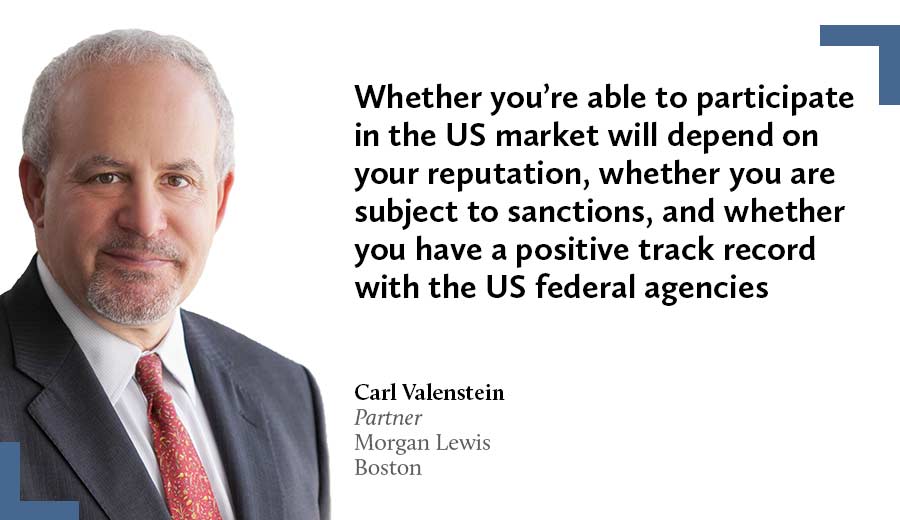
“Whether you’re able to participate in the US market will depend on your reputation, whether you are subject to sanctions, and whether you have a positive track record with the US federal agencies,” says Valenstein. “What we’re seeing now under the Biden administration is increased use of federal assistance as a means of ensuring domestic production and supply.”
A recent example is the Creating Helpful Incentives to Produce Semiconductors (CHIPS) and Science Act 2022, which offers almost USD53 billion in grants for the US semiconductor industry and up to 25% in investment tax credits for capital expenses for semiconductor manufacturing and related equipment, with some caveats. Any semiconductor company that receives federal financial assistance is required to notify the Department of Commerce and seek clearance of any significant transactions involving the material expansion of semiconductor manufacturing capacity in China, and certain other countries of concern.
The ACC’s Ian Robertson observes that this move has attracted Asian semiconductor companies to invest in the US, signalling global demand for the next couple of years. “Given the current supply-chain issues with semiconductors, it’s become apparent to the US government how dependent their manufacturers are on semiconductor supply chains in the Far East,” says Robertson. “It’s not going too far to say that congress sees this as a national security issue for the US, as something like 75% of world semiconductor production comes from East Asia.”
South Korean leading semiconductor companies Samsung and SK Hynix are already re-evaluating their existing facilities in China as the act restricts companies receiving US federal funds from expanding or upgrading their advanced facilities in China for 10 years.
For general counsel aiming at the US market, Robertson highlights antitrust as a key area where investors should be particularly careful. Transactions with a value of USD101 million or less are not subject to merger control under the Hart–Scott–Rodino Antitrust Improvements Act, but could still be subject to non-competition merger control laws.
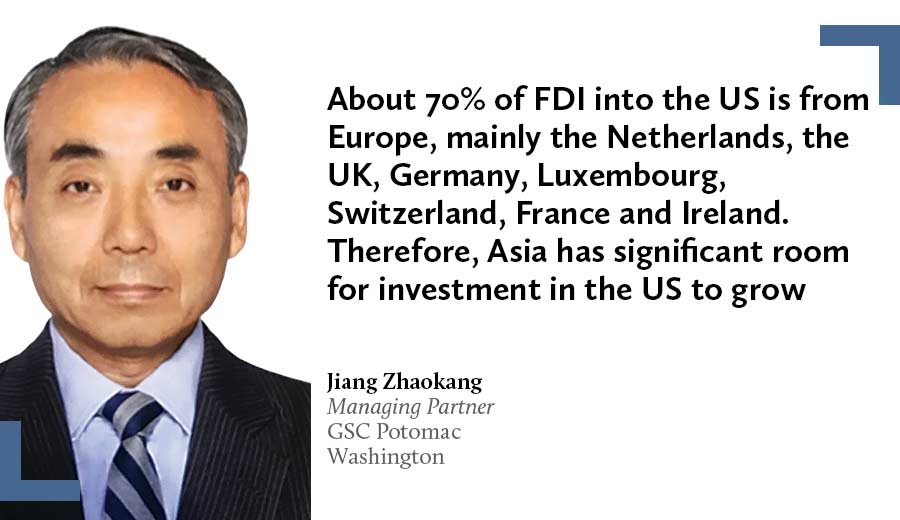
Although Japan is the major source of Asian investment coming to the US, followed by South Korea and China, Jiang Zhaokang, managing partner at a global supply chain and trade legal service firm GSC Potomac in Washington, says that such inflow is by no means remarkable. “About 70% of FDI into the US is from Europe, mainly the Netherlands, the UK, Germany, Luxembourg, Switzerland, France and Ireland,” says Jiang. “Therefore, Asia has significant room for investment in the US to grow.”
NATIONAL SECURITY
To “strengthen and modernise” the national security review of FDI transactions by the CFIUS, the US Congress passed the Foreign Investment Risk Review Modernisation Act (FIRRMA) in 2020, with mandatory filing requirements related to US critical technology companies, among other things. Although this security concern is seen as aimed primarily at Chinese investors, Robertson argues that this is no longer the case as Chinese investments have triggered few submissions of CFIUS notices or transaction reviews in recent years.
“It may be argued that the CFIUS in this respect has achieved its goal as it has deterred Chinese investors from making US investments that are in any way sensitive,” says Robertson. “Any Asian investor looking to make an investment in the US, where they may be able to exercise some form of control on the target business entity, and where US national interests are seen to be involved, will have significant CFIUS challenges.”
The key focus of the FIRRMA and the implementing regulations is on investment by foreign persons in critical technology, infrastructure and sensitive personal data, where even a non-controlling investment can trigger CFIUS filing requirements.
As regulatory scrutiny continues to affect Chinese acquisitions, Li, of AllBright Law Offices, sees Chinese investors may consider minority investment and strategic collaboration as a starting point to help address regulatory concerns and to obtain more opportunity, time and space to find the right target.
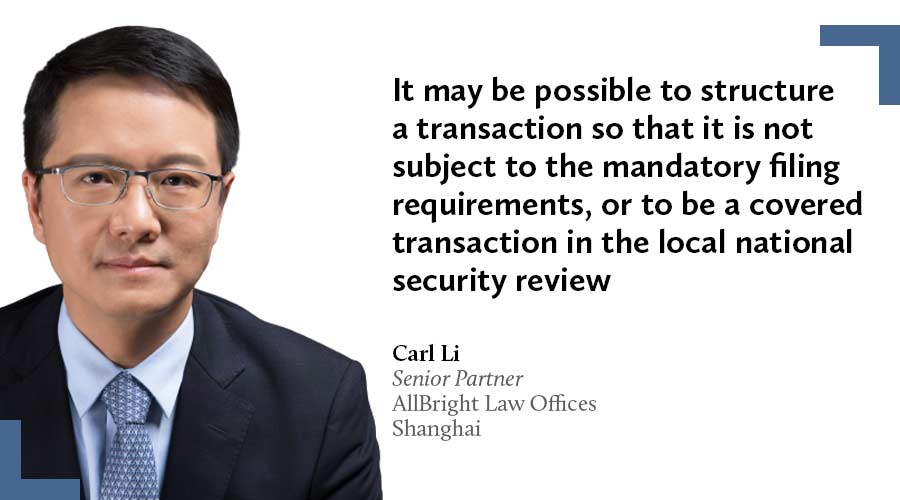
“Deal-wise, contractual language shall be included to address any potential national security review,” says Li. “Various strategies may be developed to address the concerns. For instance, it may be possible to structure a transaction so that it is not subject to the mandatory filing requirements, or to be a covered transaction in the local national security review.”
Li adds that parties can also consider potential mitigation strategies to address any national security concerns, such as adopting special technical security review agreements, proxy control, or spinning off certain assets and product lines that present national security issues.
Screening mechanisms are being developed throughout the world, and Chaisse, of the City University of Hong Kong, believes there is a fundamental trend of most states toward a reassertion of sovereignty. In this respect, states develop mechanisms that allow better control of FDI.
“National security also is a manifestation of unilateralism, as there are no universal definitions of that national security,” says Chaisse. “There is a real concern from a legal perspective to the multiplication of national security disputes leading to rejection of FDI and, perhaps later on, international disputes that could go to investment arbitral tribunals and perhaps the WTO.
“In any case, the trend that sees national security law and policy development is here to stay,” says Chaisse, adding: “I believe it will define the characteristics of domestic investment policies for 10 years to come.”
[/ihc-hide-content]