



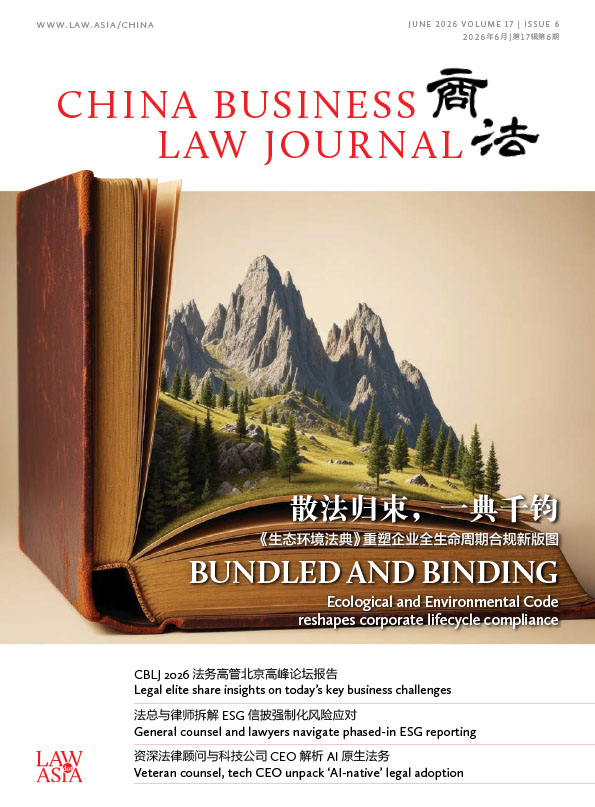

In the article titled “18A listings amid a more nuanced regulation” (China Business Law Journal, volume 17, issue 6), the authors examined regulatory focus in Hong Kong’s chapter 18A listing regarding review priorities including core product qualification, R&D capabilities, use of proceeds, IP control and sophisticated investors.
Expanding on that topic, this article explores from a project execution standpoint how applicants can translate these requirements into concrete preparation and establish a robust evidentiary chain for core product eligibility before filing.

Partner
Jingtian & Gongcheng
Demonstrating core product qualification requires anchoring in specific products, R&D stages and regulatory pathways. During preparation, applicants should systematically compile clinical approvals, ethics clearances, protocols, trial sponsors, endpoints, enrolment data, primary results, safety profiles, regulatory meeting minutes and filing communications to fully reconstruct the product’s development trajectory.
For collaborative projects, applicants must clarify their actual involvement, such as participation in clinical design, data analysis, registration communications or product optimisation, and whether these arrangements are sufficient to support the company’s control over ongoing R&D and commercialisation.
For in-licensed or acquired assets, the focus shifts to whether the company has continuously invested resources post-acquisition to drive further R&D progress. Accordingly, transaction documents, R&D arrangements, IP ownership and follow-on investments should be audited early in the project lifecycle.

Partner
Jingtian & Gongcheng
R&D continuity is vital for proving a continued focus on core product development. Applicants must substantiate R&D momentum using hard facts and figures. Where the reporting period shows a sharp drop in R&D spending, a low proportion of core product expenditure, extended gaps between clinical phases, a lean R&D team, or heavy reliance on contract research organisations (CROs), hospitals or third parties for core work, applicants must prepare well-grounded justifications ahead of time.
Falling R&D spending or shifting clinical phases do not automatically lead to stalled progress. A company may transition into data collation, filing preparation, regulatory talks, protocol amendments, site activation or technology transfer, temporarily lowering direct trial costs.
Crucially, such explanations require robust quantitative analysis and documentary support rather than generalised statements from management.
Accordingly, applicants should disaggregate R&D expenses by product, stage, year and workflow, ensuring that narrative descriptions of R&D progress, clinical timelines, regulatory activities, CRO arrangements and staffing in the business section corroborate the financial figures.
Linking capital investment directly to the product development pathway. The primary objective of chapter 18A listing is to support core product R&D and commercialisation. Consequently, applicants must map their use of proceeds directly to upcoming development plans: showing how funds will support ongoing trials and regulatory filings for clinical-stage assets and detailing the necessity of post-approval studies, indication expansion, overseas filings, process validation or commercial preparations for assets near commercialisation.
Additionally, funding arrangements must align with the product’s current stage, historical R&D spend and future plans. If the core product receives a relatively small proportion of proceeds, or if primary capital is directed towards other pipelines, applicants must prepare well-grounded R&D and commercial rationales.
Clear capital planning not only bolsters chapter 18A eligibility arguments but also helps investors grasp the company’s research priorities and strategic trajectory.
IP issues spanning R&D history, partnership structures and commercial rights demand early analysis. Applicants must demonstrate effective control over the R&D and commercialisation of core technologies. In practice, teams must map the precise correlation between core products and underlying patents, covering protection scope, title origins, inventors and holders, licensing or collaboration terms, commercial rights boundaries and potential restrictions.
For example, if core technologies are in-licensed or co-developed with universities, research institutions or corporate partners, applicants must verify that underlying agreements secure ongoing R&D and commercialisation rights. Where core patents involve joint ownership, pledges, transfer restrictions, buyback clauses or other encumbrances, their potential impact on core product control must also be thoroughly evaluated.
Proactively assembling thorough investor due diligence materials to satisfy sophisticated investor requirements. This mandate is both a core chapter 18A listing condition and a key indicator of market validation for the company’s R&D capabilities and core asset value.
During preparation, applicants should systematically review investor profiles, covering assets under management, healthcare portfolios, investment teams and decision-making structures, inter-entity relationships, investment timelines and amounts, and post-listing shareholding positions.
Where multiple investment entities, industry players or specially backed investors are involved, applicants must articulate the underlying investment relationships and rationales. This ensures that the records convincingly demonstrate investor qualification and validate the company’s market value.
Pre-co-ordinating the intermediary agencies to boost efficiency. As chapter 18A projects span complex domains, including clinical trials, regulatory filings, finance, IP and investor relations, successful preparation demands early, collaborative alignment across multiple professional advisers.
Applicants should mobilise sponsors, legal counsel, IP lawyers, industry consultants, and, where necessary, regulatory consultants at the earliest opportunity to establish a cohesive, verifiable Chapter 18A eligibility case ahead of filing.
Additionally, applicants must maintain strict consistency across core product R&D spending, headcount, clinical timelines, regulatory schedules and use of proceeds. Where projects involve complex R&D histories, joint development arrangements or intricate commercial rights, potential issues should be identified early and robust solutions formulated.
Stella Yeung and Stephen Luo are partners at Jingtian & Gongcheng
 Jingtian & Gongcheng
Suites 3203-3207, Edinburgh Tower, The Landmark
15 Queen’s Road Central
Hong Kong
Tel: +852 2926 9300
E-mail: stella.yeung@jingtian.com | stephen.luo@jingtian.com
www.jingtian.com