













Ben Frumin examines how the vicious cycle of poor remuneration, judicial delays and lack of accountability has bred corruption in the legal establishment, and asks how it can be defeated … and by whom
The charges against him were damning, the proof clear, the scandal well-publicized. And yet, he essentially went unpunished.
It was the early 1990s, and India Supreme Court Justice V Ramaswami was charged with, among other things, spending roughly Rs5 million (US$117,000) of public money on carpets and furniture (purchased from handpicked dealers at highly inflated prices), during his earlier posting as chief justice of Punjab and Haryana High Court. The household goods were supposedly for his official high court residence, but were soon shipped to his personal home in Madras (now Chennai).
As outrage grew, a motion to impeach Ramaswami scored an impressive and unprecedented victory – it obtained the signatures of 100 members of parliament, the threshold needed to initiate impeachment procedures. This was, according to one expert, the first and only time in modern Indian history that this significant hurdle was cleared. But when Ramaswami’s impeachment came to an actual floor vote, members of the ruling Congress Party abstained, and the impeachment movement died a quick death.
[ihc-hide-content ihc_mb_type=”show” ihc_mb_who=”3″ ihc_mb_template=”2″ ]
What happened? Prashant Bhushan, a prominent civil liberties lawyer with a populist bent and a founder of the Campaign for Judicial Accountability & Judicial Reforms, still sounds frustrated as he recalls the episode on a hot afternoon in his small office in the new lawyers chamber at the Supreme Court in Delhi.
“He escaped removal because he had some political deal with the Congress Party,” Bhushan says, emphasizing that even India’s political elite shy away from direct confrontations with judges, whom it’s nearly impossible to hold to account.
“They are fearful,” says Bhushan. “The judiciary operates as a trade union. So if you go after one judge, by and large that judge is able to leverage his connections in the rest of the judiciary to go against the political party or those MPs. All of them have cases pending in the courts. So they’re afraid of what will happen to their cases.”
“People generally think the judiciary is one of the most corrupt institutions in this country,” he continues.
When asked why, Bhushan laughs sardonically. “Because it’s true,” he says. “That’s why people think that.”
A widespread problem
Today, roughly 15 years after the mass parliamentary abstention on the Ramaswami impeachment vote, India’s judiciary still remains largely unaccountable. Corruption, according to many lawyers, is a widespread problem in the country’s judicial and legal systems. It’s no secret that in India “justice” can often be bought or bullied. And while the issue of judicial corruption has grabbed headlines in a recent series of bold stories in one of India’s largest English-language newspapers (see Much ado about nothing, page 20), meaningful reform doesn’t look to be on the horizon.
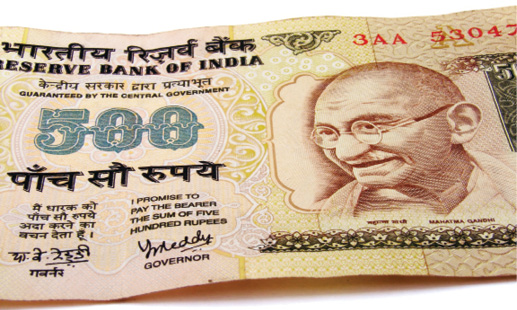
A 2007 report from Berlin-based Transparency International claimed that “bribes seem to be solicited as the price of getting things done” in India’s legal system. The report estimates the amount paid in bribes in India’s lower courts each year was just under US$600 million: 61% to lawyers and 29% to court officials.
“This is simply shocking, and simultaneously an unfortunate state of affairs,” says Priti Suri, the proprietor of Delhi-based law firm PSA. “The Indian judiciary is plagued with corruption, which has been in existence for decades now.”
“It is not easy to quantify, but the fact that some corruption exists is bad enough news,” says Mysore Prasanna, group executive president and head of legal services at the Aditya Birla Group. “It shakes the very faith that people repose in the system. For justice to be seen to have been done, the judiciary, like Caesar’s wife, should be above suspicion.”
Succumbing to temptation
One huge factor that fuels judicial corruption at the lower levels is the comparatively low pay. “The salaries of judges have failed to keep pace with spiralling inflation,” says FoxMandal Little partner Indranil Ghosh. “The judges of lower courts are grossly underpaid, and it is not difficult to understand that they fall prey to easy money when there is a huge difference between [the] remuneration of the judges and the amounts involved in the cases which come before them.”
Suri agrees with Ghosh’s analysis, though qualifies it by noting that while low salaries are an explanation for judicial corruption, they’re hardly an excuse.
“I am not trying to justify corruption,” says Suri. “But the salary structure at the lowest rung of the judicial service is low, and not in consonance with the earnings of the lawyers who stand in front of the judges. As a consequence, judges in the lower court succumb to temptation and it becomes an ongoing vicious circle.”
Another factor, some lawyers say, is the immense workload and subsequent backlog placed before India’s justices, as reported in depth in the June issue of India Business Law Journal. There are more than 27 million civil and criminal cases pending before India’s courts, and India only has approximately 10 judges per million people. That amounts to 20% of the UK’s judge per capita rate, and 10% of that ratio in the US.
“Not even 5% of the cases are decided within five years,” says Bhushan. And that is what drives many parties to try to pay for an unfair advantage.
“Due to the vast number of cases pending in Indian courts, the most common reason why clients bribe court officials and lawyers is for the purpose of ensuring [a] speedy delivery of justice,” Ghosh says. But of course, this strategy works both ways.
“Another reason and a diametrically opposite one, is that accused persons bribe officials and lawyers to delay facing a trial for as long as possible,” Ghosh explains.
“Higher compensation and more benefits, coupled with [the] appointment of more judges to adjudicate the vast number of cases, may play a vital role in stemming corruption at all levels,” says Ghosh.
Lack of oversight
Many believe that India’s judicial and legal corruption isn’t simply a problem that festers in the lower courts at the bottom of India’s legal pyramid, but rather a disease that trickles down from its apex bodies to all the courts below.
The Indian judiciary, says Bhushan, “is very highly corrupt, one of the most corrupt institutions in the country. And the reason is obvious”.
Bhushan says that because the only constitutional law checking the authority of the Supreme Court and high court justices is impeachment, and because “it is virtually impossible to get any judge impeached,” judges at the top of India’s legal system aren’t held to account. This can present major problems, as there’s no judicial oversight body with any real power.
“They know that they can get away with anything, and they have become very corrupt and brazen,” Bhushan says. “They are a law unto themselves.”
In addition, anyone who makes noise about judicial corruption may find themselves in contempt of court. “That is a big problem,” Bhushan says. One of the articles of contempt is scandalizing or lowering the authority of the courts and as a result, any criticism of justices can essentially be viewed as contempt.
Indeed, even the Bar Council of India faced accusations of contempt of court as a result of questions relating to corruption that were included in a survey it sent to lawyers in February.
One important reform in recent years, Bhushan notes, is that if a criticism of a judge is true, that truth can now be used in a person’s defence against contempt charges, where that once wasn’t so.
Still, there are plenty of loopholes. Often, Bhushan says, the same judge who is criticized or questioned is also the one who issues a contempt notice. That’s what happened to Booker Prize-winning novelist and activist Arundhati Roy, a client of Bhushan’s. She was sentenced to a three-month jail term for contempt by the same judge whose earlier order she said, illustrated “a disquieting inclination on the part of the court to muzzle dissent and stifle criticism.” Roy paid a Rs2,000 fine and had her sentence shortened to one day.
Not everyone agrees entirely with Bhushan’s black-and-white indictment of India’s highest courts, however, many lawyers seem to concur with his conclusions, though perhaps less strongly and directly.
“As far as excluding the high courts and the Supreme Court,” Ghosh says, “I feel that it is always easier to catch the smaller fish, even when we all know that the bigger fish may be eating more.”
The honest alternative
So faced with a system that is corrupt (at least at some levels and to some degree) what is an honest lawyer or businessman to do?
Many believe the answer is straightforward: do the right thing.
“The simplest of strategies that anyone can follow is to steer clear of the temptation to ‘speed up’ matters,” Prasanna says. “We must learn to recognize that the system is prone to act sluggishly, and this is not as much by design at it is systemic.
“If you are steadfast in your no-nonsense approach, the system grudgingly admires your clean image and will attend to your work,” Prasanna continues, adding “albeit, putting it on ‘pause’ mode for a while.”
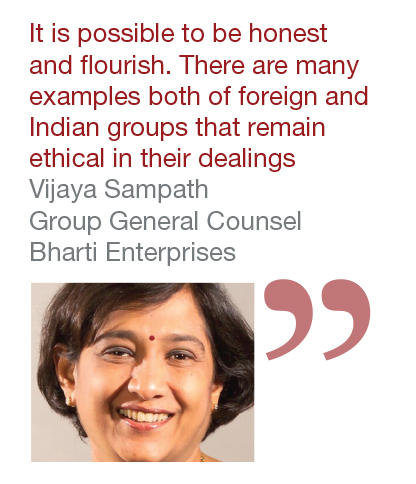
Some large industrial houses are somewhat notorious for playing the shady backroom game. But according to Vijaya Sampath, group general counsel and company secretary for Bharti Enterprises, there are plenty of others like Tata, Infosys and Bharti, that as a matter of stated policy do not offer or pay bribes under any circumstances.
“It is possible to be honest and flourish,” insists Sampath. “There are many examples both of foreign and Indian groups that remain ethical in their dealings.”
“The good thing about corruption is that nobody can force it upon you,” says Ghosh. “You become its victim only when you are willing to participate in it. Contrary to the grim scenario projected by surveys, things can be done in India in a lawful manner sans corruption. There may be delays, but there will not be [a] complete denial of justice.”
Pessimism persists
Although the answers to eradicating corruption appear simple, there are those who remain sceptical about such idealistic appraisals of India’s justice system.
Several lawyers say they’ve confronted plenty of sinking instances of corruption, though most are hesitant to offer details because of confidentiality and reprisal concerns. Among the examples cited of ways corruption may bare its ugly head, are court officials being induced to “misplace” important files, payment allowing for the delay or hastening of a case, or judgments that are so incongruent with the law that they seem to have been purchased.
“I usually lose my cases because of the influence of the companies [and] the big money on the other side,” says an exasperated Bhushan.
Bhushan, like many lawyers, says he can’t produce irrefutable evidence of corruption in such cases. He does offer by way of example, however, a recent case he worked on in which an array of high-powered developers were building shopping malls without the necessary government permission in an area of south Delhi where environmental concerns had earlier sparked a court-supported ban on numerous construction projects. Bhushan challenged the legality of this new development in court. He lost, though legal precedent appeared clearly on his side.
Sighing, Bhushan shakes his head and looks out the window of his Supreme Court office. “I find it very difficult to believe that this judgment was not motivated by extraneous considerations,” he says.
Much ado about nothing
A ‘corruption survey’ by the Bar Council of India has degenerated into a farce of controversy and newspaper headlines
‘Are courts corrupt? Bar wants to know’
‘Bar council chief says corruption survey critical’
‘Demand for open judiciary grows’
With recent headlines like these, regular readers of the Hindustan Times might be forgiven for jumping to the conclusion that there is a groundswell of support in India – led by an emboldened bar council – for tackling corruption in the judiciary. But in reality, that is only part of the picture.
The “corruption survey” referred to by the Hindustan Times is actually a general questionnaire on the state of the Indian legal profession, mailed in February by the Bar Council of India to state bar councils, who were asked to distribute it to lawyers in their jurisdictions. While the survey includes four questions on corruption, they make less than 20% of the survey’s substantive questions. In other words, not exactly what one could call a “corruption survey”.
A ‘scientific study’
The aim of the survey, according to a cover letter from S Gopakumaran Nair (who stepped down as bar chairman last month but still sits on its board), is to remedy the fact that the bar has not yet, “conducted an empirical study and collected relevant data on a national basis for making an authoritative and scientific study as to the present status of the Indian legal profession from various perspectives and angles.”
Nair’s letter calls such empirical data essential, considering the “impending threat or challenge of globalization and consequential attempts of foreign law firms and lawyers [to come] into India”.
The majority of the survey is limited to bland enquiries: name, practice area, annual income, marital status, etc. It also includes questions to determine whether respondents own their own vehicles – and if so, how many wheels they have – and whether their law chambers are computerized or not.
It isn’t until question 24 on the 36-question survey that the respondent is asked for an opinion:
“What is your assessment about the quality and performance of [the] judiciary in your state, particularly in the high court?”
Following that are three questions that pertain to judicial quality and accountability (quoted exactly as they appear on the survey):
“What is your views on the present mode of appointment to higher judiciary. Is it fair and impartial. If not what is your suggestion to make it transparent and fair”;
“What is your views on the judges sitting in the same court centre where their near relatives, like children, nephews, in-laws etc. are practicing”, and;
“What is your views on judicial corruption. Is it rampant in your state and if so the remedies or solutions to be suggested.”
Bar council secretary S Radhakrishnan told India Business Law Journal that while it may take many months and repeated nudging, he expects more than 100 replies. But nearly three months after the bar council mailed the survey, not a single response had been received – a shocking fact considering the barrage of newspaper headlines the survey has generated.
Contempt of court
Furthermore, the mere fact that the bar counsel undertook the survey has landed it with allegations of being in contempt of court.

“This [survey] is a clear affront to the judiciary and action in excess of its jurisdiction,” says B Joshi, a Delhi-based lawyer who filed an application with the Supreme Court in an attempt to have the survey stopped.
The bar council, meanwhile, has turned its attention to the Hindustan Times. In a letter to the newspaper’s chief editor (a letter the bar council requested be run on the daily’s front page), Nair blasts the Hindustan Times for its reportage on the survey’s contents and aim.
“Your daily may have your own policy decisions in public matters, particularly against [the] judiciary,” Nair wrote. “But to make use of a research study attempted for the first time to know where the Indian Bar stand[s], to project your policy is highly unfortunate and is in bad taste.”
So mark it down: while the Hindustan Times has brought the very real issue of judicial corruption into the spotlight, the Bar Council of India appears to be shying away from leading the charge.
**
Stamping out corrupt practices
Many lawyers believe that resignation in the face of suspected corruption is the wrong strategy. When confronted with such situations, they say, it’s critical to take the evidence of malfeasance to the proper authorities.
“When confronted with [a] request for bribery by either the judiciary or their support staff, lawyers must report it to an independent body, who must take strict action against those involved,” says Suri.
If and when a foreign investor confronts such a hurdle, he must immediately meet with the highest authority of the relevant governing department and explain, Suri continues. “There are numerous government officers who are keen to establish that there are honest people in India. We do transactional and regulatory work on a daily basis without any element of bribery.”
Evidence of honesty within India’s legal and judicial system, does exist, and in the past, such institutions have taken strict measures to clamp down on corrupt activities.
“If a foreign investor has concrete proof that its Indian counterpart has indulged in bribery or any other corrupt practice in getting a deal through, the foreign investor has the right to approach the courts and take action against the erring entity,” explains Ghosh. “Indian courts have been known to come down heavily on corrupt entities in the past.”
Ghosh also notes that the Indian Penal Code defines and provides specific punishments for bribery and corruption among public servants, which is also dealt with in the Prevention of Corruption Act.
“At the end of the day, it is all about enforcement. Weak enforcement machinery will ensure that the rampant corruption will stay,” says Suri.

Calls for reform
That’s why the best strategy for dealing with corruption in India’s judicial and legal systems, according to lawyers and activists alike, is to reform them.
“Lawyers should actively encourage and support changes in the civil and criminal procedure codes so that the ability of the litigants to seek delays and unnecessary adjournment is eliminated,” Suri says.
Another measure of progress would be reforms to the contempt of court rules so that parties who suspect corruption could voice their thoughts without fear of imprisonment. Bhushan suggests that perhaps India might adopt a US standard for contempt, which essentially sets the bar at clear and present danger to the administration of justice rather than India’s standard of lowering the authority of the court.
“Except for stray cases in the high court and the Supreme Court [none of which were pursued to conclusion], no judge has been indicted on corruption charges, mostly due to lack of proof and fear of contempt charges for making allegations without being able to sustain and prove these charges,” says Sampath.
A necessary reform, some say, is an institutional mechanism other than ineffective impeachment to scrutinize allegations of corruption against higher judges. Also important, Bhushan says, is to overturn a 1991 Supreme Court judgment that says no higher judge can be investigated on criminal charges without the consent of the country’s chief justice.
Stand up and be counted
While these macro-institutional reforms would certainly go a long way towards reducing corruption and increasing transparency and accountability, many lawyers believe that what’s more important is for a mass movement among those who work in the legal and judicial sectors to reform their behavior on an individual level.
“The only manner in which lawyers and clients can minimize corruption is to completely stop offering bribes or any type of inducement to any judicial officer,” says Sampath. “This needs a change in thinking and attitude, which will take time and effort.”
”Lawyers need to think more [about] the interest of the client,” Suri adds, “and not their vested pecuniary interest when the litigation is prolonged.”
YP Chhibbar, general secretary of the People’s Union of Civil Liberties, says that such changes must trickle down from above. “If the seniors or the players in charge are honest, it can directly appeal to them and may succeed at times to block corrupt practices,” he said. “There is always a possibility to check or eliminate corrupt practices. It would be a farfetched idea to claim that all deals by foreign investors were possible only after satisfying corrupt pockets.”

Changing ingrained habits like this is not easy. It requires tremendous will. “There are very few lawyers or retired judges who are willing to take a stand on this issue,” laments Bhushan.
An emerging markets problem
Of course, corruption is not a problem limited to India’s judicial and legal sector, nor is it a problem that’s confined to India.
“It’s an emerging markets problem,” says Chris Flosi, legal director of Barclays Capital in Singapore. “It’s not [only] an Indian problem.”

Suri is quick to note that the West also has its share of corruption problems, although “the numbers are much bigger there, while in India a subordinate clerk will accept a bribe of 100 rupees easily”.
Corruption, while not absent from the private sector, certainly seems to be more prevalent in the Indian government than elsewhere in the country. Ghosh believes this is because the government “is a mammoth setup” with lax supervision, so it’s easy to avoid getting caught.
“Moreover, the regulatory framework is in the hands of the government and it gives them a sort of a monopoly,” he says.

It often seems that everyone in India has at least one story of small-time bribery, be it obtaining a driver’s licence without passing the required test, adjusting electricity meters to avoid clocking heavy usage, or paying off police officers for ignoring any number of offences.
Upon arriving in India for the first time in 2006, your reporter was asked to pay a bribe to a police officer at Mumbai airport. The officer held out his hand and muttered, “Baksheesh, baksheesh. I’m a good Christian.”
His request was politely declined.
[/ihc-hide-content]