












How the government selects law firms for infrastructure Projects. By Vandana Chatlani
The Indian government is often described by infrastructure lawyers as a poor paymaster. In line with its lowest bidder wins (L1) policy, it tends to put price at the forefront of its selection process when instructing legal consultants for infrastructure projects. Thus it comes as no surprise that so many law firms shy away from government work altogether.
Some take on such mandates because representing the government lends prestige and credibility. But to earn the title of a government adviser, lawyers often need to slash fees – a move that may become commercially unviable.
Partners who prefer to spend their time on high-paying endeavours quickly pass the work on to associates, leaving the government with an inexperienced team to see a transaction through. When legal questions and conflicts arise, who is to blame?
[ihc-hide-content ihc_mb_type=”show” ihc_mb_who=”3″ ihc_mb_template=”2″ ]
How low can you go?
Price wasn’t always the government’s primary focus. A Balasubramanian, of counsel at J Sagar Associates, recalls how different the government’s appointment system was in the early days of public-private partnerships (PPP) during his time at IDFC. IDFC was engaged mainly to assist with financing for infrastructure projects, but only in the private sector.
“We were asked by the government to prepare model concession agreements for national ports and highways and we also helped prepare bidding documents for the selection of investors in the early days of PPP projects when bankability was important,” he says. “Selection was on the basis of competence in understanding sector issues and project complexities. They engaged us directly because they were convinced by the strategic fit of their bankability objective with our mandate.”
The L1 policy evolved after the PPP project process had been tried and tested in India and repeated in different parts of the country. “L1 comes from the centralized domain of the Comptroller and Auditor General, which sits like an umbrella over all industries,” says Badrinath Durvasula, the vice president and legal head at Larsen & Toubro. “No one can give up that model unless a special ordinance is issued.”
For engaging legal advisers, “the L1 policy is absolute nonsense,” says Munish Sharma, a partner at Dua Associates.
“I’ve seen firms charge US$5,000 for a matter they would ordinarily bill at US$30,000.” Sharma says such firms cannot recover their costs, but sign up for projects and then fail to deliver, thus jeopardizing the government’s position. Despite this, the same firms continue to return and be selected, says Sharma, “because the system is designed to promote incompetence”.
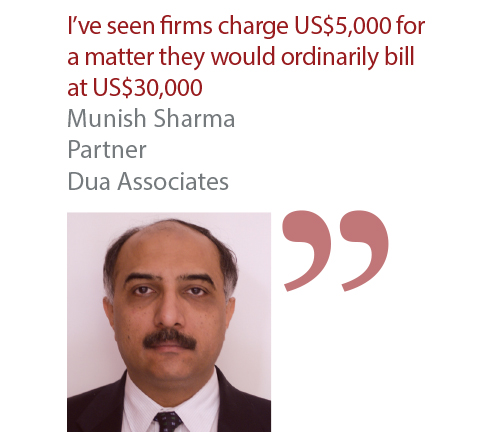
One solution, he says, could be to eliminate the highest and lowest bidder and go with the median bidder, because this would dissuade firms from charging ridiculous rates. “This could also guarantee senior-level participation because a partner will see it as worth their time and effort,” he says. “As the Singapore premier once said, ‘If you throw peanuts, you’ll only get monkeys’.”
“To some extent, we ourselves are to be blamed,” says Atul Sharma, the managing partner of Link Legal India Law Services, referring to the price wars between law firms. “We are undercutting each other without taking into account the economic rationale of these quotes.”
He points out that state governments such as Gujarat are less stingy than the central government and pay reasonably well.
“We don’t do a lot of work with the central government because of their L1 process,” he says. The firm occasionally takes on work for entities such as Power Finance Corporation and Rural Electrification Corporation, but he says this is to bolster credentials rather than for economic benefit.
“Frankly speaking, it’s a sham of a process; there is no honesty,” he says. “It’s a completely skewed and cockeyed approach. They try to shortlist law firms on technical grounds but they inevitably choose the lowest bidder regardless of the capabilities demonstrated by the other bidders. I don’t think it’s a fair process at all.”
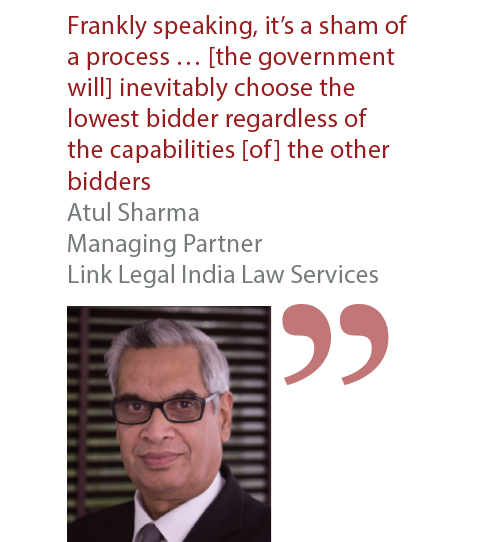
He jokes: “I always tell them, when you need surgery, do you go to the best doctor or the cheapest doctor?”
Is bigger better?
The government’s eligibility criteria are another sign that its approach may be flawed. In many instances, law firms can only qualify for the first round of bidding if they meet a certain threshold in terms of their annual turnover and the volume of projects they have handled in the past. This automatically knocks out smaller law firms and experts who may possess the qualifications and experience needed for a job.
“Today, the government is looking at how many deals you’ve done, the size of those deals, your sector experience and how recently you did the work,” says Balasubramanian. “Just because you worked on a large deal does not mean you understand the nuances of a deal, and although you may have worked in a few sectors doesn’t mean you know those sectors because you may only have worked on the documentation.” Similarly, he says deals completed in the last five years do not hold much relevance unless the scenario of the current project is the same.
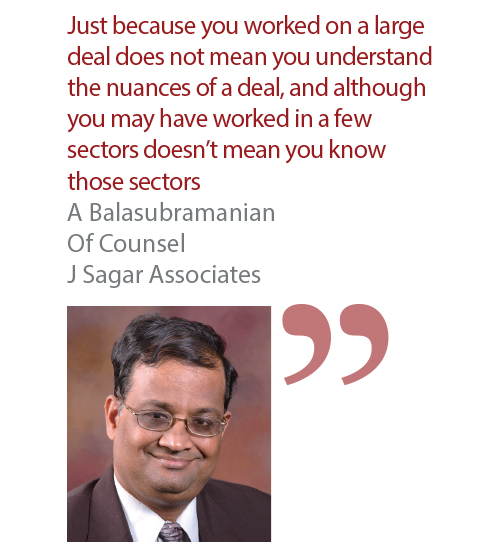
Because non-lawyers on the government side are judging technical competence, they may have a limited appreciation of the subtleties of a project. In addition, they may not have the experience to assess claims made by law firms about domain or sector expertise and could make poor choices by favouring firms with a large turnover and high deal volume.
Sujjain Talwar, a co-founding partner at Economic Laws Practice, stresses the importance of relevant experience. “A water project can’t be equated with power and transport,” he says. “It’s a very different ball game. Water is … not something you can just switch off if people don’t pay. There are significant constitutional right-to-life issues connected with water, which may not be the case with electricity.”
He adds: “Forget how rich or poor you are as a firm, the government needs to look for lawyers with innovative ideas on how to make a project work.”
Another frustration cited by many firms is pretence in the bidding process. Lawyers report submitting proposals for government mandates only to realize later that those roles have already been assigned to their competitors.
Box-ticking exercise
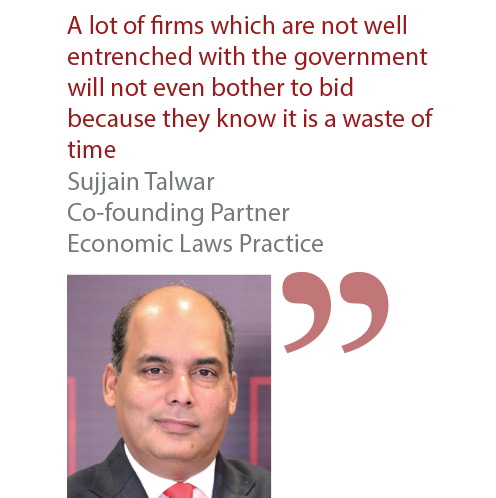
“Some of the [requests for proposal] for the Commonwealth Games, for example, were so tainted in favour of firms the government had preselected,” says Talwar. “A lot of firms which are not well entrenched with the government will not even bother to bid because they know it is a waste of time. We have been asked for our income tax records … what bearing does this have on the lawyering that is needed? They should be asking about our professional indemnity cover.” (See The private selection process, page 38).
“Most of the government’s RFPs are kind of tailor made to suit larger firms,” says Sunil Seth, a partner at Seth Dua & Associates. “The thresholds eliminate mid-level firms straight away, even though those firms may have more area or sector expertise. Railway bids, for example, are designed so only a few large firms can qualify.”

Scoring on skill
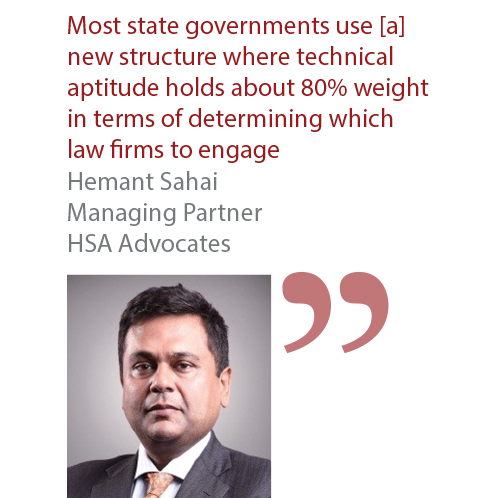
Hemant Sahai, the managing partner at HSA Advocates, insists that the government has changed its approach and is less driven by cost than in the past because it realized that low fee structures seemed to correlate with inadequate services. This, he says, led the Planning Commission to draft model request for proposal and request for qualification documents for technical, financial and legal consultants, a process that was approved by the Cabinet Committee for Infrastructure. “By and large, most state governments use this new structure where technical aptitude holds about 80% weight in terms of determining which law firms to engage,” says Sahai.
In its second edition of the model RFP for the selection of legal advisers, published in 2014, the Planning Commission specifies that “proposals should finally be ranked according to their combined technical and financial scores … 70% for the technical bid and 30% for the financial bid”. According to the Planning Commission, the applicant with the highest combined score should be selected. If two or more proposals have the same score in the final ranking, the proposal with the higher technical score should be ranked first.
Sahai provides a list of projects for which HSA has scored highly on technical capability. These include ultra mega power projects in Odisha and Cheyyur; an elevated rail corridor project in Mumbai; the development of Vizhinjam International Deepwater Multipurpose Seaport in Kerala; the Mahanadi Port project in Odisha; and the development, operation and maintenance of four airports including Chennai.
In addition to achieving the highest technical score on almost all of these bids, Sahai says, “in each of these cases we have never bid the lowest fee”. However, in one instance, he says HSA qualified on technical merit, but lost out on the bid because a firm which achieved a lower technical score was willing to charge one-third of the legal fees HSA had quoted.
While the process of assessing bids may have improved, as Sahai attests, many law firms with technical expertise still find that they have been sidelined because a rival firm quoted a lower fee.
The private selection process
Badrinath Durvasula tells India Business Law Journal how he shortlists law firms for infrastructure matters
Having handled a wide array of infrastructure assignments for companies such as Reliance Industries, Great Offshore and Lloyds Steel, in his position as vice president and legal head at Larsen & Toubro, Badrinath Durvasula has developed his own matrix to assess and select the right legal advisers. He considers four key factors in his selection process: subject matter expertise, track record of success, partner-to-associate ratio, and cost.
Knowledge is power
Law firms may showcase their credentials and capabilities, but for Durvasula, it is crucial to focus directly on the partner who will be spearheading the transaction. “I don’t take the claims of the firm,” he says. “I want to know which partner will handle my matter and how well versed they are on the subject, as well as their tenacity and dedication to a project. Infrastructure projects frequently span a long gestation period, so I need to know who will stay committed and really deliver the goods.”
Attitude versus outcome
The government tends to approach a firm’s track record from the perspective of how much income a firm has generated from infrastructure projects and the number of projects it has handled. For Durvasula, this kind of success isn’t crucial. “We don’t mind engaging a firm which has lost in a race, as long as they have proven that they have fought hard and thought strategically about winning,” he says. “Vodafone’s investment in India is an example – the law firms advising on this matter have all gained and lost at some point, so it’s necessary to consider the skills and competency of these firms along with the ability and bandwidth they have to handle the length and breadth of infrastructure operations.”
Partner time
Poor partner visibility is a constant concern for in-house counsel. To mitigate the risks of finding himself stuck with inexperienced junior associates, Durvasula asks for details of who will be working on his matter. “Firms may claim to be big, but the partners who promised to be by your side sometimes dedicate very little time,” he says. “I expect to speak to a partner throughout the duration of the deal, or at least their first-level senior associate. So I’d ask for the structure of their pyramid or at least who will be on their team before deciding which firm to engage.”
Money matters
The bottom line for most in-house counsel is ensuring value for money. “The cost of legal services will either facilitate or impede my process,” says Durvasula. “I don’t mind loosening my purse strings, but I also don’t want to be robbed.”
–
Room for improvement
Most lawyers argue that the model for selecting legal advisers for infrastructure deals requires re-examination.
At the same time, Balasubramanian says the government must move away from price to value and allocate a fair amount for lawyers’ fees to attract bids for high-quality advice. “Law is the last element of the race,” he says. “If the last person in the relay race runs badly, all the good work done by the previous team members will go to waste.”“One shoe doesn’t fit all feet,” says Balasubramanian. “Finally what prevails is the legal document. You need someone who understands the issues of the particular sector, be it roads, ports, etc., plus an interdisciplinary perspective, because without this, there can be inconsistencies between intentions and outcomes in the contract.”

Seth says the government could consider combining the expertise of several firms to fulfil its infrastructure goals, particularly for the development of smart cities. “Why not have a consortium of two or three Indian firms?” he asks. “The government has stated it will develop 100 smart cities in India over the next 10 years. These are huge projects requiring expertise on real estate, land issues, construction, roads, water, transmission lines, technology, etc. There is so much work involved – no one firm can claim to be an expert in all these areas.” Working alongside other firms, however, would require cooperation within the legal community, which seems impossible at a time when rivalry in the profession is at a peak.
In addition to working together, Durvasula says law firms engaged by the government must lose their rigid outlook. “Law firms selected by the government tend to have an alignment with the government’s thought process,” he says. “They don’t counter the government – that’s a mindset that needs to change. They need to correct the government’s myopic view.”
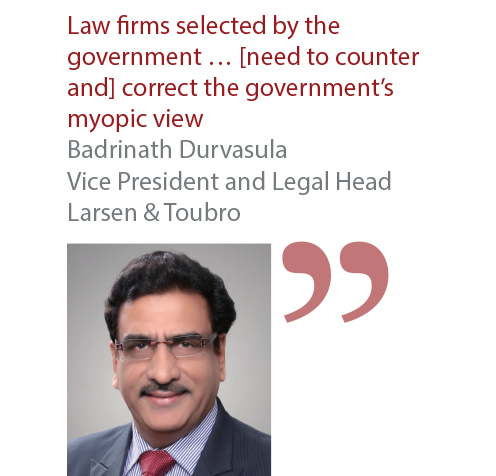
Durvasula says the government should encourage law firms to actively engage and provide independent opinions from both sides of the fence. “It’s not about who is the big fish,” he says. “Infrastructure is for the public good and a consultative arrangement is in the best interests of the government and the public.”
[/ihc-hide-content]