







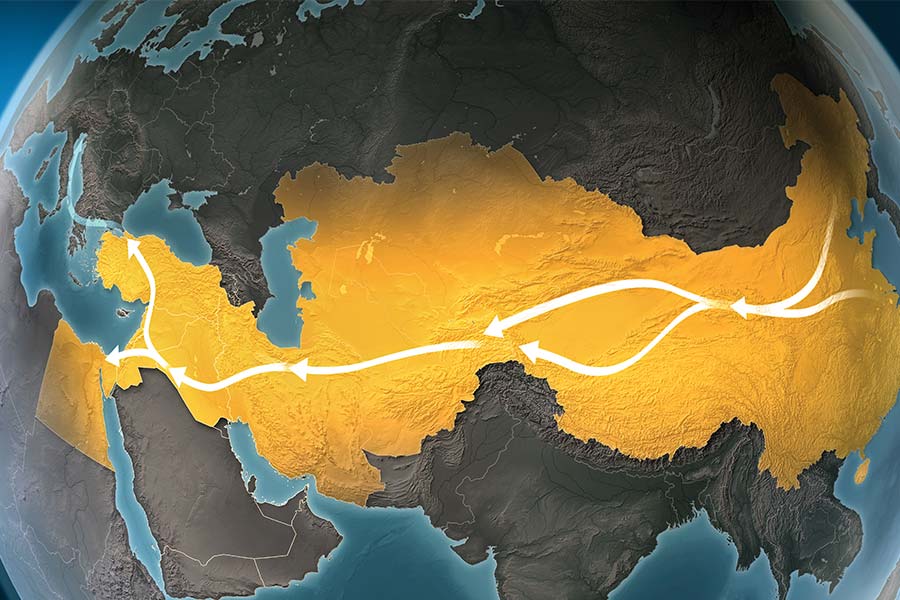





A changing global geopolitical environment and China’s ambitious investment strategies are bringing resource-rich countries of Central Asia, the Middle East and North Africa closer to Beijing
China’s rise as a global investor has had a massive impact on countries around the world as they seek to diversify their sources of foreign direct investment (FDI), especially in critical, capital-starved sectors such as infrastructure, energy, resources and construction.
The biggest sectors for Chinese investment have been energy, infrastructure and construction. Transport is a pillar for construction, with rail projects getting the most money and roads seeing the most deals.
Chinese investment in Asia and Oceania has risen steadily from USD5.7 billion in 2005 to USD60.5 billion in 2020, and the ambitious Belt and Road Initiative (BRI) has been the big engine of China’s outbound investment.
Chinese investments under the BRI have remained robust, although flat on a year-on-year basis through the pandemic, with the total value of contracts signed by Chinese enterprises reaching USD59.5 billion in 2021 compared with USD60.5 billion in the previous year, according to data from the Ministry of Commerce (MOFCOM).
Until 2020, Asia and Africa accounted for more than 80% of the business, with 56% and 26.6% of the newly signed contracts, and 57.2% and 24.6% of the completed turnover, respectively.
In 2021, Asian countries received 35%, the largest share of Chinese investment. However, African and Middle Eastern countries picked up an increasingly large share of Chinese engagement, up from 8% in 2020 to about 38% in 2021. Arab and Middle Eastern countries, particularly, increased investment by about 360% and construction engagement by 116% compared to 2020, MOFCOM data show.
President Xi Jinping, in a 2017 address, noted: “In pursuing the Belt and Road Initiative, we should focus on the fundamental issue of development, release the growth potential of various countries, and achieve economic integration and interconnected development and deliver benefits to all.”
Central Asia, the Middle East and North Africa have been key geographic areas of strategic interest for both the central government and businesses. Foreign contracted projects covered a wide range of sectors including transport construction, general construction, power engineering and the petrochemical industry as the main fields, and newly signed contracts and completed turnover both accounted for more than 75% of the total.
China is also an important strategic ally to countries in the region, given that it is one of the largest consumers of resources and oil, which are economic mainstays of these economies. While several of the countries in the region embraced the BRI, others have sought to maintain strong business and government-to-government relationships with China.
Central Asia
The Russia-Ukraine war in 2022 and associated Western sanctions imposed on Russia have developed new dynamics in the region.
“China is effectively the only alternative to Russia, therefore, China becomes even more important for countries of Central Asia as the major market for export of goods from Central Asia (e.g. oil, gas, and agriculture projects) and major investor, lender and supplier of goods and technologies,” says Marina Kahiani, a Kazakhstan-based partner at law firm GRATA International.
“Chinese businesses, both SOEs [state-owned enterprises] and private companies have even more opportunities in the energy sector including renewable energy, in the oil and gas sector, in public infrastructure (airports, roads, etc.), in the financial sector, in agriculture and industry in Central Asia,” she notes.
“The BRI scaled up China’s investment in infrastructure in Central Asia, however so far Chinese banks and companies have neglected the public-private partnership (PPP) as a specific mechanism available under the current legal framework, mainly because Chinese SOEs opted for special arrangements with local governments instead of participating in open tenders. Lately, however, Chinese companies have started considering PPPs.”
Saniya Perzadayeva, the managing partner of Unicase Law Firm in Kazakhstan, says the transit role of Kazakhstan may strengthen as political instability worldwide and sanctions may pave the way for unprecedented amounts of goods being transported through the country.
“As Kazakhstan goes towards low-carbon development and green economy policies, we assume investments into the renewable energy sector will be welcomed by the Kazakhstan authorities,” says Perzadayeva. “In addition, Kazakhstan has untapped potential in the agricultural sector, and further investments may provide for the export of agricultural goods into China and beyond, diversifying Kazakhstan’s economy.”
Chinese companies have outstanding experience in infrastructure development in Kazakhstan as investors, clients and contractors, and China and Kazakhstan have long-term mutual economic relations based on a shared commitment, she adds.
Perzadayeva says her firm has identified four sectors of increased attention for investors in 2022 – healthcare, big tech, solar power and IPOs. The most interesting legal practice areas in Kazakhstan would be finance, trade, energy and natural resources, oil and gas, nuclear energy, transportation and logistics, fintech, crypto, and IT.
The gradual shift towards PPP projects has come at a time when all governments in the region have enacted enabling legislation. While Tajikistan has had a PPP law since December 2012, Kazakhstan’s PPP law dates back to October 2015. Uzbekistan adopted PPP legislation more recently in May 2019, while Turkmenistan and Kyrgyzstan introduced legislation in June and August last year, respectively.

“Public-private partnerships have an adequate institutional and legal framework in Kazakhstan,” says Perzadayeva. “Chinese investors do not normally use public-private partnership mechanisms as investment tools compared to loans and direct investments. Therefore, implementing public-private partnerships can be viable long-term tools for infrastructure projects in several sectors of the economy,”
[ihc-hide-content ihc_mb_type=”show” ihc_mb_who=”1″ ihc_mb_template=”2″ ]
Yelena Manayenko, a partner and head of M&A at AEQUITAS law firm based in Almaty, Kazakhstan, says: “In our opinion, currently the most interesting and actual practice areas for Chinese companies in Kazakhstan are subsoil use, energy, project financing and investment, and M&A.”
Arman Bigazin, a partner at Haller Lomax in Nur-Sultan, Kazakhstan, points out that traditionally Chinese companies have been interested in subsoil use operations in Kazakhstan such as oil and gas exploration and production, and acquiring companies with subsoil use contracts.
Of late, however, “there has been some interest in banking services – the Bank of China and Industrial and Commercial Bank of China have subsidiary banks in Kazakhstan,” he adds. “However, we think they mainly work with Chinese companies operating in Kazakhstan and facilitate export-import operations between the two countries.
“Recently we saw the relocation of Chinese crypto-mining business into Kazakhstan. However, due to regulations imposed by the Kazakhstan government, the businesses are now facing hurdles.”
Perzadayeva says: “As Kazakhstan emerged as a top destination for crypto miners, Unicase was approached by several mining companies from China seeking legal advice for the operation of crypto farms in Kazakhstan. In response, we launched a practice dedicated to the comprehensive legal advisory of crypto enthusiasts seeking business opportunities in Kazakhstan.”
Uzbekistan is another regional economy that has seen increasing Chinese investor attention. Uzbekistan has announced plans to bring the annual volume of Chinese investment to USD5 billion by 2025.
In the past five years China has ranked as the biggest trading partner of Uzbekistan, with a share of 17% to 20% of the country’s total annual trade. In total in the past five years, Uzbekistan has received investment worth more than USD4 billion from China.
Ilkhom Azizov, a partner at Azizov & Partners in Tashkent, the Uzbekistan capital, says there has been a visible increase of Chinese investment in the economy of Uzbekistan in the past few years. “At the beginning of this year, there were more than 1,800 enterprises with Chinese investment, of which more than 10% of enterprises are enterprises with 100% Chinese capital,” says Azizov. “China’s share of Uzbekistan’s exports is about 13%, which is mostly agricultural products, minerals and natural gas.
“The main investment activities of enterprises with Chinese capital are the production of building materials (including cement, glass and facing materials), oil and gas, chemicals, pharmaceuticals, textile industries, transport, construction and telecommunications. Chinese companies are investing in areas such as telecommunications and industry, as well as in agriculture, water management and logistics.”
In recent years, dozens of major projects have been completed with the help of Chinese investment in Uzbekistan, including: three branches of the China-Uzbekistan gas pipeline; Peng Sheng industrial park in the Syrdarya region, with over 30 projects; LT Textile International textile factories in Karshi and Andijan textile industrial zone; Ming Yuan Silu glass factory in Jizzakh; and new cement plants such as the Huaxin Cement Jizzakh, and Farg’ona Yasin Qurilish Mollari.
Chinese companies are active in credit financing in the country as well, says Azizov. “Areas of credit financing include highways (auto and railway), power lines and facilities generating electricity,” he says. “The projects are implemented with the involvement of Chinese contractors and labour, equipment and materials. Chinese companies are often involved in projects financed by international financial institutions.”
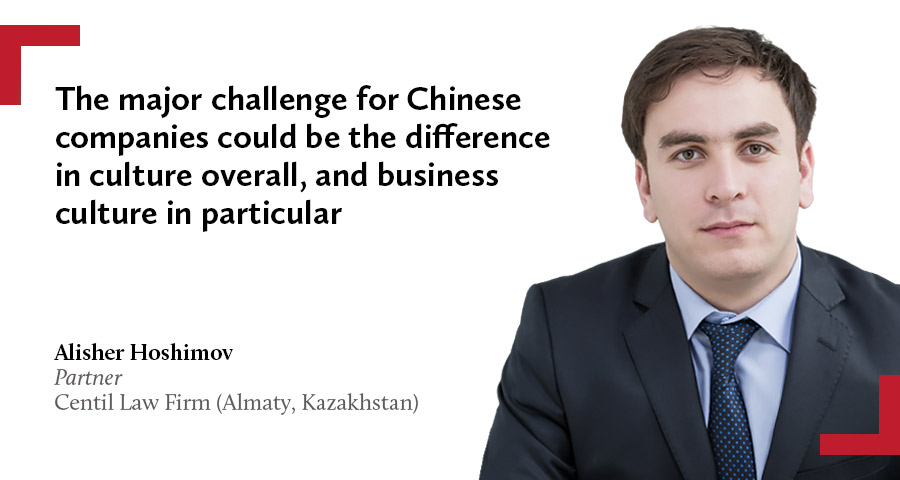
In Tajikistan, Alisher Hoshimov, a partner at Centil Law Firm in Almaty, says Chinese investments are mostly forwarded to mining, agriculture and infrastructure sectors of the economy. “There is also a significant increase in direct investments to local companies and projects,” says Hoshimov.
Azim Ishmatov, co-founder and managing partner of Dushanbe-based ABG Legal Adviser, adds: “Chinese companies are mostly interested in the industrial sector in Tajikistan, particularly in the mining of subsoil assets like zinc, silver, gold, cement, etc.”
[ihc-hide-content ihc_mb_type=”show” ihc_mb_who=”1″ ihc_mb_template=”2″ ]
Middle East and North Africa
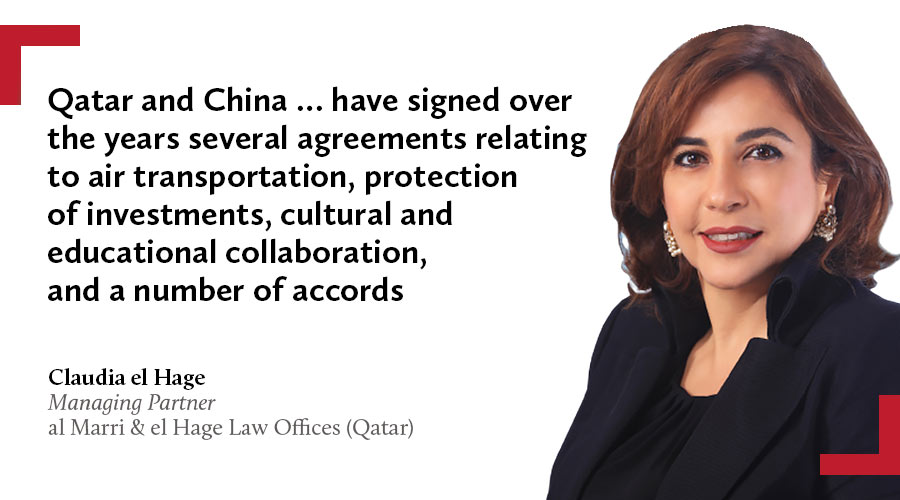
The gas-rich Middle Eastern nation of Qatar has been a major business ally of China for several decades. “The exchange between Qatar and China goes a long way back since 1988,” says Claudia el Hage, managing partner of al Marri & el Hage Law Offices, which has offices in Qatar and Lebanon. “The two countries have signed over the years several agreements relating to air transportation, protection of investments, cultural and educational collaboration, and a number of accords, one of which entailed the formation of a China-Qatar Strategic Partnership,” says el Hage.
“Qatar was the first Middle Eastern country to open a first-of-its-kind Chinese renminbi clearing centre with capital of RMB30 billion (USD4.43 billion), which gives the local financial institutions access to foreign exchange markets and Chinese yuan, and facilitates transactions between China and Qatar, as well as China and Gulf countries and the rest of southwestern Asia,” she says. “This centre also makes new financial products in renminbi currency accessible to Qatar and other Gulf investors.
“There are more than 15 fully owned Chinese companies and 180 joint Qatari–Chinese companies currently operating in Qatar, mainly in the construction industry.”
The areas of co-operation between China and Qatar extend from the export of Qatari gas to China, to joint infrastructure and construction projects.
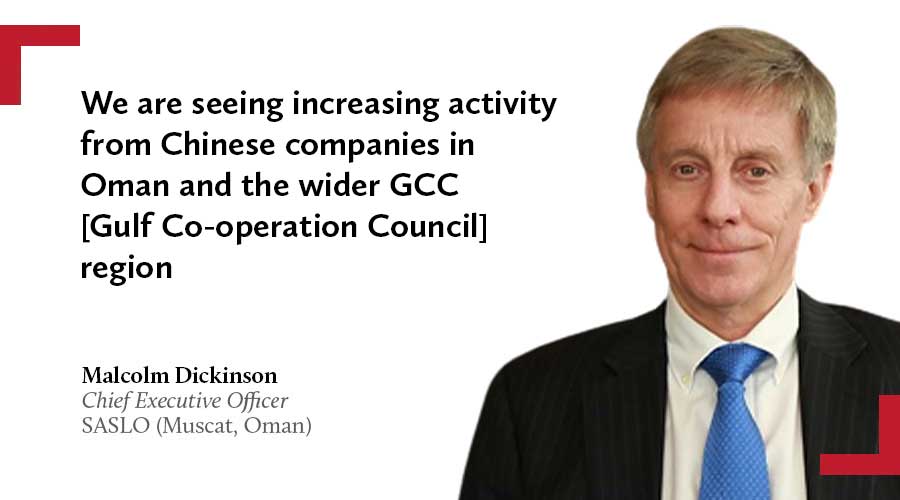
Oman is another Middle Eastern country that attracted significant Chinese investment interest. “We are seeing increasing activity from Chinese companies in Oman and the wider GCC [Gulf Co-operation Council] region,” says Malcolm Dickinson, chief executive officer of Muscat, Oman-based law firm, SASLO. “Clearly, Oman is a strategic destination for inbound investment into North Africa,” he says. “We are seeing Chinese investment in logistics, manufacturing, infrastructure and finance.”
Chinese conundrum
“A lack of cultural understanding on both sides can sometimes slow down or frustrate transactions,” says Dickinson. “In the past few years, Oman had modernised and improved its investment regime to make it much easier and simpler for foreign companies to invest in the country, he says.
Al Tamimi & Company Egypt’s partner, Khaled Attia, says the main challenge is the registration and deregistration of agents and distributors operating on behalf of Chinese companies in the Egyptian market. “Another challenge is the compliance with the requirements of laws and regulations, especially under consumer protection and data protection laws,” says Attia.
“Further, we noted challenges in relation to the notification via diplomatic channels of court proceedings to entities based in China, which sometimes results in substantives delays in the proceedings,” he says.
“The firm has helped Chinese clients operating in Egypt by providing legal assistance in all types of disputes arising with agents and distributors, and also helped explain the requirements of laws and regulations so as to make sure Chinese clients fully comply with the same. Lastly, the firm tailors an action plan to China-based entities to overcome and mitigate hurdles/delays related to notification via diplomatic channels.”
El Hage says that while Qatar laws allow foreign firms and individuals the possibility to directly invest in almost all economic sectors with 100% capital ownership with the pre-approval of the competent authority, Chinese companies do face challenges that are perhaps common to investors in Qatar, including: meeting the legal and regulatory requirements for incorporation and setting up; keeping up and complying with changes in legislation; obtaining licences to bring in labour and employees in accordance with the applicable labour and immigration laws; and recent mandatory insurance coverage for all employees and residents.
He says there are also issues relating to contractual performance delays, payments, extensions of deadlines, variation orders, bank guarantees and environmental regulations. Language barriers for both non-Arabic and non-English speakers and associated cultural differences are another issue that many investors face. The official language is Arabic, however most of the contracts and communication over projects are in English.
Bakhyt Tukulov, a partner at Tukulov & Kassilgov Litigation in Kazakhstan, says Chinese investors usually face issues with understanding local rules and regulations, as well as language issues, which sometimes lead to serious regulatory risks.
“Usually, regulatory risks may be seriously mitigated with the involvement of legal counsel at an early stage,” says Tukulov. “Establishing internal compliance and controls may be an important factor to mitigate risks. We have helped clients mostly within the litigation and arbitration context. Good understanding of the client’s business and knowledge of local practices allows us to properly articulate the client’s position.”
Unicase’s Perzadayeva says document legalisation is a considerable challenge that requires local expertise, and may require up to two months for each document to be legalised. “Also, Chinese companies face translation issues as there is a certain lack of qualified translators,” she says.
“Lastly, opening bank accounts may be a rigorous process as bank compliance standards require disclosure of ultimate beneficial owners. When it comes to the solutions, to legalise the documents, we work with the Kazakhstan Embassy in China to ensure a faster and easier legalisation process.”
AEQUITAS’ Manayenko says the long consideration of approvals for transactions by state authorities is worthy of mention, but this issue is always resolved. “In case of difficulties in interaction with state bodies, the issue is often solved by complex structuring of transactions and the introduction of intermediate Kazakhstani companies into the structure,” he says.
Azizov says Uzbekistan, has its own unique set of challenges. “The first problem is the lack of a strong judiciary, which is often replaced by a significant role for administrative bodies,” he says. “The second problem is the lack of simple and accessible information about the procedures and rules for making investments, for example, a very complex system of benefits and preferences, and an even more complex and inconsistent system of taxation.
A lack of stability in the investment regime, complicated access to bank financing, an over-regulated market for basic commodities, and ongoing administrative procedures are other issues investors face. “But it should be noted that in the past three years, the state has managed to significantly simplify the procedures that have accumulated in the past 25 years,” he says.
“The main interest of Chinese companies entering the market under such projects lies in the legal support of their temporary presence in the country until the completion of the project. These are traditionally requests for permanent establishments, labour imports, licensing and regulatory advice.
“The number of such requests grew steadily before the pandemic, but in the past two years the dynamics of investment projects have somewhat decreased. We hope that the interest of Chinese companies in investment projects in Uzbekistan will be restored.”
Hoshimov, of Centil, says the Tajik government guarantees equal rights and protection of investment to local and foreign investors. “The major challenge for Chinese companies could be the difference in culture overall, and business culture in particular,” he says. “Local regulations are quite similar to regulations throughout the Central Asian region.”
Ishmatov, of Tajikistan’s ABG, says most of the challenges faced by Chinese investors are due to their late appeals for legal support. “Chinese companies try to resolve any challenge that appeared firstly by themselves, and they only contact legal firms when there is a dispute and/or problem,” he says. This may occur for reasons including a lack of knowledge on local laws, absence of an in-house lawyer in the company, and language challenges, and can lead to the imposition of penalties by state authorities, which might lead to misunderstandings.
“Our Chinese partners should consult with local law firms and get legal support during their whole operation,” he advises.
[/ihc-hide-content]