







As China sharpens its counter-sanctions toolkit, foreign businesses must balance on wires stretched between East and West. Luna Jin reports
“When the winds of change blow, some build walls, others build windmills.” This Chinese proverb illustrates the delicate dance multinational companies (MNCs) now face as China tightens its legal defences against foreign sanctions. With the rollout of new implementation regulations under its Anti-Foreign Sanctions Law (AFSL) in March 2025, China has laid down a more structured, if still politically charged, framework for retaliating against what it deems discriminatory foreign measures.
The Regulations on the Implementation of the Anti-Foreign Sanctions Law represent the latest addition to China’s increasingly sophisticated counter-sanctions framework. Over the past five years, the country has methodically built a triad of legal instruments to respond to foreign pressure: the Anti-Foreign Sanctions Law, the Unreliable Entities List and the Rules on Counteracting Unjustified Extra-Territorial Application of Foreign Legislation and Other Measures.
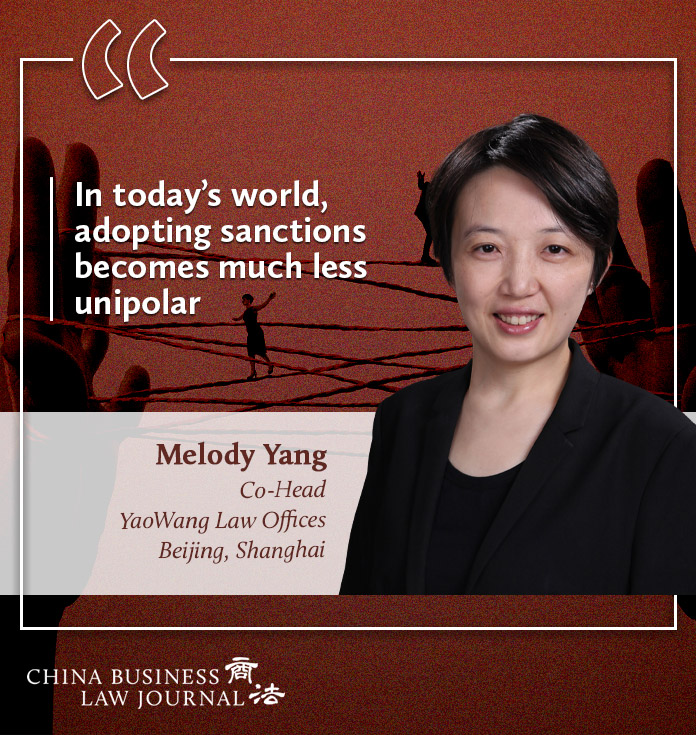
As Melody Yang, a co-head at YaoWang Law Offices in Beijing and Shanghai, puts it, “In today’s world, adopting sanctions becomes much less unipolar.”
For foreign businesses deeply entrenched in China, the moment calls for both agility and foresight. The new rules are not merely symbolic – though symbolism abounds – but also have real teeth and their enforcement is already reshaping corporate risk calculations in boardrooms from Beijing to Brussels.
From sabre-rattling to strategy
Although the language of China’s AFSL and its implementing regulations is notably stern, Kang Yingjie, a Beijing-based partner at Fangda Partners, notes their enforcement has so far been measured.
“The Chinese government remains relatively cautious,” he says, especially in applying these laws to foreign commercial entities.
Kang says current countermeasures primarily target US defence firms involved in arms deals with Taiwan, as well as entities perceived to be meddling in China’s internal affairs, such as in Hong Kong, Xinjiang or Tibet.
Yang of YaoWang echoes this assessment. She says the nature of these countermeasures is “responsive and defensive rather than aggressive”, led by ministries also tasked with driving economic development.
Yet, the list of tools available to regulators is far from toothless. As Shi Wei, a partner at Cyan Law Firm in Beijing, outlines, the new regulations empower authorities to impose a wide range of restrictions: from visa denials and deportations to asset freezes and bans on participating in entire sectors such as education, science or tourism.
Article 6 of the regulations even opens the door for intellectual property seizure – a chilling prospect for tech giants such as Microsoft with deep R&D roots in China.
Targets of these countermeasures are not limited to these companies. They may include senior executives and ultimate beneficial owners. Given this broad applicability, Yang advises that “it’s essential now to look carefully at the exact orders issued by the Ministry of Foreign Affairs or the Ministry of Commerce” to determine who is sanctioned and what specific measures are in place.
Another significant aspect of these regulations is that the threat of sanctions, more than their actual use, is becoming a geopolitical lever.
This “strategic ambiguity and the threat of punitive measures”, as Shi calls it, can influence corporate behaviour even without active enforcement.
While much focus remains on state-level targets and their signalling power, the implications for private sector actors, especially foreign investors, are no less significant.
Yang notes that the extraterritorial reach of China’s countermeasures is particularly relevant to foreign firms investing in or partnering with Chinese entities. She advises clients – mostly funds and financial institutions – to conduct rigorous anti-money laundering checks and continuously monitor counterparties. If a counterparty becomes subject to China’s countermeasures, Yang urges firms to review “the exact order” and seek professional legal advice before acting. Depending on the situation, the appropriate response could range from “ceasing the transaction” to “initiating a mandatory redemption” or even applying an asset freeze.
Compliance in the crossfire
For MNCs operating in China, the regulatory landscape has become a minefield. The new rules directly challenge foreign sanctions laws, creating a legal paradox for businesses that must comply with both US and Chinese frameworks – often in conflict.
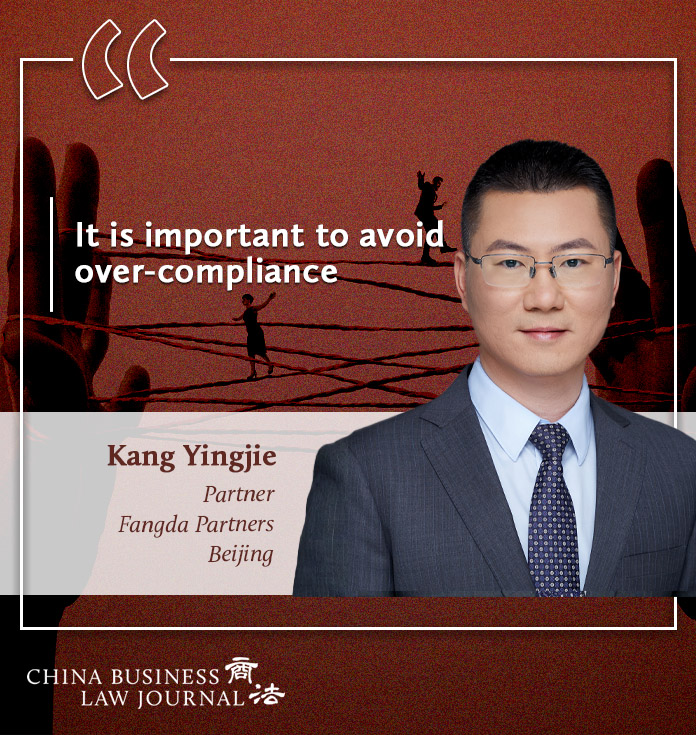
“It is important to avoid over-compliance,” warns Kang. He advises MNCs to comply with foreign laws only to the extent necessary and avoid exceeding those obligations, which could trigger authorities’ enforcement.
His observation reflects a growing trend: MNCs doing business with China are increasingly prioritising compliance with China’s anti-sanctions regime, revising internal policies accordingly.
The sectors most exposed include technology, defence, finance, logistics and professional services – industries at the intersection of strategic value and international legal entanglements. Kang identifies the most pressing risk as “how to deal with Chinese business partners who have been listed as specially designated nationals”.
Reflecting this heightened focus, Shi says that companies he works with, especially Chinese state-owned enterprises and foreign MNCs, have developed “robust contingency plans” that are both proactive and scenario-driven, “anticipating not only direct penalties under the law but also the broader strategic uncertainty it creates”.
[ihc-hide-content ihc_mb_type=”show” ihc_mb_who=”1″ ihc_mb_template=”2″ ]
These plans cover a range of risk scenarios:
- Compliance risk. Unclear definitions of “discriminatory restrictive measure” leave companies guessing. Shi describes this “legal limbo” as forcing foreign firms to establish internal firewalls and case-by-case protocols. He suggests cross-functional sanctions compliance teams involving legal, risk, supply chain and executive leadership to oversee policy developments, monitor legal developments and co-ordinate incident responses.
- Asset risk. Article 7 of the regulations expands the list of assets potentially subject to seizure, including intellectual property, which has real implications for innovation-heavy firms.
- Supply chain risk. Sanctioned suppliers or partners can halt operations. Companies should assess exposure to high-risk jurisdictions, customers, partners and suppliers; identify choke points in business processes and legal obligations that may be affected by sanctions from either side; and stress-test their procurement strategies.
- Reputational risk. Being caught in geopolitical crossfire can attract unwanted publicity and investor anxiety. Shi recommends crisis communication strategies and stakeholder engagement frameworks.
When signing contracts with overseas partners, Shi says companies should clarify compliance with Chinese laws and regulations. If there is a conflict between foreign sanctions and China’s anti-sanctions rules, companies may need to include clauses that allow for exceptions or further negotiation.
Since Chinese companies can sue others for helping enforce discriminatory measures, he says, “It is necessary to re-evaluate and amend the dispute resolution, governing law, termination clauses, breach of contract clauses, etc.”
To navigate these complexities, companies are turning to structural solutions. One approach Shi recommends is corporate compartmentalisation: creating legally distinct subsidiaries that can comply with local laws without exposing the entire global operation.
He also suggests separating decision-making across jurisdictions. For example, letting a US-based team handle sanctions-related decisions independently of Chinese operations.
In addition to structural changes, Shi emphasises the importance of proactive regulatory engagement. He suggests that MNCs prepare for potential investigations by engaging proactively with regulators across jurisdictions. This may include seeking informal guidance or legal exemptions, which, he says, “can pre-empt enforcement action and demonstrate good faith compliance.”
To better understand their obligations and manage risks, Shi also recommends obtaining independent legal opinions from both Chinese and foreign counsel, allowing companies to “make risk-informed decisions” based on a clearer view of the legal landscape.
Best practices are emerging from global players such as HSBC, which Shi cites as a model. The bank uses scenario planning, localised compliance policies and advanced sanctions screening to mitigate risk. Employees receive regular training, and the bank frequently updates its technology to detect high-risk transactions.
“The goal is to isolate legal obligations by jurisdiction, reducing the risk of extraterritorial enforcement,” says Shi.

A door left ajar
A quieter yet significant component of the new regulations, complementing stipulations of the AFSL, is a formal remedy mechanism. This process allows sanctioned entities to apply for the suspension, modification or cancellation of penalties. While the broader regime is often viewed as rigid and politically charged, relevant clauses suggest a degree of procedural flexibility and, at least in theory, offer affected parties a way back into compliance.
Shi of Cyan describes it as a “behaviour adjustment mechanism”, one that encourages sanctioned entities to correct their conduct and eliminate the consequences of their actions. Applicants must submit facts and legal arguments to the relevant State Council departments, demonstrating meaningful steps taken to address the reasons for sanctions.
Still, he cautions that the practical effectiveness of this mechanism remains uncertain. “Transparency, judicial independence and geopolitical considerations” will all influence the outcome.
Kang of Fangda says that Chinese authorities appear receptive to such applications, at least when there is a shift in strategic context.
He cites ViaSat, a US satellite communications company sanctioned in early 2024 for supplying weapons to Taiwan. The penalties included asset freezes and a ban on co-operation with Chinese entities. By July, however, the Ministry of Foreign Affairs lifted sanctions “based on changes in the circumstances that warranted the sanction”. While no official explanation was provided, the move was widely interpreted as a pragmatic decision to protect Chinese firms relying on ViaSat’s services.
Nevertheless, Shi warns that a remedy is unlikely in politically charged cases, especially where national security or diplomatic reciprocity is at play.
“For now, entities subject to sanctions should temper expectations, as there are very few cases and the outcomes will be likely to hinge more on national interests than procedural rights.”
For Chinese companies, the new regulations mean greater empowerment to challenge foreign sanctions in Chinese courts.
Complementing article 12 of the AFSL, article 18 of the new regulations grants Chinese citizens and entities the right to sue in Chinese courts for damages and to stop the infringement of their rights if harmed by foreign discriminatory measures.
In a landmark application of China’s AFSL in October 2024, the Nanjing Maritime Court accepted the nation’s first tort lawsuit against a foreign entity for complicity in third-country sanctions. A Chinese marine contractor sued a foreign firm after it withheld USD11.86 million in funds, citing third-country sanctions. Following a pre-trial ruling of a vessel arrest and court clarification on sanction-compliance risks, the parties reached a mediated settlement within just 39 days.
As geopolitical friction intensifies and countermeasures mature, this case no doubt foreshadows a new front in the global sanctions battleground, with more similar cases likely, enriching China’s tools of commercial counterstrike.
The tightening of the country’s counter-sanctions regime is not merely a legal manoeuvre – it is a geopolitical chess move. As the US, the EU and China weaponise trade and law alike, the private sector is caught in the middle, forced to reconcile conflicting rules, jurisdictions and national interests.
The lawyers we spoke to all agree: This is a moment for strategic clarity, not panic. The rules are evolving, the enforcement is selective and the consequences – though serious – can be managed with the right structures, policies and foresight.
But the tightrope is getting thinner. And the wind is picking up.
[/ihc-hide-content]