








LinkedIn
Facebook
Twitter
Whatsapp
Telegram
Copy link

As China’s appetite for energy increases, so does its desire for sources that will alleviate a traditional reliance on foreign oil. Vanessa Ip reports on the quest for alternative energies

The world’s largest energy consumer’s reliance on foreign oil resources continues to increase at a rapid pace, prompting an acceleration in its global quest for sustainable, reliable and affordable energy. In 2016, it is predicted that China’s energy consumption will increase alongside higher demand for non-fossil fuels.

“In comparison to the traditional energy sector, Chinese capital has clearly shown much greater interest in renewable energy assets globally,” says Xiong Jin, an international partner at King & Wood Mallesons (KWM) in Beijing. “They are looking for good assets in major jurisdictions such as Australia, Europe, North America and South America. The recent acquisition by State Power Investment Corporation (SPIC) of Pacific Hydro is a telling case. These Chinese investors are looking for new growth opportunities overseas.”
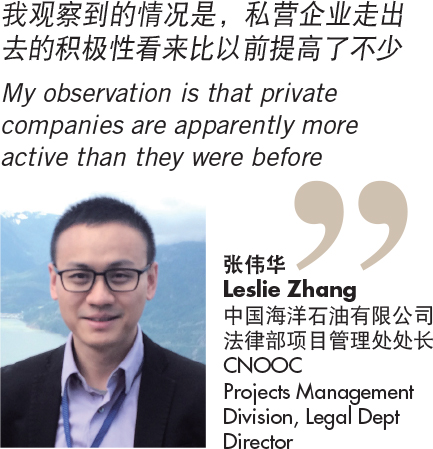
Power hungry-Leslie Zhang

China is the world’s largest investor in clean energy. But Leslie Zhang, an experienced corporate counsel, believes that despite major strides in renewable energy development and investment, Chinese state-owned oil companies have reduced outbound investment in the clean arena due, in part, to low oil prices and the central government’s tightening supervisions on state-owned enterprises.

[ihc-hide-content ihc_mb_type=”show” ihc_mb_who=”1″ ihc_mb_template=”2″ ]

“Personally, I think few people know how long the low oil prices will last,” says Zhang, a director at the projects management division of the legal department of China National Offshore Oil Corporation (CNOOC). “Chinese companies are being cautious about investment decisions and most are cutting expenditures. But at the same time, companies continue to look closely at the market, and if they see any good opportunities they will go after them.”

While state-owned oil companies are somewhat reluctant to invest overseas, Zhang has noticed the private sector is playing a more important role. “My observation is that private companies are apparently more active than they were before. Last year, they made more than US$3 billion of investments in oil and gas transactions overseas,” he says.

Distressed energy and commodities markets have not stopped Chinese investors from going overseas. According to Xu Ling, a partner at Guantao Law Firm in Beijing, the implementation of “one belt, one road” initiatives have offered some significant opportunities around the world for Chinese enterprises.

Brazil

Practitioners are seeing an increase in Chinese investment in the Brazilian electric energy sector, in projects ranging from upstream oil and gas projects to power plants and transmission. In the past decade, all four major Chinese energy companies – CNOOC, China Petroleum & Chemical Corp (Sinopec), Sinochem Group and China National Petroleum Corporation (CNPC) – have entered into the Brazilian upstream oil and gas market.

Power hungry-Pedro Freitas

In July 2015, State Grid won the concession to build and operate what will be Brazil’s longest transmission line, and in the power generation sector China Three Gorges Corporation (CTG) succeeded in an auction held by the Brazilian government in November 2015 to find new operators for 29 hydropower plants with expired or nearly expired licences.

According to Pedro Freitas, a partner at Veirano Advogados in Rio de Janeiro, “Chinese investors contemplating entering the Brazilian market in general should consider that doing business in Brazil requires basic understanding and compliance with a comprehensive set of statutes and regulations, more so in regulated sectors such as energy and natural resources. In particular, careful tax review and planning are essential before committing to an investment in Brazil due to complex tax legislation that provides for the application of different taxes at each of the three levels of government [federal, state and municipal].”

Valdo Cestari de Rizzo, founder and corporate partner at Lobbo & de Rizzo Advogados in São Paulo, warns: “As to mining and oil and gas sectors, Chinese investors should be aware that there is an ongoing discussion to significantly alter the main regulations in force in Brazil. In this context, it is important for the Chinese investor to be diligent [during] this transition period.”

Power hungry-James Hosking

James Hosking, a partner at boutique dispute resolution law firm Chaffetz Lindsey in New York, has been involved with disputes arising from Chinese investment into the energy and natural resources sectors in Latin America. “In Brazil, most of the disputes we see arise out of Chinese misunderstanding of the complicated regulatory environment in Brazil,” he says. “Chinese investors often have unrealistic expectations that they will be able to structure investments to avoid Brazilian local content requirements, local labour requirements, and protection of environmental and indigenous rights. Partnering with an experienced local player helps to minimize those risks, as does good local legal advice.”

Canada

According to partners Gregory Peterson, Frank Sur and Thomas Timmins, at Gowlings in Calgary, Canada is the sixth-most-popular investment destination in the world for renewable energy, with much of this activity increasingly stemming from China.

While there has been little direct Chinese investment in Canadian renewable energy projects, China is still a central player as a major supplier of equipment to project developers, particularly in the solar energy field, says Eugene Chen, a partner at McMillan in Calgary.

“The Canadian clean or renewable energy industry is attractive to Chinese investors because the Canadian government supports the industry through favourable tax treatments for research and development and the establishment of two funds for the development and demonstration of innovative technological solutions in clean technology,” he says.

The renewable energy industry in Canada is a dynamic and evolving sector, in which companies face a broad range of legal issues. According to Craig Spurn and Seán O’Neill, partners at McCarthy Tétrault in Calgary and Toronto, foreign investment in the Canadian energy and natural resources sectors is subject to federal and provincial government oversight.

“While the reach of such regulations does not always extend to the level of the investor, investments that could result in a foreign person acquiring a material percentage of ownership in a Canadian entity, or an interest in a sensitive industry or commodity, will receive additional scrutiny from certain Canadian regulators,” says Spurn.

O’Neill adds that “transactions that exceed a certain size will be reviewable and permitted, provided they meet certain criteria, including that they are in the national interest. In recent years, additional restrictions have been adopted to limit the acquisition of control of Canadian oil sands businesses by foreign state-owned enterprises.”

Germany

Germany is the world’s third-largest economy for renewable energy after China and the US, as measured by investment in the sector, according to Kai Bandilla, a partner at Heuking Kühn Lüer Wojtek in Hamburg. Recently, Beijing Enterprises Holdings acquired 100% of the shares in EEW Energy from Waste, from Swedish investor EQT for about 1.4 billion (US$1.5 billion). “The agreement is subject to clearance by the Federal Ministry for Economic Affairs and Energy,” says Bandilla. “This acquisition is by far the largest Chinese direct investment in a German company.”

When it comes to investing, Bandilla says foreign investors in the German renewable market “tend to underestimate the complexity” of market regulations. “Central pieces of legislation, such as the Renewable Energy Sources Act, are constantly amended, but on the other hand past legislation must also be considered for investment. Therefore a very precise review of the applicable legislation and legal framework, which varies from project to project depending on energy source, location and date of start of operation, is required.”

India

Chinese investment in India’s energy sector covers coal, gas, hydroelectric, solar and other alternative energies. According to Rajiv Luthra, founder and managing partner at Luthra & Luthra Law Offices in New Delhi, Chinese companies are some of the largest suppliers of equipment to India’s renewable energy sector. “This progressively moved towards investments, particularly in the coal sector. If you were to look at the total value of Chinese investments into India between 2007 and 2015, almost 50% has been in the energy sector,” he says.

Power hungry-Rajiv Luthra

“In the past year, however, there has been a significant shift in focus towards alternative energy, solar in particular. The past 12 months have seen about three major investments in solar, of over US$250 million each, including investments by Trina Solar. This accounts for the lion’s share of Chinese energy sector investment into India during this period. This is a clear signal, and it is likely that this trend will continue.”

Vineet Aneja, a partner at Clasis Law and head of its Delhi office, says Sany Group has committed to developing 2,000MW of renewable energy projects in India at an investment of US$3 billion. “The Government of India on its part is promoting investment in this sector through its investor-friendly policies, which could be one of the reasons for attractiveness of the sector,” he says.

“Some issues that the investors need to consider are fuel supply shortages, problems with land acquisition, difficulty in obtaining environmental approvals and land clearances, degrading financial health of state distribution utilities, competitive bidding that leads to picking up projects at low prices that are unsustainable in the long run, regulatory hurdles, demand supply mismatches, and financing.”

Indonesia

“In the upstream oil and gas sector, [three of] China’s major oil and gas companies currently operate in Indonesia, namely CNOOC, CNPC and Sinopec. However, due to the current market situation, unattractive oil prices, the high cost to produce oil, and certain GOI [government of Indonesia] regulations that are disincentives to new exploration, there is little current investment progress being made in this particular industry, except for natural gas,” says Darrell Johnson, a senior foreign adviser at SSEK in Jakarta.

He adds that, following the export ban of raw mineral resources imposed by Indonesia, Chinese investors seem keen on mineral refinery investment, particularly the construction of nickel and bauxite smelters. China Hongqiao Group has been building a US$1 billion alumina project in Indonesia, and its first phase, with 1 million tonnes of annual capacity, is expected to reach full production in the first quarter of this year.

Chinese investors are also seemingly keen on Indonesia’s renewable energy scene. Johnson says that in 2016, various Chinese investors “have stated their interest in investing approximately US$2.2 billion in solar panel production, waste treatment-based energy and methanol production”.

“Crucial aspects that all inbound investors must take into account include the Indonesian Negative Investment List, which contains business sectors that are closed to foreign investment,” says Johnson. “Indonesia is generally open to foreign investment in the energy and natural resources sector. However, if there exists a foreign shareholding cap in a business sector, finding a reliable partner is paramount.” The Negative Investment List is soon to be amended and re-issued. Planned revisions include the increase of foreign ownership thresholds across various energy sectors.

Malaysia

The largest Chinese outbound energy deal announced in 2015 was the US$2.3 billion acquisition of 1Malaysia Development Berhad’s entire energy portfolio in Edra Global Energy by China General Nuclear Power Corporation. According to Mohamed Ridza, managing partner of Mohamed Ridza & Co in Kuala Lumpur, this is one of the largest transactions in Asia’s power sector to date.

Power hungry-Mohamed Ridza

When asked how Chinese investors should structure their investments in Malaysia’s natural resources sector, Ridza says “It depends on whether the investment is in a public listed or private company, as the former would entail complying with the rules and regulations of relevant authorities, including the Take-overs Code and Securities Commission, with Bursa Malaysia regulations. There are also some sectors in energy and natural resources that would require the approval of the relevant ministry and requirement of local participation, as it is a regulated industry.”

The Netherlands

Marc Padberg, a partner at Kneppelhout in Rotterdam, says Chinese companies have not been very active in the Dutch renewable energy market, but he believes the coming years will bring opportunities, particularly in wind energy.

“During the China-Dutch energy summit held in China last year, the Dutch government explicitly invited Chinese investors to participate in tenders for offshore and onshore wind parks in the Netherlands,” he says. “The government intends to start five tenders until 2019, each for 700MW projects.”

Power hungry-Anja Mutsaers

Anja Mutsaers, a partner at De Brauw Blackstone Westbroek in Amsterdam, says that even though the Dutch regulatory environment generally is stable, “Dutch subsidy schemes for renewable energy are rather detailed and complex”, with extensive reporting requirements and strict deadlines.

“The renewable energy sector is subject to many environmental regulations [including nature and wildlife conservation], which are enforced strictly. Thresholds for administrative law proceedings are low: [there is] risk of subsidy decisions and permits being challenged by competitors, unsuccessful bidders and public interest groups; and security rights may not be permitted with respect to government grants. In addition, permits and grants may not be transferred freely.”

Pakistan

In the past year, the Chinese and Pakistani governments entered into a number of long-term agreements focused primarily on energy and infrastructure development. According to Danish Shah, a partner at Kabraji & Talibuddin in Karachi, Chinese investors focus on renewal resources such as wind and hydro-electric projects, and have also shown interest in coal-based projects. “Pursuant to the China-Pakistan economic corridor (CPEC), 21 projects have been initiated within the energy sector in Pakistan,” he says. The Planning Commission of Pakistan has categorized 14 projects as CPEC energy priority projects, including: the 1320MW Port Qasim Electric Company coal-fired project; the 1000MW Quaid-e-Azam solar park project in Bahalwalpur, Punjab; the 100MW UEP wind project in Jhimpir, Sindh; and the 720MW Karot hydropower project in Azad Jammu, in Kashmir.

Shah says that pursuant to the CPEC, significant investments are being made in Pakistan’s renewable energy sector. “The Board of Investment has stated that through the CPEC, out of Chinese investment of US$46 billion, approximately US$34 billion, or 76% of the investment, is related to the energy sector. And it is hoped that 25,000MW of electricity will be added to the national grid system in the next 10 years.” He adds that the Alternate Energy Development Board has stated that China will provide Pakistan with US$500 million for the development of solar and wind power projects.

Nadir Altaf, a partner at RIAA Barker Gillette in Islamabad, says potential Chinese investors interested in Pakistan’s energy and natural resources sector “must, as a starter, be aware of the applicable policies of the Private Power and Infrastructure Board, the Alternate Energy Development Board, the Punjab Power Development Board, and the regulatory regime, i.e. laws and feed-in tariffs of the national electric power regulatory authority”.

“There are various policies for different kinds of projects – thermal, renewable, co-generation power projects,” he adds.

United Kingdom

According to Sarah Pollock, a partner at Herbert Smith Freehills in London, the UK is a world leader in offshore wind power, consistently topping the rankings as the best place to invest. Chinese investors have been active in the UK wind and renewables space, for example via China General Nuclear Corporation’s (CGN) development of the Brening wind farm in Wales, and its acquisition of three operational UK onshore wind farms from EDF, the UK’s largest producer of low-carbon energy, in 2014.

Power hungry-Sarah Pollock

EDF is in ongoing negotiations with CGN over the disposal of an equity stake in the Hinkley Point C nuclear power station. “At completion, this will be a major Chinese investment in a key UK generation asset,” says Pollock. She adds that Chinese companies also stand to benefit from the major supply chain and construction opportunities becoming available. Swansea Bay Tidal Lagoon recently named China Harbour Engineering as its preferred bidder for a £300 million (US$423 million) marine works construction package.

Pollock notes that a new contract for difference (CfD) auction is anticipated for the end of autumn this year, which may also kick-start a number of major projects and provide opportunities for new market entrants. “As with all overseas investments, Chinese investors must be mindful of China’s own overseas investment rules, which, notwithstanding the recent reforms, remain complex. These will need to be factored into any timetable and process for completing a successful investment. Investors should consider how to manage this as far as possible so as to increase the counterparty’s confidence in their bid.”

United States

Chinese investors continued to seek opportunities in American energy and natural resources in 2015. In particular, they focused on upstream and downstream oil and gas, solar power, clean energy and other greenfield energy projects. However, few deals closed last year, with the exception of Yantai Xinchao’s US$1.3 billion acquisition of an oilfield in west Texas from Tall City Exploration and Plymouth Petroleum.

Power hungry-Sheila Hollis

Nonetheless, Sheila Hollis, a partner at Duane Morris in Washington, says investment in US energy is a sweeping opportunity. “Oil and gas reserves have been a potentially attractive investment for foreign entities and, depending on appetite for risk and long-term investment goals, may present such opportunities for investment under favourable terms.”

However, there has not been a significant change in the level of Chinese investment in US renewables, although a handful of Chinese players such as Sany, Sky Solar and Goldwind are directly engaged in the market, notes Rohit Chaudhry, a partner at Chadbourne & Parke in Washington. But according to Nelson, Chinese investment in renewable energy will continue to increase steadily now that the US has extended tax credits for solar power for the next several years.

The biggest legal issue facing Chinese companies is the Committee on Foreign Investment in the United States (CFIUS). “Foreign companies buying US businesses or projects must decide whether to alert the US government about the transaction,” Chaudhry says. “If they do not and the government decides later that the transaction raises national security issues, it can be unwound. The next largest issue is how to structure the inbound investment. The US does not tax foreigners on their capital gains when they exit US investments, except to the extent the investment is considered ‘real property’. Chinese companies usually invest in a way that avoids this tax.”

Power hungry-Robert Nelson Jr

Chinese interest in upstream oil and gas peaked following the easing of export restrictions on American resources. Robert Nelson Jr, a partner at Shearman & Sterling in San Francisco, says that a part of this interest relates to “the Chinese desire to learn more about state-of-the-art technology for accessing unconventional hydrocarbon resources through horizontal drilling

According to Nelson, it is extremely helpful for Chinese investors to bring on board seasoned American veterans of the industry in which they are operating. “Recent examples of Korean companies that tried to enter the US gulf coast petrochemical industry with horrible results, due to their lack of American management input, serve as a signal lesson to other foreign investors,” he says.

Hollis says that in cases of major foreign investments, close review is to be expected from many bodies with jurisdictional reach. “For solar and wind facilities, like all the major situations set for the above, there is also review of the viability, environmental, consumer impacts, homeland security and other issues, some of which may relate to the degree of control of the facility by the potential investor, the size, cost, reliability, and socio-economic impacts of the ownership structure.”

Power struggles

According to Hosking, the slowdown in the PRC economy has had a marked effect on Chinese investment. “Many Chinese investments in the energy sector have a construction component to them, seeking to maximize Chinese competitive advantages in labour and production costs. But the Chinese slowdown has led to cash flow problems, foreign exchange difficulties and project defaults that have led to us acting in several high-profile arbitrations,” he says.

On further challenges, Xiong at KWM says: “It is still challenging to find assets with good return. Chinese investors have to generally take a more strategic approach when it comes to valuation. The auction process still proves to be challenging for most Chinese SOEs, but they are adapting to the process.

“Post-acquisition consolidation has been very challenging so Chinese investors will need to heavily rely on the existing management team. Lack of cross-border deal making skills and capability has always been the major challenge. There has also been a clear tension between (the centrally-administered) SOE parent and their fledging subsidiaries when it comes to the decision making structure.”

Hosking contends that in the past year, the renewables sector generated by far the greatest number of new investor-state disputes, predominantly with European states. Chinese investors therefore need to be taking all the right steps to protect their investments, in particular by maximizing investment treaty coverage at the time of structuring investments.

[/ihc-hide-content]

Practitioner’s perspectives
Wang Jihong is a partner at Zhong Lun Law Firm PP
Chinese energy in the midst of intensive adjustment?
Wang Jihong, Zhong Lun Law Firm
William Greenlee is partner and managing director at DFDL Myanmar PP
Legal wheels turn for foreign investors in Myanmar
William Greenlee, DFDL Myanmar
Gilles Athaw is director at C&A Law in Mauritius PP
Investment opportunities in Mauritius and through the island in Africa
Gilles Athaw, C&A Law in Mauritius
LinkedIn
Facebook
Twitter
Whatsapp
Telegram
Copy link