














As commercial cross-border disagreements become more numerous and sophisticated, well-prepared chinese entities are now playing a larger role in international dispute resolution. Sophie Cheng reports
STEPS TAKEN BY CHINESE COMPANIES to venture beyond the national border have often been met with geopolitical pushbacks or region-specific market risks. Yet, these companies have persisted, with each foray into foreign territories increasing knowledge and experience.
Now, Chinese entities are playing a more active and professional part in resolving such international disputes. This reflects both a shift towards stronger rights enforcement among domestic companies and investors, and closer policy-based connections between Chinese and international arbitration institutions.
Complex dispute cases such as cross-border data transfer are testing the expertise of legal practitioners, and also compelling companies and investors to take proactive steps to prepare for and deal with dispute risks. Within this theatre, choices for dispute resolution to do with method, venue or language can spell the difference between winning or losing.
Trending in dispute
A sharp increase in China’s outbound disputes has not escaped the attention of experts such as Wilfred Ho, a partner at White & Case in Hong Kong. He says that one driver is the country’s pivot from a traditional economy to “new productivity forces”. This is particularly so within China’s real estate sector, which is struggling to recover.
“Companies facing financial pressure are increasingly restructuring their operations, leading to disputes over contractual obligations in offshore projects and liquidation of assets abroad,” says Ho.
This trend aligns with China’s increasingly prominent role in international trade and economic affairs. As Chinese companies embrace “going global” as a new economic norm, and a volatile geopolitical landscape adds uncertainty, disputes are easily triggered in cross-border trade and compliance with foreign regulations.
A majority of companies invest in the energy, mining or infrastructure sectors. Cao Lijun, a Beijing-based equity partner at Zhong Lun Law Firm, says such investments are capital-intensive, have long payback periods, and involve sensitive issues such as local resources and environment. These factors make them dispute-prone.
Cheng Jun, a partner at Zhong Lun Law Firm in Beijing, says Chinese companies must be aware of the complexities and challenges of overseas construction projects, especially those companies engaged in the mining and energy sectors.

He says outbound investors sometimes make hasty commitments to secure projects. They can be overly optimistic about things like the timeline for financing closure and operational launch. “But, in practice, many projects fail to be completed on schedule,” says Cheng.
Cao notes that conflicts are common in traditional mining, renewable energy, international engineering, international finance and bonds, telecoms, and those sectors involving variable interest entity structures.
In particular, in construction, energy and infrastructure, Rachel Turner, a Shanghai-based partner at Pinsent Masons, observes an uptick in the scale of projects, with many “giga projects” in locations such as Saudi Arabia. These projects pack higher value, but also a greater risk of disputes.
The Saudi legal framework is also undergoing a rapid revamp and upgrade, recently introducing a new law on civil transactions. “This will lead inevitably to a wider discussion on how giga projects are contractually structured and delivered,” says Turner.
Responding to the increase in overseas disputes, she says Chinese entities are keenly engaging in cross-border dispute resolution and continue to be significant users of international arbitration institutions such as the Court of Arbitration of the International Chamber of Commerce (ICC), the Hong Kong International Arbitration Centre (HKIAC), the Singapore International Arbitration Centre (SIAC), the London Court of International Arbitration (LCIA) and the Arbitration Institute of the Stockholm Chamber of Commerce.
“[Their] experience and sophistication has made it easier for Chinese companies to refer lower-value disputes to arbitration,” she says.
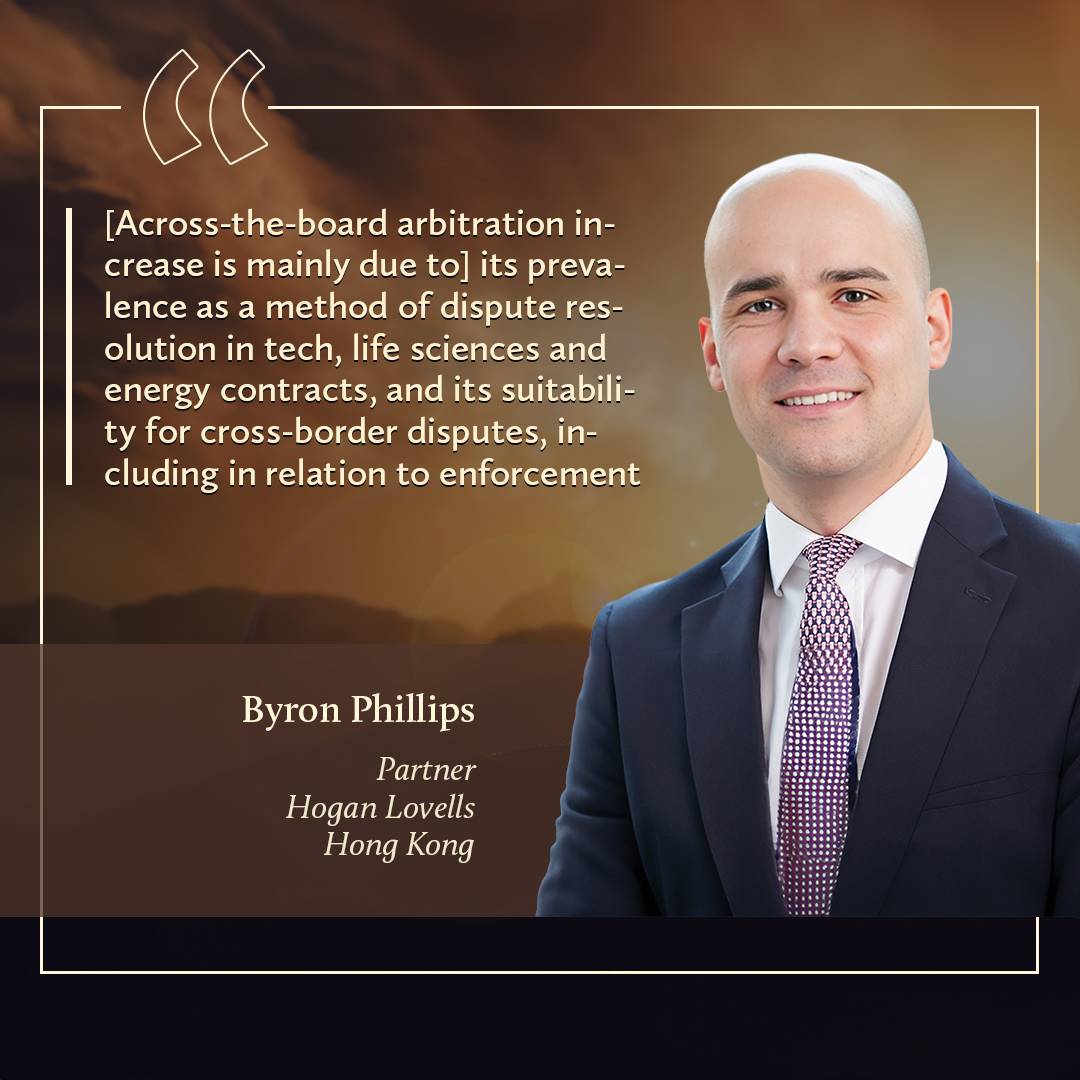
Byron Phillips, a partner of litigation, arbitration and employment at Hogan Lovells’ Hong Kong office, has seen a significant increase in arbitration “across the board”, due mostly to “its prevalence as a method of dispute resolution in tech, life sciences and energy contracts, and its suitability for cross-border disputes, including in relation to enforcement.”
Enforcement risks
For businesses and investors, it is important to be cognisant of the variation in enforcement of judgments and arbitral awards across jurisdictions. White & Case’s Ho says that, even among signatory nations to the New York Convention, the effectiveness of enforcement can vary according to local laws and practices.
He says that with a rise of protectionism in arbitration, certain jurisdictions may impose restrictions on foreign arbitral institutions or favour local arbitration centres that may not offer the impartiality and expertise expected from established institutions.
Heidi Chui, a Hong Kong-based partner at Stevenson Wong & Co, says enforcement risks, including sanctions, are critical factors to consider before commencing proceedings. Chui says sanctions can complicate enforcement of existing judgments or arbitral awards, particularly cross-border payments or settlements.
“In some cases, sanctions may also prevent arbitration from proceeding, as sanctions-related disputes may not be arbitrable, or certain parties may be unable to act in jurisdictions affected by sanctions,” she says.
Chui cautions companies with interests in jurisdictions plagued by war or conflict to carefully consider their dispute and enforcement strategies, stressing that enforcement of arbitral awards may be difficult if assets are located within the borders of warring nations.
She says recognition and enforcement of arbitral awards rely on courts whose jurisdictions cover the locations of assets. However, a place of conflict may not have properly functioning courts, which will block access to the assets.
Dong Chungang, a partner at Jingtian & Gongcheng in Beijing, underscores the importance of choosing a neutral venue and institution for dispute resolution to avoid the interference of protectionism, and to minimise the impact of potential sanctions.
White & Case’s Ho advises companies to localise disputes in arbitration-friendly jurisdictions such as Singapore, Hong Kong and London. “Arbitration-friendly jurisdictions generally have established legal frameworks and institutions to uphold arbitral awards and ensure procedural fairness,” he says. “Further, these jurisdictions are often neutral seats, reducing fairness concerns that may otherwise arise for parties with competing home seats.”

On the litigation side, Hogan Lovells’ Phillips observes that the US, Canada, EU and UK have seen a surge in collective or class actions relating to ESG (environmental, social and governance) matters, data breaches, antitrust matters and other regulatory action.
“This has yet to really take hold in the Asia-Pacific area, but there is definitely contagion from these other regions being felt in APAC, and we are starting to see signs that these types of disputes will grow here, too, even if certain jurisdictions, for example Hong Kong, do not have class action regimes,” he says.
With societal attitudes in Asia shifting towards greater enforcement of rights, private litigation has been perceived as a more viable option than before. “The perception pre-covid that private parties in Asia are less inclined to bring actions is becoming outdated,” says Ho.
With an increase in M&A activity, Ho has noticed a shift in litigation strategies by biotech companies: plaintiffs are increasingly allowing mergers to proceed before subsequently filing class action lawsuits to seek damages for alleged misrepresentations during the merger process. This tactic aims for greater financial recovery post-deal closure, rather than blocking transactions initially.
Emphasising the importance of pre-litigation preparation, Ho says it is often too late to implement strategic responses by the time a dispute arises. Good preparation includes maintaining thorough documentation, training employees on regulatory requirements, and establishing clear governance structures. Early engagement with legal counsel to develop strategies and contingency plans also facilitates effective actions in the event of a dispute.
“Such proactive measures would not only enhance the company’s ability to defend against claims, but also position it favourably in negotiations, potentially avoiding costly and protracted litigation,” he says.
Ho says it is vital to recognise that “Asia is no longer a sleepy region on the enforcement of rights”. Businesses should be prepared to face increased class actions spreading across matters including employment, data security, ESG and consumer protection.
“In particular, companies should be aware of institutional investors increasingly using class action as a corporate governance tool to influence management decisions,” he says. “There has also been a rise in the use of class action to recover lost investments from cryptocurrency and other complex financial products.”
When commercial arbitration or litigation cannot fully resolve disputes or recover losses, Zhong Lun’s Cao suggests investors may consider safeguarding their legitimate rights and interests through investor-state dispute settlement.
He advises investors to pay close attention to the contents of bilateral investment treaties (BITs). “Given the flaws in the scope of arbitrable disputes in China’s first-generation BITs, domestic investors may consider establishing a special purpose vehicle in a third country if necessary,” says Cao.
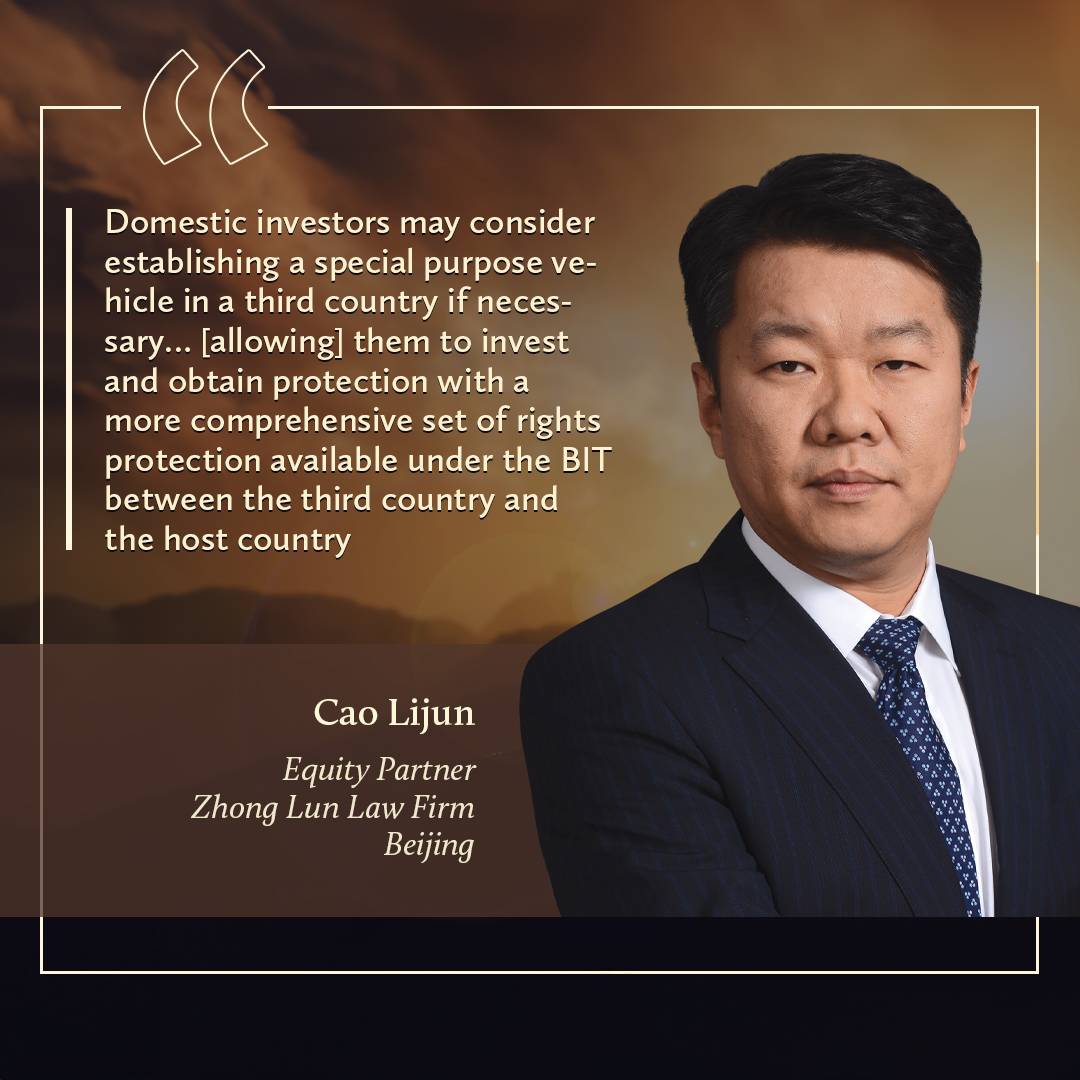
“This would allow them to invest and obtain protection with a more comprehensive set of rights protection available under the BIT between the third country and the host country.”
Stevenson Wong’s Chui says investment treaty arbitration is another option, although it is typically more appropriate for large projects with significant sunk costs. “Even where an award is obtained, risks remain around enforcement, particularly the non-payment of awarded sums,” she says.
Riding high on the institutional co-operation between mainland China and Hong Kong, Chui highlights the growing tendency of enforcing mainland or foreign judgments in Hong Kong.
With the new Mainland Judgments in Civil and Commercial Matters (Reciprocal Enforcement) Ordinance, effective 29 January 2024, Hong Kong has enhanced its enforcement regime for mainland judgments.
Chui says the new regime expands the scope of enforceable judgments, allowing for the recognition of both monetary and non-monetary judgments, and removes the requirement for exclusive jurisdiction or a contractual basis. This contrasts with the previous Mainland Judgments (Reciprocal Enforcement) Ordinance, which only allowed enforcing monetary judgments related to commercial contracts.
“The wider range of eligible courts and streamlined enforcement process offers greater certainty and flexibility in cross-border dispute resolution,” she says. “Companies should take note of these legal developments to optimise their enforcement strategies across jurisdictions.”
Amid talks of enforcement, Pinsent Masons’ Turner notes interesting recent statistics about arbitral award enforcements in China, presented in the Supreme People’s Court of China’s 2023 Annual Report on Judicial Review of Commercial Arbitration. “It contradicted the common misconception that it is difficult to enforce an arbitration award in China,” she says.
The report shows Chinese courts received 75 cases requesting the recognition and enforcement of foreign arbitral awards in 2023. Sixty-nine were recognised and enforced. These figures bring China’s aspirations in international arbitration practice to the fore. They are embodied in a strategy to build international arbitration centres, which has been elevated to the status of central policy and implemented in regions such as Beijing and Shanghai.
For example, the China International Economic and Trade Arbitration Commission (CIETAC) has expanded its panel of arbitrators to 145 countries, including 112 countries along the Belt and Road Initiative, in 2023.
“Overseas arbitration institutions, represented by the HKIAC, are about to establish representative offices in Beijing, which may offer a new option to users of cross-border dispute resolution to enjoy international arbitration services right at home,” notes Dong, of Jingtian & Gongcheng.
Data and IP
Around the globe, countries wrestle one another over data security regulation. Evolving systems of cross-border data transmission of evidence add a complex layer to the changing landscape of outbound disputes.
“Apart from the Hague Evidence Convention, this issue will inevitably involve China’s Personal Information Protection Law, Data Security Law, and other provisions related to cross-border data transfer, and it may even involve the Law on Guarding State Secrets,” says Li Ran, a Beijing-based partner at Tian Yuan Law Firm.
She says the “most prominent issue in the cross-border transfer of evidence in litigation or arbitration is the conflict between the discovery rules of the US litigation and the information protection laws of other countries”. Parties often find themselves mired in dilemma.

Ray Liu, a global partner and managing partner at Dorsey’s Beijing office, says China mandates the approval of competent central government authorities before parties can legally submit data to foreign judicial authorities, a process which usually takes time. However, failure to submit pertinent evidence within required timeframes of foreign proceedings may subject the parties to sanctions in those places.
Different positions taken by companies correspond to entirely different strategies for dealing with the issue. Tian Yuan’s Li notes that if a company is the party requesting disclosure, it should make full use of litigation or arbitration rules to explain to the judge or arbitral tribunal the necessity of providing such information, and any obstacles or restrictions that prevent it from being provided.
If, however, a company is the party required to disclose, it should first determine whether the information should be provided, whether failure to provide it will have an adverse effect on the case, and whether it can afford the worst consequences.
If information cannot be disclosed, Li suggests companies consider limiting or narrowing the scope of disclosure as much as possible through procedural objections (e.g. challenging the jurisdiction), and by introducing provisions of the laws of other countries (e.g. mandatory provisions on data regulation in the country where the information is located).
For data that can be disclosed, Li recommends communicating with the jurisdiction’s government as necessary to meet the regulatory compliance requirements of the country in which the information is located for cross-border transfers of information. In the case of personal information, confirm that user consent has been obtained or desensitisation has been carried out.
“For Chinese companies, data regulation and restrictions on outbound data transfer have become stricter than before. In addition, the legality of witnesses testifying remotely from mainland China for overseas legal proceedings is also facing challenges,” says Jingtian & Gongcheng’s Dong.
He advises companies to fully consider these factors when choosing dispute resolution methods and jurisdictions. “Or, in case of necessity, appropriately excluding the obligations of document submission and evidence production in the agreement may help avoid more troubles in the future,” he says.
As China becomes a major intellectual property (IP) power and an IP exporter, the field of IP disputes has also seen a sea change in the context of advancements of disruptive technologies.
Besides traditional litigation, Dorsey’s Liu notes that “IP dispute resolution mechanisms have diversified”. More parties are opting for arbitration or mediation to resolve IP disputes. He points to the World Intellectual Property Organisation’s (WIPO) Arbitration and Mediation Shanghai Service recently rendering its first arbitral award in a foreign-related IP dispute.
The case was arbitrated under the WIPO Expedited Arbitration Rules and took less than two months from application to award. Liu says the Shanghai service has also administered more than 120 mediation cases of cross-border IP disputes. Highlighting regulatory issues that need attention, he says the rapid development of technology can pose challenges to IP legislation and judicial practice.
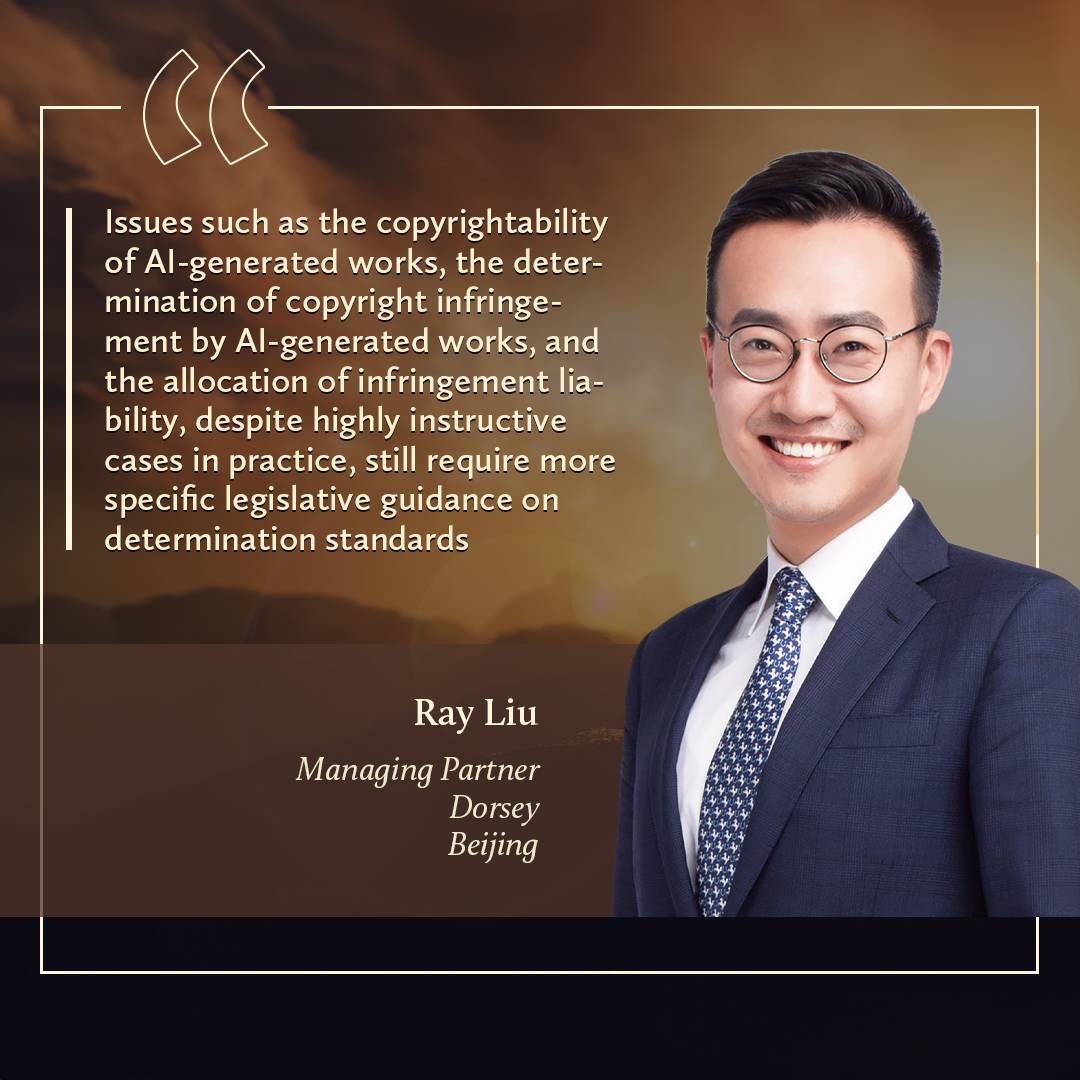
Taking copyright as an example, he says “issues such as the copyrightability of AI-generated works, the determination of copyright infringement by AI-generated works, and the allocation of infringement liability, despite highly instructive cases in practice, still require more specific legislative guidance on determination standards”.
You must be a
subscribersubscribersubscribersubscriber
to read this content, please
subscribesubscribesubscribesubscribe
today.
For group subscribers, please click here to access.
Interested in group subscription? Please contact us.
你需要登录去解锁本文内容。欢迎注册账号。如果想阅读月刊所有文章,欢迎成为我们的订阅会员成为我们的订阅会员。
Expert Strategy Articles Series
Dilemma in applying DR clauses in multiple contractsAuthor: Zhang Yaxing and San Bing, Han Kun Law Offices |
 |
Disputes over share repurchase rights in VAM agreementsAuthor: Rui Gang, Kangda Law Firm |
 |
Shareholder responsibilities in bankruptcies under new Company LawAuthor: Kong Yiding, Wintell & Co |
 |
Exploring creditor protection paths under new Company LawAuthor: Zhang Zheng and Chu Wenqin, Guantao Law Firm |
 |
Arbitration dilemmas of one-person company with sole shareholderAuthor: Li Fei, Langfang Arbitration Commission |
 |
Scenarios for extending arbitration agreementsAuthor: Tian Bin, Langfang Arbitration Commission |
 |