









Managing risk requires an understanding of the changing dynamics of the environment in which a company operates. S Ramaswamy explains
In June 2013, exceptionally heavy rain in the northern Indian state of Uttarakhand washed away roads and bridges. Around 5,000 fatalities occurred, many thousands were left stranded, and the cost to the local economy was colossal.
As most commentators pointed out, this was a disaster waiting to happen. Yet no steps had been taken to prevent it. Worse still, as the events unfolded it was evident that the state machinery had no quick response plan in place.
Sobering evidence
Uttarakhand has significant investments in both hydroelectric power and tourism. Companies operating in these areas needed to have in place sufficient risk mitigation measures to deal with all eventualities, but most reports suggest that they didn’t.
[ihc-hide-content ihc_mb_type=”show” ihc_mb_who=”3″ ihc_mb_template=”2″ ]
One study calculated the loss to Uttarakhand’s tourism industry on account of the floods in 2013 at around ₹12 billion (US$200 million). It appears that the state economy will take years to recover. While in past years tens of thousands of pilgrims travelled to the main temples each May for ceremonies to mark the beginning of the pilgrim season, there were reports that only around a hundred pilgrims would travel this year to the opening of the temple at Kedarnath, which is one of four major Hindu sites in Uttarakhand.
While the state and central governments shoulder some of the responsibility in cases such as this, companies – particularly those that are answerable to shareholders – need to do their best to secure their businesses against risks posed by natural disasters and other untoward incidents.
This article discusses how to identify risks and how to prevent and mitigate the risks identified for the benefit of all concerned, in terms of employees (human capital), material resources, inventory, infrastructure, etc.
New-age risks
In today’s environment businesses are often exposed to previously unknown risks that know no national boundaries and may be difficult, if not impossible, to protect against. In addition to risks posed by environmental disasters as described above, companies need to focus on so-called new-age risks such as terrorism, fluctuations and downturns in the global economy, fast-spreading infectious diseases, cyber warfare, business espionage, etc.
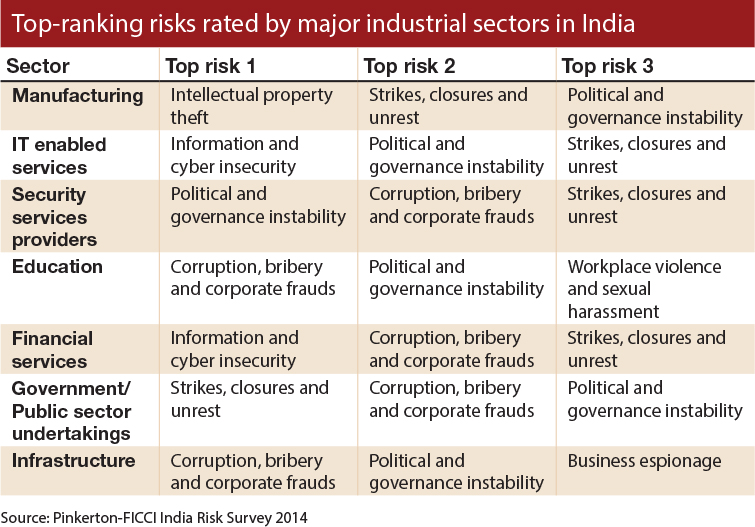
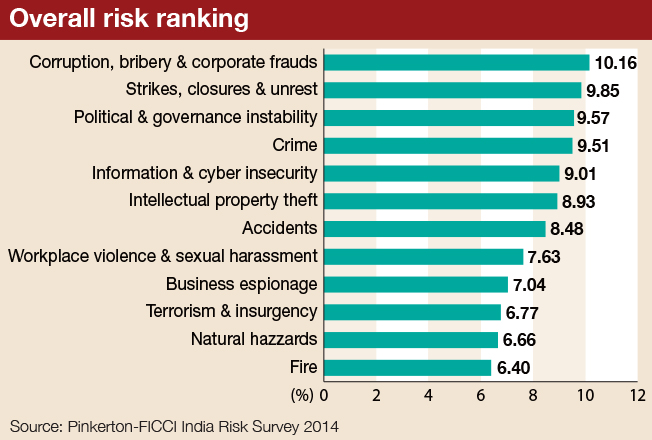
The Pinkerton-FICCI survey shows that perceptions about the relative importance of specific risks are constantly changing. Among 12 prominent risks, “corruption, bribery and corporate frauds” emerged as number one in 2014, up from number four in the 2013 survey. The change is attributed to the unravelling of scams and frauds in both the public and private sectors.As pointed out by Pinkerton and the Federation of Indian Chambers of Commerce and Industry (FICCI) in India Risk Survey 2014: ”there is a growing need for acknowledging the risks that find their way into the corporate sector owing to advancement in technology and rise of competition. These risks are apparent through the failures of some of India’s popular brands and the multitude of scams that have caused losses amounting to billions.”
At number two, “strikes, closures and unrest”, the number one risk in 2013, continues to command serious concern. “Political and governance instability” was the number three risk in 2014, down from number two a year earlier, suggesting that the current elections are of ongoing concern to corporate India.
Food for thought
It is necessary to monitor risks and trends on a regular basis and to amend risk management strategies regularly to address significant changes in the business landscape.
Risk entails uncertainty and unless the factors that trigger the risk are understood, analysed and given proper attention by companies financial loss or physical injury can result. The failure to appreciate risk can also impact the company’s reputation and competitive position.
Managing a company’s risk is about applying policies and procedures in order to: (a) identify, analyse and assess risks, including identifying the source of the risk and anticipating its impact; (b) determine the degree of exposure to risk that the company can accommodate; (c) formulate a plan to mitigate the risks; (d) identify and implement strategies to avoid the risks and any resultant litigation, loss of reputation or injury; and (e) regularly reassess and adjust strategies to deal with changes in risk levels.
Strategies devised need to consider risks that are relevant to the particular sector in which the company operates (see table on page 31 for a list of top-ranking risks as rated by major industrial sectors).
An ongoing exercise
Risk management must be ongoing to be effective. Communication with those in the field and at the management level is vital, as is periodic training on risk management trends and compliance for all concerned.
The following pointers can assist companies to put together an effective risk management regime:
- Build the annual risk assessment exercise into the company’s compliance programme.
- Put in place stringent protocols for screening all new business partners and third party agents.
- Update policies, procedures and training material based on changes in risk perceptions.
- Establish a regular monitoring system to spot problems and address them.
All of this entails inherent challenges. A Global Emerging Risks Survey published by the Financial Times states: “It is difficult to identify and analyse emerging risks, in large part because of their inherent characteristics.”
The survey found that while decision makers perceive emerging risks as potentially significant, these risks may not be fully understood. In addition, while the consequence of such risks cannot be clearly defined in monetary terms, “conventional approaches to projecting their relative frequencies, their probability distributions over time, as well as the severity of the resulting losses and other consequences may be ineffective”. The survey also points out that the challenge is to establish causality between the source of the emerging risk and its consequences.
John Ruskin, a leading art critic of the Victorian era, said: “What is the cheapest to you now is likely to be the dearest to you in the end.” These wise words should guide every company as it puts in place strategies to meet risks.
[/ihc-hide-content]
S Ramaswamy is vice president and group general counsel at Escorts, an engineering and construction equipment company based in Faridabad, India.