









Cybersquatting is a growing menace to companies the world over. India has its own mechanism to address the problem but serious challenges remain, Alfred Romann reports
Every five days, millions of internet domain names change hands. The timing is the direct result of a loophole in the global system of website registrations that allows users to try out a domain name for five days without paying for it.
This is known as “domain tasting”. While the majority of companies and individuals use these trial periods for legitimate purposes, a growing number are abusing the system by serially registering thousands of domain names and keeping them for the prescribed period before letting them go. This practice is called “domain kiting”, a term coined by Bob Parsons, the CEO of GoDaddy.com.
Domain kiting has serious implications for intellectual property (IP) owners around the world. In particular, it has given rise to a marked increase in instances of “cybersquatting”, which is defined in the US Anticybersquatting Consumer Protection Act, as “registering, trafficking in, or using a domain name with bad-faith intent to profit from the goodwill of a trademark belonging to someone else”.
[ihc-hide-content ihc_mb_type=”show” ihc_mb_who=”3″ ihc_mb_template=”2″ ]
Complex problems
Many of the problems associated with cybersquatting stem from the complexity of the system through which domain names are registered and administered.
Domain names are the unique addresses of World Wide Web pages. They can be hosted on servers located anywhere in the world. Names are often allocated on a first-come, first-served basis to users, who pay a fee for the right to use a particular name for a given period of time, usually two years, after which the name may be renewed.
There are several different types of domain names. “Top-level domains” are the most coveted and can be divided into two categories, “generic top-level domains” and “country-code top-level domains”. Generic top-level domains end in commonly used suffixes such as “.com”, “.net” and “.edu”. Country-code domains end in suffixes that identify the country in which the domain was registered (for example, “.in”, “.co.uk” and “.aus”). Each country sets its own rules for the registration and use of country-code domain names.
The multi-level administration of domain names (some on a country-by-country basis and others globally) combined with the sheer number of names in use (more than 140 million have been registered so far) has given rise to serious problems in monitoring and enforcing the associated IP rights.
According to World Intellectual Property Organization (WIPO), this situation is set to get worse.
The increasing number of accredited registrars, private registration services and professional domain name dealers is already compounding the problem, as is the growing popularity of “domain name parking”, a practice whereby numerous domains are registered and then redirected to pay-per-click sites that generate revenue from advertising.
A speculator’s market
“Domain name ‘tasting’ risk[s] turning the domain name system into a mostly speculative market,” said France Gurry, the deputy director-general of the WIPO. “Domain names used to be primarily specific identities of businesses and other internet users, but many names nowadays are mere commodities for speculative gain.”
“The rate at which domain names change hands, and the difficulty to track such mass automated registrations, challenge trademark owners in their pursuit of cybersquatters,” adds Gurry. “With domain names becoming moving targets for rights holders, due consideration should be given to concrete policy responses.”
WIPO tracks incidences of cybersquatting and offers arbitrations based on a set of rules called the Uniform Dispute Resolution Protocol (UDRP) in cases of disputes. On average, 84% of cases are settled in favour of the complainants.
In 2006, the number of cases brought before WIPO jumped 25% on the previous year and was expected to keep growing. Practices such as domain name tasting, parking and kiting are blamed for much of this increase.
Elisa Cooper, marketing director at MarkMonitor, a brand protection agency, explains how cases have surfaced where groups of three or more registrars have simply passed names among themselves, taking advantage of the five day trial period to effectively block names permanently without ever paying for them.
When the five days are up, the names are transferred from one company to another, freezing out legitimate users who could put the names to permanent use.
“We are talking millions [of domain names],” says Cooper. “It’s a loophole that is being used to take advantage of the system.”
Cooper compares the problem (in words she adds were not originally her own) to buying a fancy dress, wearing it to a party once and then returning it to the shop the next day.
The wholesale transfer of domain name portfolios is a latter-day incarnation of a long established internet practice that, while not illegal, falls clearly within a grey ethical area.
Unique challenges for India
Cybersquatting is a global issue that relates no more to India than it does to China, the US or Europe. What is unique to India, however, are domain registrations carried out under the India-specific country code (“.in”), and the remedies that are available to tackle abuses.
According to Rodney Ryder, a partner at FoxMandal Little, India is still suffering from the botched introduction of “.in” domain names. At first, registrations were tightly controlled, but once government restrictions were lifted in 2003, they became available on a first-come, first-served basis. Individuals seeking to register a domain were not required to demonstrate any prior or legitimate use of the name and this led to wholesale squatting on domain names that infringed well known international brands such as MSN, Microsoft and Google, as well as domestic ones. (Tata once fought to recover the domain name www.bodacioustatas.in.)
Furthermore, it wasn’t until two years after the registration restrictions were lifted that India established a mechanism for dealing with domain name disputes.
The Indian body now charged with this is the National Internet Exchange of India (NIXI). Established in 2003 to provide high-speed connections for Indian internet service providers, NIXI’s role was expanded in 2005 when it was given the responsibility for arbitrating domain-related disputes.
In determining whether an individual or organization is guilty of cybersquatting, NIXI uses the same URDP rules as WIPO. The judgment hinges on three factors: Whether the site is confusingly similar to a legitimate site, whether the registrar has a right to the name and, perhaps most significantly, whether the site is held in bad faith.
“Registering and keeping a name and not using it for a site is generally seen as evidence of bad faith,” says Ryder, who has represented a number of large corporations in arbitration procedures at both WIPO and NIXI, and was involved in NIXI’s first arbitration.
On 30 November 2007, NIXI concluded a case that is indicative of the problems associated with cybersquatting in India. Back in 2005, an individual named Vishal had registered the domain name www.itcportal.in through a registrar called Net4India. ITC, a well-known Indian corporation, subsequently filed a case with NIXI to recover the site. Vishal did not file a response and the arbitrator ruled that the domain name should go to the corporation. It was a successful result, says Ryder, who represented ITC.
But thousands of other contentious websites are yet to be challenged, and in the worst case scenarios these sites are defrauding their users, a practice known as “phishing”. In one notorious example, the site www.sbicard.com was registered. Users accessing the site believed they were applying for a State Bank of India credit card, when in reality they were simply handing over personal information that would later be used to defraud them.
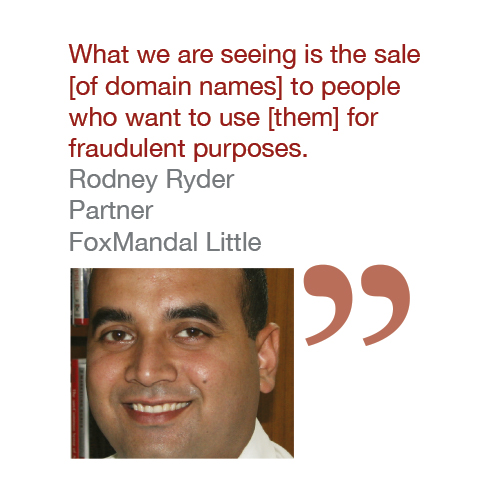
“What we are seeing is the sale [of domain names] to people who want to use [them] for fraudulent purposes,” says Ryder.
Puzzling decisions
Since it took on the role of arbitrator, NIXI has proved reasonably efficient, normally providing judgments within three months or so. It has not, however, been without criticism.
Ryder says that there are simply not enough IT experts becoming arbitrators with NIXI, while Shamnad Basheer, an Indian IP lawyer who lectures at George Washington University Law School, notes a string of what he calls “decisions that are truly puzzling”.
He cites cases where generic domain names such as “hotels” and “ISP” have been handed over to complainants by arbitrators in spite of the fact that generic names cannot be trademarked.
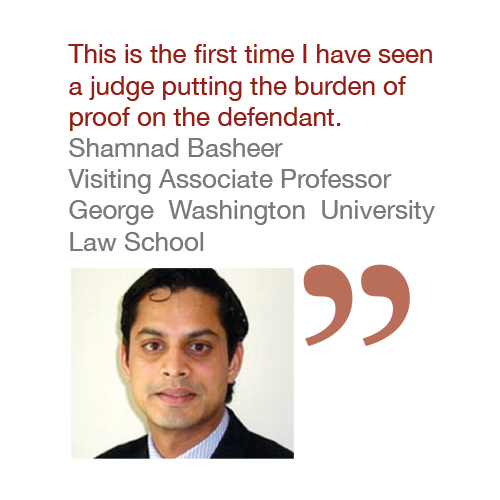
Moreover, he argues that it has become virtually common practice for arbitrators to take a guilty-until-proven-innocent approach in domain name disputes. “This is the first time I have seen a judge putting the burden of proof on the defendant,” says Basheer.
“If you allege something, it (should be) up to you to prove it.”
In spite of these concerns, Basheer sees improvements in India’s system of domain name registration and administration. The current weaknesses, he believes, are not in the legislation but the implementation.
An expensive business
For large companies, managing and protecting domain names is an expensive and time-consuming business. One approach is to be proactive and register domain names before the cybersquatters can get to them. But a multinational corporation with several brands may already have up to 10,000 domain names registered internationally and a larger conglomerate as many as 25,000.
Establishing a defensive set of domain name registrations worldwide – including brand names, variations, negative connotations and even common misspellings – would therefore cost hundreds of thousands of dollars. It’s an expensive proposition, but perhaps not as expensive as battling for each name at WIPO.
Ryder says that the cost of an arbitral hearing at WIPO is around US$1,500, while NIXI charges about half of that. Once the legal fees and other costs are factored in, Cooper at MarkMonitor estimates that the total cost of arbitrating can easily exceed US$10,000 per domain name.
But cost is not the only concern. Corporations fighting their domain name battles one at a time through protracted arbitrations have no hope of keeping pace with syndicates that hold and transfer millions of “virtual” domain names at the click of a button. In its two-year history, NIXI has dealt with less than 100 cases, barely a drop in the ocean.
As Indian corporations extend their brands into global markets, and international companies make further inroads into India, it may be that they have only encountered the tip of what is likely to become a huge cybersquatting iceberg.
[/ihc-hide-content]