







Finding himself in a highly competitive industry, Peter Zhang is required to take into consideration both legal compliance and business requirements. He shares his views on the role of a corporate counsel with Richard Li
It simply is not enough to understand the law. To be a good inhouse counsel, one has to have an extensive understanding of the industry.” This is Peter Zhang’s idea of what makes an outstanding corporate counsel. His clear vision is perhaps a result of his industry background.
Zhang currently serves as general counsel of Sony Mobile Communications (China), responsible for legal affairs in the mainland, Hong Kong, Macao and Taiwan. He previously held positions as inhouse counsel of multinational giants Ericsson and Yahoo!, which once dominated the internet and telecommunications markets.
The fierce competition in the telecom industry can be unforgiving as upgrade cycles continue to shrink. Today’s market leader may be tomorrow’s hasbeen if its pace slackens ever so slightly. Perhaps this heightened Zhang’s awareness of the many important extralegal factors to success.
Increased competition is the direction many industries are trending, not just telecommunications. With such high stakes, corporate counsel need to have a clearer definition of their roles.
[ihc-hide-content ihc_mb_type=”show” ihc_mb_who=”1″ ihc_mb_template=”2″ ]
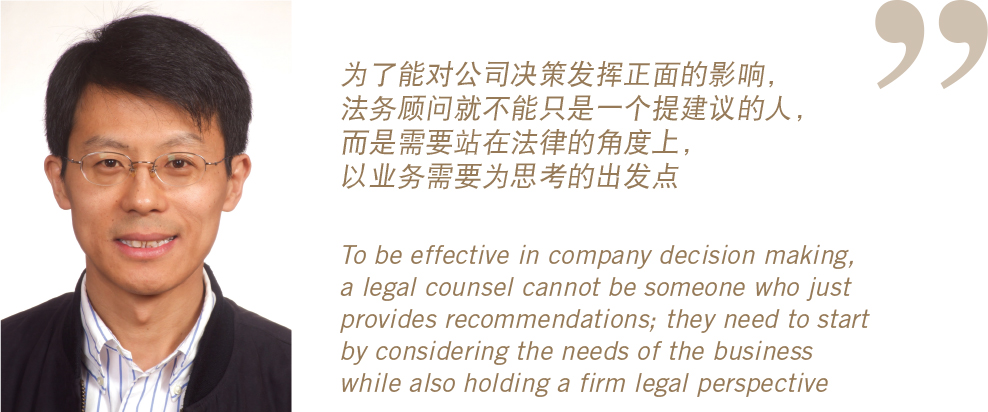
“To be effective in company decision making, a legal counsel cannot be someone who just provides recommendations; they need to start by considering the needs of the business while also holding a firm legal perspective”, says Zhang. “This is the only kind of counsel of any value.”
“Fierce competition in the electronics market has led to new ways of thinking and an endless stream of products, and these new matters will give rise to new pressures in an inhouse counsel’s work. It is impossible to weigh these new matters against existing matters, as there are often no precedents or experiences available for guidance,” he says.
“If you are a telecommunications inhouse counsel, you have to keep abreast of issues related to the commercial division, such as the latest industry developments, your competitors, successful business models, and so on.”
Extralegal factors
Zhang sees these issues as extralegal factors, and one key distinction between corporate counsel and lawyers. “A corporate counsel is required to have a grasp on numerous extralegal factors, factors that account for a not small proportion of their day-to-day work,” he says.
“In a law firm, as long as your work is outstanding insofar as how you wield legal provisions and principles, that’s all you need. In business, how creative the legal department is in applying the law is not necessarily something of much concern to the commercial division. What they care about is getting inhouse counsel’s support for the innovations and plans made with their sweat and blood, and for it not to be vetoed by the counsel.”
Zhang emphasizes that corporate counsel should first come to terms with the commercial division’s concerns, and then give their legal recommendations based on this understanding. “The commercial division will feel that your advice is not based solely on your personal perspective, but made with consideration of their needs. This will have them willing to seek you out rather than avoid you. When they come to you, it is because these extralegal factors have let them realize your value.”
For large multinational corporations, the legal division for the greater China region may not necessarily be required to report to the regional head. The division Zhang manages, for example, reports to their overseas head office. However, he states that the reporting line should not affect the communication between the corporate counsel and local management. “Some inhouse counsel hold that, since they don’t report directly to anyone locally, they don’t need to pay any attention to local management. If that is how things stand, conflicts could arise between the legal and commercial divisions”, he says.
Compliance
An increasingly stringent regulatory environment poses just as many challenges to corporate counsel in their work as does market competition – antitrust compliance, for one. Chinese antitrust authorities have stepped up law enforcement and determination with intensity in recent years. The National Development and Reform Commission’s citation of the US wireless firm Qualcomm sent a jolt through the market in February. The firm was ruled to have committed monopoly behaviour in abusing its dominant market position to eliminate or restrict competition and fined RMB 6.088 billion (US$956 million).
Antitrust compliance forms a significant portion of Zhang’s day-to-day work. Zhang says that there is always a possibility of unfair competition for a commercial business. The thorny issue, he says, is the discrepancy between business goals and compliance.
“The business division’s objective is breakthrough performance, while legal’s objective is keeping operations legal. It is difficult to be at the top in terms of both business and compliance as far as competition law is concerned. Senior corporate counsel are faced with a tradeoff between the two. Counsel will not necessarily be able to find a resolution that satisfies both when time is a factor.”
And any resolution will continue to need to be tweaked. “What worked last year may not be suitable for this year. New situations are always arising, including new regulations and changes in how the law is enforced”, Zhang says.
Employment issues also form a considerable portion of his work. Some international firms have adjusted the scale of their Chinese business in the previous few years, he says, resulting in personnel cutbacks.
“A company cannot depend simply upon the letter of the law when constructing a staff reduction plan”, says Zhang. “It has to consider prior practice, the state of the industry, the situation of individual staff, and other such factors, all of which are extralegal. Which is to say, extralegal factors have to take precedent to legal ones if an inhouse counsel wants to play a constructive role in creating a staff reduction plan. And this can be a challenge for inhouse counsel.”
He suggests that inhouse counsel faced with this conundrum consider exerting their influence in two ways. “First, they can inform management of the extralegal factors that should be added to the reduction plan and what might occur as a result.
“Second, they can inform employees of their expected value based on the existing legal framework. That way there will be a smaller expectation gap between management and staff when the plan is rolled out. You can’t entirely eliminate the gap, but it’s at least possible to find a good balance between the two.”
Choosing the profession
For those with a background in legal studies, the question of whether to work in business, a law firm or court is an important one to make. While there may be large differences in the work of a corporate counsel and a lawyer in a firm, Zhang feels that under certain circumstances the transition from one to the other can be quite smooth.
“If a lawyer has advised telecommunications clients for many years and then gets the chance to become corporate counsel, chances are that it will be for a telecommunications company. In this case, they would be quite familiar with the development of the telecommunications industry, so it’s just a matter of the former client becoming a new employer.”
The relatively low pay and high stress in the work of judges has made many graduates of law wary of the courts. Recent cases of violence against judges may also heighten this caution. But Zhang argues that the court can rapidly enhance a legal worker’s overall capabilities. He says that fresh graduates should not overly concern themselves with remuneration for the first few years and work for a court for a period of time. This, he says, can build a solid foundation for when they later go to work for a law firm or in the legal division of a business.
“A judge in a Beijing court will handle, roughly, several hundred cases in one year, writing on average two judgments per day. They will be responsible for a number of matters, such as reviewing case materials or court hearings. The jobs that let you be involved in several hundred cases per year are few and far between”, notes Zhang.
“Sound judgment requires superior understanding and application of the law, because it not only needs to be consistent with the substantive law, but also able to stand up to examination and questioning by the parties involved.”
“I thus believe that a person who has served as a judge may have a deeper and more precise understand of legal principles than anyone else. The experience that a person accumulates while working at court will definitely be greater than that gained at a law firm or in a legal division for the same amount of time”, says Zhang.
As the number of fresh graduates entering the Chinese legal market continues to rise, Zhang’s advice may be something for young legal minds to consider.
[/ihc-hide-content]