






LinkedIn
Facebook
Twitter
Whatsapp
Telegram
Copy link

The US Department of Commerce’s top legal eagle is in sharp focus when it comes to advising China on commercial law reform. He talks to John Church about his career as general counsel and his China strategy

As general counsel go, this one is a high flyer. Nominated for chief counsel to the US Department of Commerce by none other than President Barack Obama, it’s a fair bet that Kelly Welsh’s career will fly even higher should a certain former first lady take the White House at the next US elections and become the first female US president.

Harvard-educated and with a solid legal grounding, Welsh has plenty of savvy and friends in all the right places. He spoke with China Business Law Journal on the eve of his first year as general counsel to the department about his job, his vision and the role he is playing in forging closer ties with China on commercial law reform.
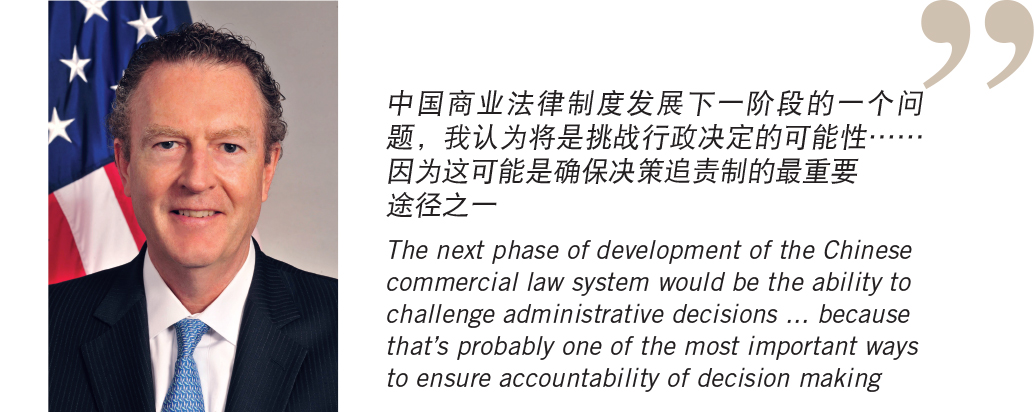
High flyerWelsh says he was drawn to law because it’s an intellectually challenging profession “but also one that operates in the real world, unlike academia.”

[ihc-hide-content ihc_mb_type=”show” ihc_mb_who=”1″ ihc_mb_template=”2″ ]

“I think that combination was appealing, and also in the US especially a legal background can be the foundation for doing a lot of different things, including working in government, which is something I’m doing. Those were the two things that attracted me.”

Welsh started out at Mayer Brown as an associate and then partner before making the move to corporation counsel for Chicago – the head lawyer for the city, principal legal adviser to the mayor and the chief legal officer for the city. “That job was great. I did it for about four years and it was a terrific mix of being involved with policy issues, challenging legal issues and politics, and it was a great mix of things that we dealt with,” he enthuses.

“There were cases that went to the Supreme Court from Chicago’s legal department, and we also dealt with parking tickets. The breadth of what we did was fantastic, and as a result that experience led me to think that I liked being the head of a legal department more than I liked being a partner in a law firm, because of the mix of different parts of my brain that it used.

“When I left the city of Chicago I went to Ameritec [now AT&T Teleholdings] … where I was deputy GC [general counsel] and then GC. That was also a job that I liked a lot. I then went to Northern Trust, a global financial services company based in Chicago, and I was GC there. Those were all great experiences. In all of those settings I liked the mix of being a policy adviser and legal adviser, and running large legal departments.”

Earlier this year Welsh was entrusted to lead a US delegation to China for the 19th US-China Legal Exchange. The delegation included the Federal Trade Commission, National Institute of Standards and Technology and the Environment Protection Agency, and on the Chinese side the Ministry of Commerce and the State Council’s Legislative Affairs Office.

Views on everything from bilateral trade to data security to air pollution regulations were put forward. Assistant Minister of Commerce Tong Daochi said the legal exchanges had made great contributions in promoting mutual understanding of the two commercial legal systems and safeguarding the healthy development of bilateral economic and trade relations.

It’s a sensitive charge, mingling with and offering advice to Chinese officials, academics and lawyers on topics with fractious potential, but by all accounts the exchange was yet again a success, in no small part due to Welsh’s performance.

In his speeches, Welsh sought to find common ground and consistently referred to policy initiatives and principles in the central government’s Fourth Plenum as being the same as those that the US emphasizes within its own commercial rule of law.

He pushed for greater transparency: “Commercial rule of law could be strengthened by requiring the publication of all laws, administrative regulations, departmental rules and normative documents in draft in a single location before they are promulgated, and by allowing for a time period – say 30 days – for the public to comment on these drafts. China is currently revising its Law on Legislation, creating an opportunity for China to enhance regulatory and legislative transparency. Mandatory transparency rules in these revisions could make a real difference to the business environment in China, particularly if the revisions reach all measures impacting businesses and provide an adequate opportunity for public comment.”

And he advocated increasing foreign engagement in legal services “by allowing global law firms doing business in China to hire Chinese-licensed lawyers. Rule of law also would be enhanced by allowing foreign lawyers to attend administrative proceedings, not in order to practice Chinese law, but to advise on international law and practice and provide information on the impact of the Chinese legal environment.”

He also made his case, within the outlines of the Fourth Plenum, for fairer competition and equality, great IP protection and an acceleration of anti-corruption measures, among other issues.

Importantly, Welsh tells China Business Law Journal, his own observations from the visit were that officials, academics and legal professionals were on the same page with commercial law reforms. “Officials are focused on improving the commercial rule of law and trying to make the system more transparent and accountable, and I’d say the academics and professionals I met with would say that’s their impressions too,” he says. “There’s always a question of how quickly things change and many people outside of the government would like to see change happen more quickly, [but] I’d say generally the themes from both were the same.

“One area I’d say is in the next phase of development of the Chinese commercial law system would be the ability to challenge administrative decisions, either in court or in some kind of appeal process, because that’s probably one of the most important ways to ensure accountability of decision making. And accountability of decision making is one of the key themes in the Fourth Plenum, so it’s consistent with the principles articulated by officials at the highest levels, and how that gets implemented, and how quickly that gets implemented, is very important.”

More denunciation of foreign bribery

Welsh is particularly strong in his views on bribery of foreign government officials in international business transactions and the need for the next step of enforcement following the enactment of legislation in China in 2011. “I think China could do more to publicize its law against foreign bribery and treat it with the same seriousness as it treats domestic corruption,” he says.

“China, along with the US, is one the leaders of the global economy, and as a global leader China should be taking leadership on global business ethics. It would be good to see them investigate and enforce the prohibitions on foreign bribery by [Chinese] companies just as it investigates bribery within its borders.

“The Chinese have taken a number of steps to integrate with other countries on foreign bribery issues. They were involved with a recent Asia-Pacific Economic Cooperation conference on that. But it would also be good to see them accede to the OECD foreign bribery group, which is generally acknowledged to be the leader among world economies on these issues.”

US a level playing field for China business?

Does Welsh believe the commercial environment in China is level for non-domestic players? “I know that non-Chinese companies feel as if the playing field is not level,” he replies. “I don’t know whether there are any places where the playing field might be level, but in general they don’t think it’s level, and I think that’s particularly true dealing with, and competing against, state-owned enterprises. It’s also true in establishing a company, and in the process of making initial investments, and in that stage of developing an enterprise the non-Chinese companies operate at a significant disadvantage.”

But what about discrimination against Chinese companies in the US? Does Welsh believe there are issues of unfair scrutiny against legitimate Chinese operations there? Case in point, Lenovo’s US$2.1 billion acquisition of IBM’s x86 server business in 2014. Covington & Burling, legal counsel for Lenovo on the deal, told China Business Law Journal the transaction raised significant issues including to what extent should governments erect security requirements based on the nationality of IT companies, and also whether the US will remain open to investment by transparent, multinational IT companies that originated in China given the cyber security concerns affecting the Sino-US relationship.

On this Welsh is uncompromising. “I think the US has a very open system for investment for all countries, including China,” he says. “The investment from China into the US has increased dramatically in the past several years, so I think the stats are proof that the Chinese see the US as a good place to invest.

“In fact just a few weeks ago, Secretary [of Commerce Penny] Pritzker and the Commerce Department, with a group including the US president, held a summit called SelectUSA, designed to encourage foreign investment into the US, and there was a delegation of about 150 senior-level mainland Chinese and HK investors to the summit, which was the largest delegation of any country.

“I think there’s a strong and growing sense that Chinese investors are welcome in the US, and that Chinese investors are seeing great opportunities to invest in the US. The US will take care to protect its national security when that’s an issue. But in general I think there’s a tremendous opportunity for Chinese companies to invest in the US.”

Positive movement in IP protection

Intellectual property (IP) protection is a perennial thorn in Sino-US trade relations, but Welsh lists the newly established IP courts as a good example of reform. “They’re relatively new and it will be important to see how they perform as judicial institutions protecting the IP of non-Chinese companies,” he notes. “I think getting continued progress on transparency in the rules and regulations in China – and that includes being posted for public comment and having the process for rule-making be consistent, not just for the most high-level rules, but for all the rules, including those at lower levels – that will significantly affect business.”

He says it’s also crucial in the next several years for China to focus on expanding administrative reconsideration and litigation so that there is more accountability built into the system for administrative decisions.

“It’s fair to say that inadequate protection and enforcement of IP, despite the introduction of the IP courts, is a continuing problem that ranks at or near the top of the list of problems facing US companies doing business in China,” he says. “It’s an issue both with respect to protection of IP in the technology area, and it also relates to trade losses due to counterfeiting and piracy. And we hear from companies in all types of business sectors, whether it’s entertainment with respect to counterfeiting and piracy, or the fashion sector, or the tech sector.

“We think it’s very important in the long run to see China’s protection of IP grow and I would say, too, that as China itself develops more IP that it seeks to protect, they should become themselves more focused on protecting IP. ”

Another area of possible contention is data security. Given recent accusations from both sides involving hacking and cyber offences, it’s difficult to think of any way there could be common ground, but Welsh has found some.

“One of the things we focus on is areas where it might be more fruitful to have cooperation, which is cyber security in the commercial world,” he says. “There are a number of Chinese companies that are large, successful, profitable internet companies, and if the Chinese consumers lose confidence in their ability to conduct transactions on the internet without data breaches, or information being stolen, or funds being stolen, it would have a dramatic negative effect on some very large important Chinese companies.

“So we, at the Legal Exchange, talked about the National Institute for Standards and Technologies’ framework for improving critical infrastructure cyber security. The institute is based in the Commerce Department and one of their leading experts came and spoke on the panels on the legal exchanges. I think Chinese companies and consumers share the interest that US companies and consumers have in maintaining security around their commercial transactions on the internet.”

Progress in commercial rule of law

Overall, Welsh sums up the US view on the pace of commercial law reform in China in positive terms. “I’d say especially in the last couple of years there’s been an acceleration in progress,” he concludes. “Based on what we at the Department of Commerce hear from businesses doing business in China, there’s still a long way to go, there’s still a lot of frustrations and gaps in the total package of a strong commercial rule of law in China – but I think there’s definitely been a lot of progress.

“One measure of that is with respect to rules, regulations and transparency. There is significantly more publication of rules, it’s easier to find the rules that apply to business now, and a higher percentage of new rules are submitted to the public for comment, or at least the ability to review them before they become enforceable.

“Last December at the JCCT [US-China Joint Commission on Commerce and Trade] talks in Chicago, one of the outcomes from that was several measures including increasing the level of due process in merger and anti-competition enforcement actions, and that was a real change in terms of how the Chinese legal system works.”

[/ihc-hide-content]

LinkedIn
Facebook
Twitter
Whatsapp
Telegram
Copy link