












Brexit talks have slowed in advance of elections across Europe. What should companies do while they wait for negotiations to conclude?
Vandana Chatlani reports
Last month, former European Council president Herman Van Rompuy told the BBC that negotiations over Britain’s exit from the European Union would take a back seat for at least a year until Germany’s new government was formed after elections next September. “You can always start with more technical matters, but the hardcore … difficult topics, will be tackled after the constitution of a new German government and that will be October/November [2017],” he said. Van Rompuy has referred to Britain’s exit from the EU as a “political amputation of the first degree”, saying that the image of a “strong Europe” had “tarnished a lot after Brexit”.
European powers remain nervous following the United Kingdom’s vote to end its membership of the EU in a referendum on 23 June. Many have voiced concerns that the UK’s exit could inspire other EU members to follow suit. European Council President Donald Tusk urged EU member states to introspect during their meeting in Bratislava without the UK to discuss the road ahead.
[ihc-hide-content ihc_mb_type=”show” ihc_mb_who=”3″ ihc_mb_template=”2″ ]
“We haven’t come to Bratislava to comfort each other or even worse to deny the real challenges we face in this particular moment in the history of our community after the vote in the UK,” said Tusk. “We can’t start our discussion … with this kind of blissful conviction that nothing is wrong … we have to assure … our citizens that we have learned the lesson from Brexit and we are able to bring back stability and a sense of security and effective protection.”
Tusk has also previously warned that the UK’s decision to leave the EU should not be viewed in isolation. The concerns expressed in Britain about immigration, security and cultural preservation, he said, were part of “a desperate attempt to answer the questions that millions of Europeans ask themselves daily”. Both European Commission President Jean-Claude Juncker and German Chancellor Angela Merkel have said that the EU is facing an “existential crisis”.
As an opinion piece in The Hindu put it: “Europe is much like a stack of Jenga blocks at present. Each move needs precision and care in order to preserve the integrity of an increasingly tenuous union.”
DRIVING BLIND
UK Prime Minister Theresa May has been firm about Britain’s departure from the EU, stating “Brexit means Brexit”. She has confirmed that the government will trigger Article 50 – officially beginning the EU departure process – in March 2017. Once Article 50 is invoked, the UK will have two years to leave the EU with an official exit by April 2019.
A timeline may be in place, but the concrete terms of Brexit remain unknown. May told the BBC she would ensure a “smooth” exit but admitted there would be “bumps in the road”. Apart from this, she said she would try to prevent disruption to businesses and honour Britain’s vote to “control the movement of people coming into the UK”. Beyond these general statements, very little has been spelled out.
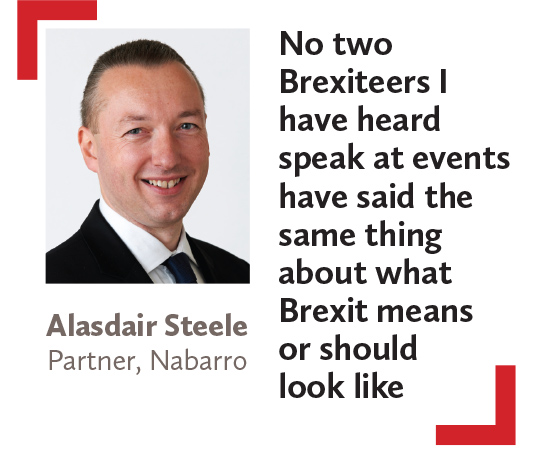
“No one knows what will happen next or what the future holds,” says Alasdair Steele, a partner at Nabarro. “Everything is conjecture, which is not helpful to businesses in the UK, India or elsewhere.”
Steele also points out the “neither the so-called ‘Brexiteers’ nor other European countries know what they actually want from a Brexit. Indeed, no two Brexiteers I have heard speak at events have said the same thing about what Brexit means or should look like.”
Despite the uncertainty, Indian and other foreign companies should have enough time to consider possible outcomes and actions before any Brexit agreements are struck. “It is more likely to be a case of evolution over a number of years rather than a revolution,” says Magnus Rodrigues, a partner at Chadbourne & Parke. “Indeed, from a practical perspective there are major limits as to how much legislation the UK’s houses of parliament … can pass in any year.”
In a sense, this means a longer drawn out period of uncertainty, but equally, business as usual. “Given past history, the likelihood is that any deal between the UK and EU will not be done until the very last minute,” says Steele. “And early indications are that non-EU countries do not want to enter into trade negotiations with the UK without knowing first what the UK’s relationship with the EU will be.”
MEASURING EXPOSURE AND RISKS
So against this backdrop of uncertainty, what should businesses be doing? Steele and his team have advised clients to perform an assessment exercise to establish the impact on their business if no deal between the UK and EU is struck at the point of Brexit, and to quantify the costs, impact and potential solutions to those consequences including the time required to implement the solutions.
“This will then mean that once the two-year notice period is triggered, businesses will know what they need to decide and when in order to be ready for Brexit,” says Steele. “For those businesses looking to launch or expand in the UK and Europe, they can also factor these thoughts into their planning. The UK is a full member of the EU until the moment of Brexit, so it is very much business as usual. However, it would be foolish not to be thinking ahead as to possible consequences and solutions.”
The key is for companies to understand what their exposure is, says Gavin Williams, a corporate partner and a member of the Brexit team at Herbert Smith Freehills. “Companies need to do their homework, conduct detailed due diligence and identify the major risks. They may find that Brexit only affects their businesses in a minor way. For companies that realize it’s a big concern, minimizing the impact depends on devising alternative structures – physical or legal – to minimize the impact of changes, and on making their businesses more resilient and robust.”
Samantha Mobley, a partner and head of the EU, competition and trade practice group at Baker & McKenzie, says many of the firm’s Indian clients have EU distribution centres, research and development facilities and/or production plants in the UK. In addition, many Indian companies chose the UK as a hub for regional business activities not only because of historically strong connections, but also to benefit from the UK’s favourable tax regime and the ability to rely on EU tax directives, which exempt interest, royalties and dividends from withholding tax when paid by companies in one EU country to companies in another.
“The UK has double tax treaties in place with all EU member states under which the rate of withholding tax is reduced, in some instances to zero,” says Mobley. “However, if the UK withdraws from this regime, UK companies receiving interest, royalties or dividends from their group companies in certain EU countries are likely to suffer a withholding tax cost. We have advised our Indian clients that this could make the UK a less attractive location for a European holding company.”
Some observers argue that a shared language, legal system and history mean that India will be reluctant to leave the UK. “If you’re an Indian pharmaceutical company in the UK, do you think – ‘let’s move to Germany or France’ with some of their labour laws and language issues? You don’t,” says Robert Moore, a partner at Herbert Smith Freehills. “We don’t expect an exodus from London.”
Williams, however, points out that major investments from India into Europe have been in the manufacturing sector, which will be significantly affected by Brexit. “Market access and deciding where to locate new plants will be a factor in the boardrooms of Mumbai,” he says. “If you’re an Indian conglomerate with significant manufacturing activities in the UK, you will be watching very closely to understand how things are likely to develop.”
LOSING PRIVILEGES?
The future of the historically strong business bond between the UK and India will depend on the shape of the trade deal the UK negotiates with the EU and the corresponding UK-India trade relationship.
“If the UK exits the EU single market, then depending on what trade agreement is reached between the UK and the EU, this could result in customs duties, tariffs and import requirements for goods and services moving between the UK and EU,” says Mobley. “This could result in higher costs and administrative requirements for Indian corporates using the UK as a gateway to the EU.”
Some Indian companies could be hit by changes to the benefits of EU licensing and authorizations that allowed them to register and obtain licences or authorizations in the UK and then sell goods or provide services throughout the EU. “Going forward, these passporting arrangements may no longer be available and so these Indian companies are considering the possibility of needing to register and obtain licences or authorizations in another EU country,” says Mobley, although she adds that most of her Indian clients believe it is too early to take specific action now.
While there appears to be strong political will on both sides to forge a bilateral UK-India trade relationship post Brexit, technical and legal barriers stand in the way of formal progress in this direction. “As we remain a member state of the EU, the responsibility for negotiating free-trade agreements lies not with the British government but with the European Commission,” says Williams. “So although preliminary discussions can be had, it’s not currently legal for the UK to negotiate free-trade agreements with foreign countries.”
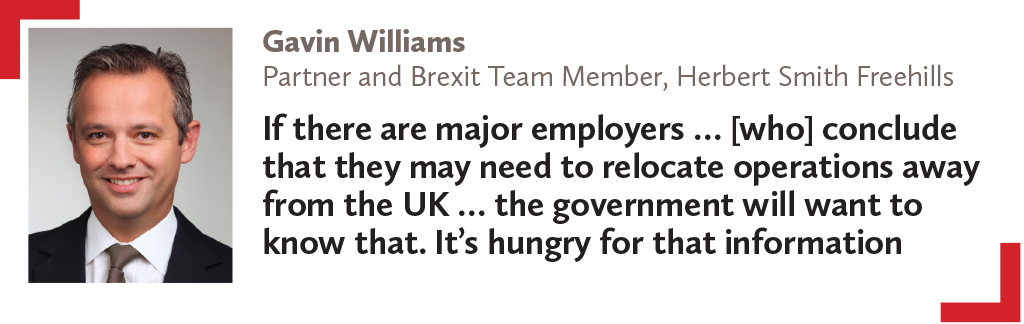
Companies can try to influence the exit negotiation process, however, as the UK government tries to ascertain which path will gain the most support. Understandably, it is mainly large Indian companies that are major employers and profit generators in the UK that will be able to wield such influence. “It’s an inherently political situation which means that jobs and taxes and livelihoods play into the debate,” says Williams. “If there are major employers out there who’ve identified really significant risks and they conclude that they may need to relocate operations away from the UK to preserve the best interests of their business, then the government will want to know that. It’s hungry for that information.”
Some companies may have enough clout to go directly to a relevant minister with their concerns, while others may be represented by industry bodies. Williams says law firms such as his can help individual companies or those represented by associations to craft arguments “into a form politicians will recognize” and hopefully steer the government towards addressing thorny issues and compromising on others.
Among the thorniest issues, immigration was at the heart of the EU referendum in the UK. For now, Europe is sticking to its guns with a strict view that the UK cannot enjoy free market access in the EU without permitting the free movement of people across its borders.
Mobley says Indian companies are concerned about the possibility of more stringent immigration requirements which would threaten their operations and their “flexibility in being able to mobilize and utilize their workforces across the UK and EU”.
But the question many Europeans are asking is whether the principle of free movement is still fit for purpose. “There are similar frustrations being expressed in other countries such as France, Germany and countries across Northern Europe,” says Williams. “These arguments we’ve seen play out in the UK are all going to get aired on the continent next year. Will they produce unexpected results like in the UK? Faced with that backdrop – it’s perfectly possible that the politics may shift – politicians may realize that unless they support fundamental reform of the principles on which the EU is based, the whole project risks collapsing around their ears.”
A SILVER LINING?
Amid all the uncertainty, some areas of law will remain unchanged. “English contract law is entirely unaffected by the UK’s membership of the EU,” says Williams. “Some tiny areas such as consumer protection may be affected, but there is no political ambition to remove those sorts of protections. There won’t be any change to the use of English contract law in international transactions or London as a
forum for settling disputes.”
Indian companies should, however, be prepared for disputes if Brexit results in higher costs, alters regulatory requirements or has other adverse effects on businesses. “There is a possibility that counterparties to contractual arrangements may try to rely on force majeure or material adverse change events to seek to modify or terminate contractual arrangements, leading to the possibility of increased disputes and potential litigation,” says Mobley.
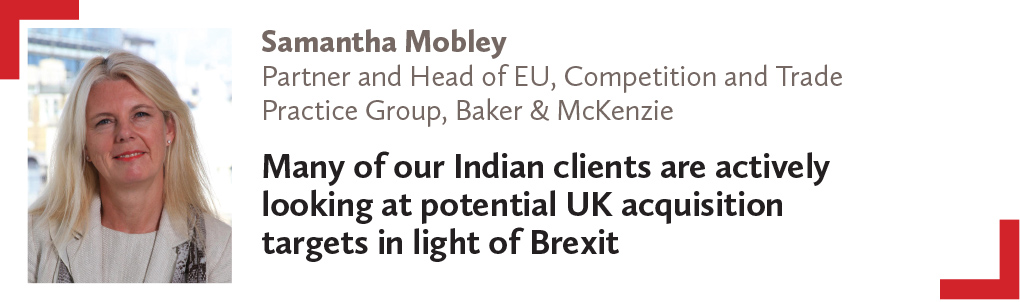
For some companies, particularly those with no exposure in the UK, Brexit may be a blessing. The plummeting pound and lower valuations mean the time is right for bargain hunting. “Many of our Indian clients are actively looking at potential UK acquisition targets in light of Brexit,” says Mobley.
Williams anticipates the announcement of several deals in the coming months. “Due diligence will be very high; acquirers want to understand where every last risk may lie,” he says. “But money is cheap. The flow of work has far from dried up.”
[/ihc-hide-content]