













As two well-known intellectual property law firms merge, Rebecca Abraham asks what clients should expect
In 2013, six lawyers who appear before Delhi High Court were designated as senior advocates, five of them in February and one, Prathiba Singh, in December. Ever since then there have been questions about what lay ahead for Singh & Singh, the reputed intellectual property law firm that Singh, one of India’s leading patent litigators, headed. The Bar Council of India Rules prohibit senior advocates from accepting briefs or instructions directly from clients.
So when it was recently announced that Singh & Singh was to merge with Lall & Sethi, a 15-lawyer IP firm headed by Chander Lall, it was not altogether a surprise.
“I’m keeping my fingers crossed and wish them luck,” Gunjan Paharia, managing partner at ZeusIP a 17-lawyer New Delhi firm, told India Business Law Journal soon after news of the merger broke.
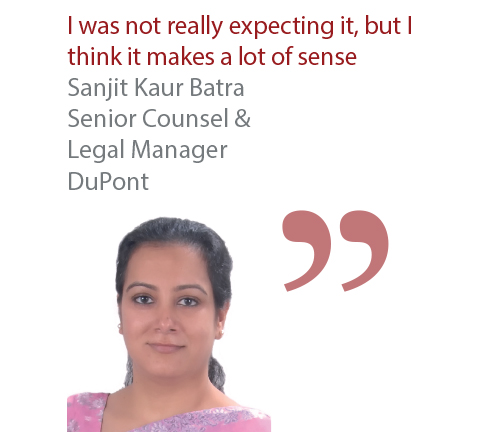
Yet as Sanjit Kaur Batra, senior counsel and legal manager at DuPont, says, it was “definitely big news”.
[ihc-hide-content ihc_mb_type=”show” ihc_mb_who=”3″ ihc_mb_template=”2″ ]
“I was not really expecting it, but I think it all makes a lot of sense,” says Batra, adding that the merger “makes life easier”, as DuPont had typically been using only Singh & Singh and Lall & Sethi for trademark enforcement.
New beginnings
On 1 April, the two firms merged to form Singh & Singh Lall & Sethi, which starts off with nine partners and 24 other lawyers. While the 20-odd lawyers from Singh & Singh continue to work out of their old offices, they expect to relocate by the end of June to Lall & Sethi’s office, after having moved their email addresses on 1 April.
Once Singh & Singh has moved out, its former office will house Prathiba Singh’s counsel practice.
“The merged entity will be run by Chander Lall and there will be eight partners under him who will take the firm forward,” says Singh. “The [Singh & Singh] name has been licensed to the firm.”
Lall says the Lall & Sethi name too has been licensed to the new firm and that it is “virtually a perpetual” licence.
“The idea was to synergize on both the names … the licence is as long as the names stay relevant,” says Lall, who founded Lall & Sethi in 1994. Lall & Sethi was converted into a partnership in September 2013, at which time Lall became founder partner and other partners were appointed as managing partners on a rotational basis.
Lall became managing partner of the new firm on its formation, and will remain so for at least a year.
“We figured that I was the senior-most person amongst the nine partners … I know the practice a lot better than the others and [can] manage the merger and the initial growth period,” says Lall, who adds that the pre-merger law firms will remain responsible for their own debts. “The new firm is neither taking the losses or profits of each other’s firms.”
Equity in Singh & Singh Lall & Sethi is split among the partners. Lall says that the firm’s partnership deed stipulates that “when you join, you are equity partner without having to pay for it and when you leave, you leave behind everything”.
Keen interest
Mergers between law firms are closely watched and more than one has ended in a high-profile failure. The merger in 2006 between Fox Mandal & Co and Little & Co, which was partly an acquisition, was supposed to create India’s largest law firm. But it began to unravel three years later and in 2011 both firms were in court after Fox Mandal filed a criminal complaint against Little & Co for cancelling a memorandum of understanding signed by both firms in 2006.
Yet others, such as the more low-key merger in 2013 between Singhania & Partners and Rajani Associates to create Rajani Singhania & Partners, continue.
“If the merger does work it will instil faith in consolidations,” says Paharia at ZeusIP.

Remarkable similarities
Singh, who forcefully refutes any suggestion that the union of Singh & Singh and Lall & Sethi may have been more of an acquisition of her firm than a merger, sees the merger as an attempt to “build an institution which grows beyond people”.
“Chander was considered as a kind of a friend of the firm. All the partners in Singh & Singh were comfortable with him,” remarks Singh, who founded the firm in 1997 along with her husband, Maninder Singh. Singh & Singh was converted into limited liability partnership in April 2012.
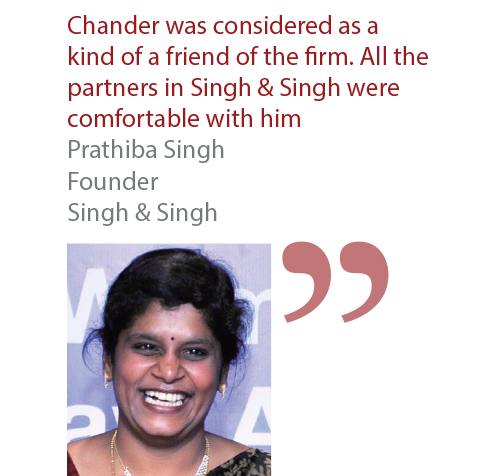
Prathiba Singh has been on several landmark patent cases, including acting for Indian drug companies when the Supreme Court denied Novartis a patent in India for Glivec in 2013. She resigned from the partnership and gave up her equity in the firm when she was designated senior advocate. Maninder Singh, who is also a senior advocate, is currently an additional solicitor general of India.
Lall, explaining the reasons for the merger from his perspective, says it was important to build a larger team.
“There was a need for broadbasing ourselves … we were both reasonably large but a combination of the two would take the size to a reasonable level,” he says, adding that it was good that the firms had different strengths. “What they were strong in and where their revenues were coming in from was entirely different … [Singh & Singh was] not very strong in prosecution, we were not strong in patent litigation.”
Lall and Prathiba Singh both report that the firms were similar in terms of revenues, partner emoluments and partnership structure. “As we discussed … we found there were more and more synergies than what we had anticipated initially,” says Lall.
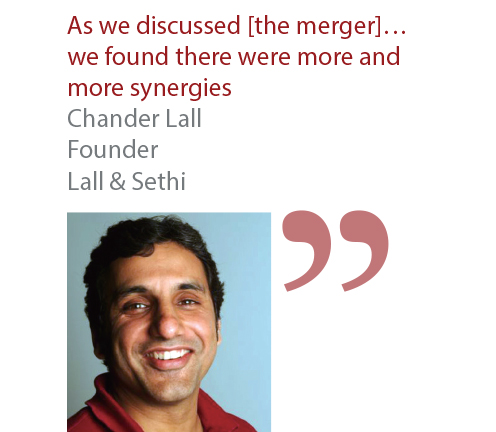
Echoing his sentiment, Singh says that while it may be “actually unbelievable for a third party”, the similarities were such that “it’s almost as though the two were meant to merge”.
Few conflicts, more benefits
Few conflicts of interest have been encountered while moving client mandates to the new entity. Singh & Singh prided itself on being a go-to firm for patent litigation and represented both innovators and generic companies. Lall & Sethi’s client portfolio has included leading brands such as Coca-Cola, Ferrari, Nike and Cisco.
“We are working out the few minor conflicts that there are, amicably with the clients,” says Lall.
There will be plenty of benefits for clients, he adds, stressing that the merged firm is a “comprehensive full-service IP law firm with strengths in each area”.
Clients such as Rajinder Sharma, vice president and general counsel for South West Asia at Samsung, are impressed.
“I am happy to see them merge… it gives industry a very good firm that is good in trademarks, patents, copyright, design, everything in one big shop,” says Sharma, adding that he has used the services of both firms for many years.

Lall expects the firm to “probably” become one of India’s top firms for trademark litigation and trademark and patent prosecution. In addition, “clients are very excited” as the firm will be involved “in virtually 80% of all patent litigation on one side or the other” while also being able draw on Lall & Sethi’s “world-class” database management systems.
“Our strength is to remove all areas of human errors in managing portfolios of clients,” says Lall donning his Lall & Sethi cap.
What’s in it for the members?
Will the merger benefit lawyers at the two firms? Lall admits that at the outset he was “a little worried” as there were two sets of lawyers from different backgrounds. But here too he expects benefits. “There is not much of a conflict … what each lawyer does is distinct and different,” he says, adding that the merger allows partners to “openly pitch a wider portfolio to clients”.
Lall is also convinced that the firm will attract quality lawyers.
“I think the kind of platform we are providing nobody else can provide,” he says. “In every other firm you are going into a setup where the ownership is very defined. In this firm the ownership will be dynamic so it gives lawyers an opportunity to grow and become … equity partners and very senior people in the organization”.
Is Singh similarly optimistic about the firm’s future?
“I don’t see any challenges as long as they trust each other and they remain united,” she says. “If they realize that staying under one roof is better than remaining on their own, I guess they will stay united.”
[/ihc-hide-content]