














The bustling Chinese private equity markets can bring great returns, yet, Leo Long writes, investors should be wary to avoid getting entangled in the legal and regulatory web when seeking out these alluring opportunities.
Private equity (PE) had a capital year in 2014. According to a February report from PricewaterhouseCoopers (PwC), Private Equity / Venture Capital 2014 Review and 2015 Outlook, investments by PEs had record volumes and values (up 51% and 101%, respectively).
Venture capital (VC) deal volumes also saw an increase of 81%, the highest recorded since 2008.
Data from the Asset Management Association of China (AMAC) show that the number of PE fund managers nationwide surpassed 12,000 from 7 February last year, when PE fund registration formally commenced, to the end of May this year. As of 31 March this year, the amount of capital managed by PE fund administration organs had reached RMB 2.79 billion (US$450 billion).
Industry experts have noted that segmentation in the industries in which PE funds raise and invest is becoming increasingly prominent, and sources of capital are becoming more diversified, ensuring that funding will be a new force for active participation in raising PE funds in the near future. Additionally, the market is seeing considerable innovations such as contractual funds.
[ihc-hide-content ihc_mb_type=”show” ihc_mb_who=”1″ ihc_mb_template=”2″ ]
The PwC report states that reform of state-owned enterprises (SOEs) is one of the driving forces behind new investments by PE and VC funds. A new round of SOE reforms has commenced following the call to develop mixed-ownership economy raised at the third plenary session of the 18th party congress. A not insignificant amount of PE funds have already begun to become involved, or are poised to become involved, in these reforms.
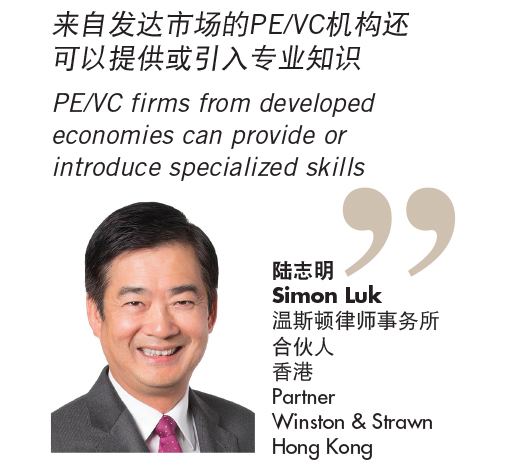
PwC’s report also points out that the uptake in outbound mergers and acquisitions is another significant factor in the expanding scale of private equity. Simon Luk, a partner and chairman of Winston & Strawn’s Asian practice in Hong Kong, says, “With the recent easing of PRC government approvals for outbound M&A activities, the saturation of the Chinese domestic market and their desires to capture a larger share of the profits in the value chain outside manufacturing, many PRC companies are seeking to obtain higher profits in distribution, marketing, retail, customer relations or upstream in product design, brand, quality control, sourcing and research and development in foreign markets.”
Besides providing some of the financing, “PE/VC firms from developed economies can provide or introduce specialized skills such as business strategies applied in western companies, management of asset transactions, and running of an overseas unit”, Luk says.
National Equities Exchange and Quotations – the New Third Market – is also attracting the gaze of a rising number of investors. More than 2,000 small and medium enterprises (SMEs) have rushed to list on the New Third Board. Presently, the market capitalization of all companies listed on the board totals more than RMB 1 trillion. Private equity firm JD Capital listed on the New Third Board in April last year, the first PE firm to do so.
Zhang Shiwei, a partner of Zhong Lun Law Firm in Beijing, notes that JD Capital disclosed in its future development plan that it would also incorporate an increased variety of bond and mezzanine investments and develop alternative asset management services and outbound investment management services in addition to conventional investment into stocks. “In pace with the advent of the asset management era, PE funds have launched an era of pan-asset management”, he says.
Mixed ownership
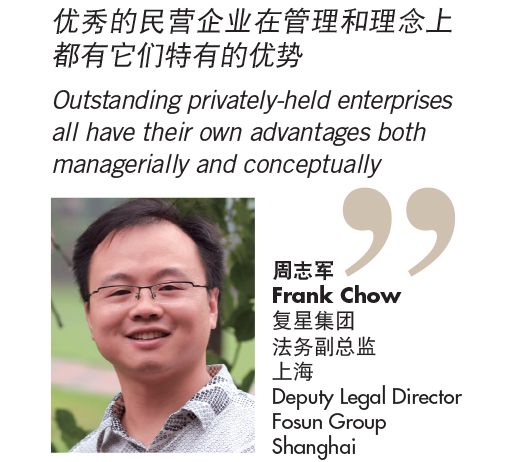
Fosun Deputy Legal Director Frank Chow finds that progress could be accelerated in SOEs when private capital is introduced at an opportune time. He says: “Outstanding privately-held enterprises all have their own certain advantages both managerially and conceptually. A privately-held enterprise can inject these advantages into an SOE after entering it via mixed-ownership reforms, giving the SOE the advantages of the two. This is rather useful for the development of an enterprise.”
This round of reforms could bring change to how SOEs themselves participate in foreign investment. Luk says, “With the mixed-ownership reform for Chinese SOEs, many of them now behave like profit-seeking companies by strategically expanding into foreign markets to improve their profits.”
Luk believes that this can be beneficial to the SOEs. “The overseas business collaboration with foreign PE/VC funds shall enable PRC companies to better deal with the demands of transparency and accountability required by foreign laws and regulations.”
Reform has brought a number of opportunities to PE firms. Shanghai-based Han Yi Law Offices founding partner Richard Xu points out that they have given PE firms the opportunity to invest and participate in industries that traditionally were monopolized. They also have the ability to collaborate with medium and large SOEs, helping them evolve and transform while benefitting from restructuring and reform. “This is an area where PE firms have previously lacked opportunities”, he notes.
The 2014 China Petroleum & Chemical Corporation (Sinopec) asset sale was seen as the flagship transaction of this wave of SOE reforms. The PE funding was more than RMB 100 billion – the largest transaction in China to date.
Zhang Xianzhong, a partner of AnJie Law Firm in Beijing, states, “SOEs have withdrawn from certain competitive spheres, which provides PE firms the opportunity to manage a controlling stake alone or via joint management.”
He gives as example JD Capital, one of China’s largest PE firms. JD Capital recently purchased Zhongjiang International Group, a company under the Jiangsu State-owned Assets Supervision and Administration Commission. As a result, JD Capital indirectly controls China Jiang Real Estate, an A-share listed company.
While opportunities are many, not all PE funds will be able to reap their benefits. Ian Zheng, a partner of Zhonghao Law Firm in Chongqing, says, “While many large SOEs are opening themselves to PE in their reforms, they require that the PE funds have extremely limited scope, background, and overall capacity in terms of asset management.”
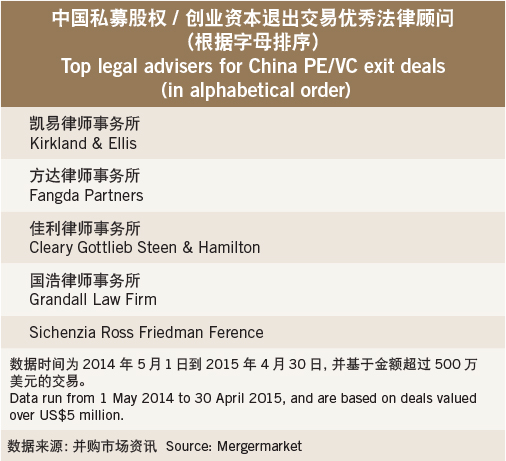
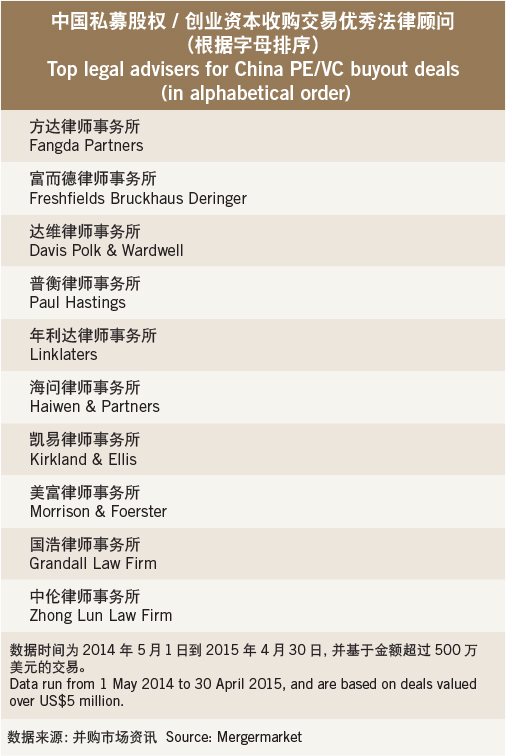
Private equity firms may also be faced with various issues when participating in certain transactions. Xu says that PE firms should especially take note of the several legal issues: (1) state-owned asset evaluation and property transfer; (2) anti-monopoly reviews; (3) state security reviews; (4) SOE managerial and staff stock ownership plans; and (5) anti-commercial bribery and improper competition reviews.
“Clauses on price adjustment, valuation and buy-backs often used by PE funds in other projects may not be fully applicable for use in investment into SOEs due to limits by rules on state-owned capital evaluation and approval. There may also be risks in their execution”, says Xu.
Many of the experts consulted believe that the evaluation and property transfer process for state-owned assets is complicated and takes a long time, and compliance becomes both a major point, both good and bad, for participating in SOE reform. Not only does it touch on the sensitive topic of state-owned asset loss, but it also can influence whether the PE firm will participate.
“Presently many PE firms are inclined toward forming a joint fund or entity with an SOE, rather than taking a direct stake in an SOE so as to avoid this issue”, says Beijing-based Zhong Lun Law Firm partner Jason Liu.
Tony Wang, a partner of Zhonglun W&D Law Firm in Beijing, states, “We would recommend that, before starting any deal in substance, one have a full understanding of laws and regulations on state-owned assets supervision and administration, as well as communicate with the state-owned assets supervision and administration commission well in advance.”
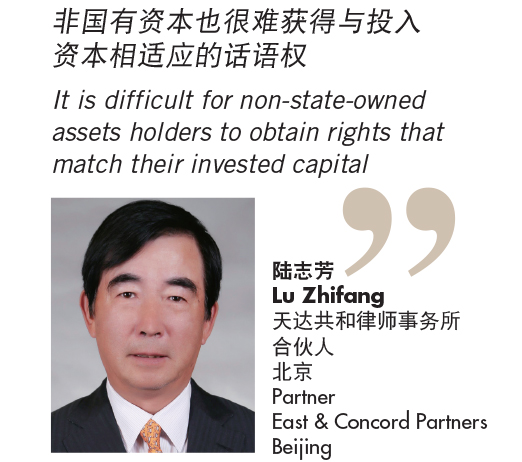
Lu Zhifang, a partner of East & Concord Partners in Beijing, sees an additional risk: “For a long time, the sacrosanctity of state-owned assets has given non-state-owned assets a disadvantageous position when collaborating with state-owned assets. It is also difficult for non-state-owned assets holders to obtain rights that match their invested capital.”
Chow believes that whether PE/VC firms can truly be effective at influencing the SOE post-investment depends on their stake and what results from asserting their rights.
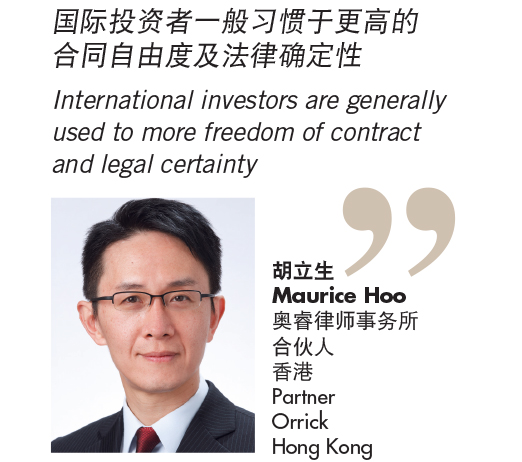
The impact of SOE reform may be limited for foreign investors. “The SOE reform creates opportunities that are sometimes very substantial because of the size of the SOEs”, Maurice Hoo, a partner in Orrick Herrington & Sutcliffe’s Hong Kong office, says. “However, international investors are generally used to more freedom of contract and legal certainty than what investments in SOEs can offer. As a result, I believe there are only a limited number of foreign PEs who can take advantage of these opportunities.”
New Third Board
While listing on the New Third Board is not as fully market-oriented as on the Shanghai or Shenzhen stock exchanges, it is a good channel for financing, says Frank Chow.
Lu notes, “IPO exit channels are poor both in China and abroad. [PE/VC funds] hope to use the New Third Board to execute a partial equity transfer of their invested projects or finance enterprise, which is one of the reasons the New Third Board is so hot right now.”
Jonathan Sun, a senior partner of Zhong Yin Lawyer in Beijing, says that, contrary to before, when exits were at an all-time low, “the crux of the New Third Board is that there is relatively little pressure for PE firms to exit.”
In August 2014, the New Third Board further introduced market-making transfers on the basis of transfers by agreement.
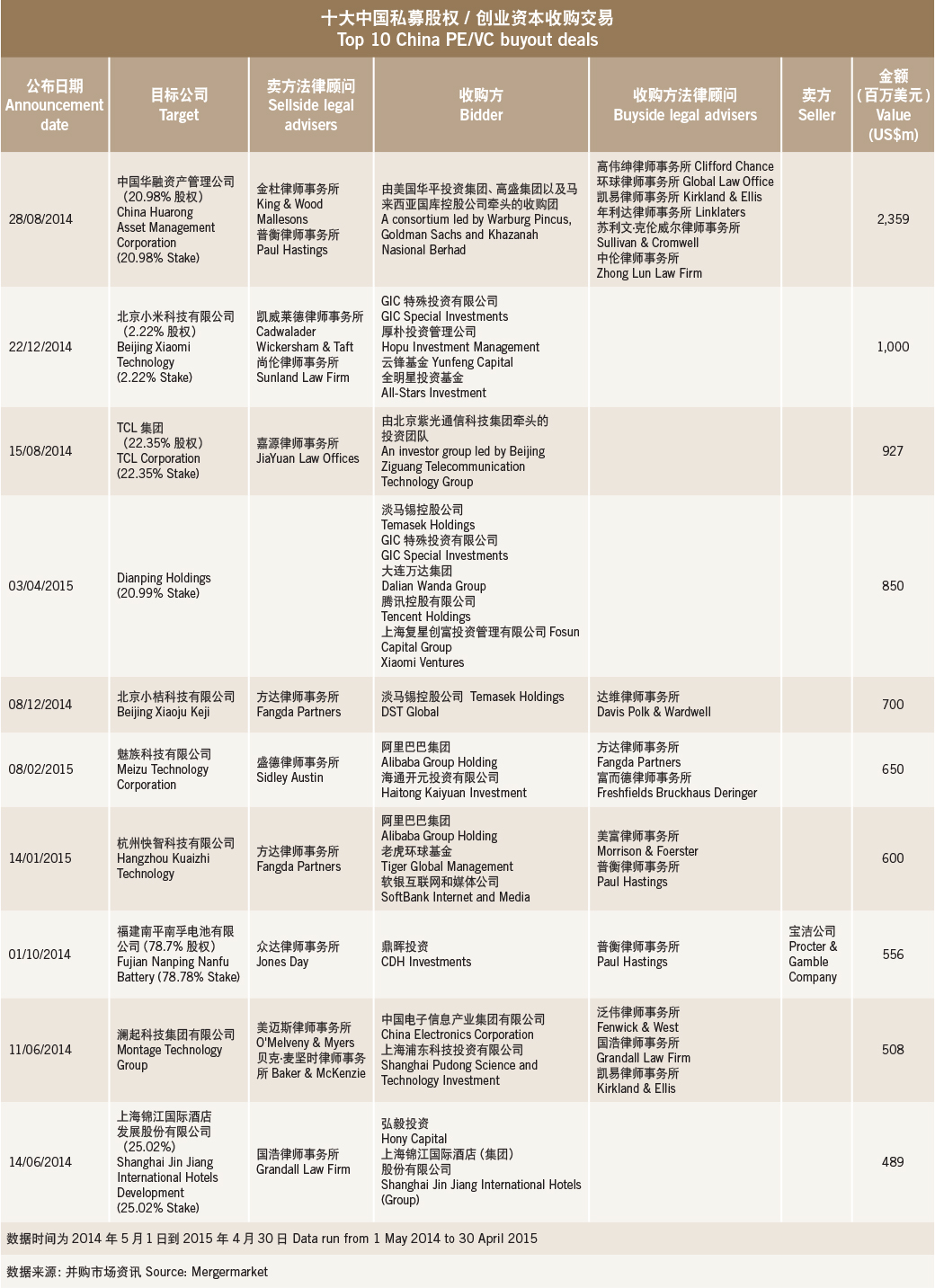
Beijing-based AnJie Law Firm partner Jeremy Dai says this gives PE funds a convenient exit mechanism. “The New Third Board, where numerous institutional investors eagerly participate, also provides a relatively rational valuation platform for the stock value of listed companies”, he notes.

The New Third Board has diversified its transaction methods, introducing transactions via agreement and market-making. In the future it may introduce bidding to further improve its offerings.
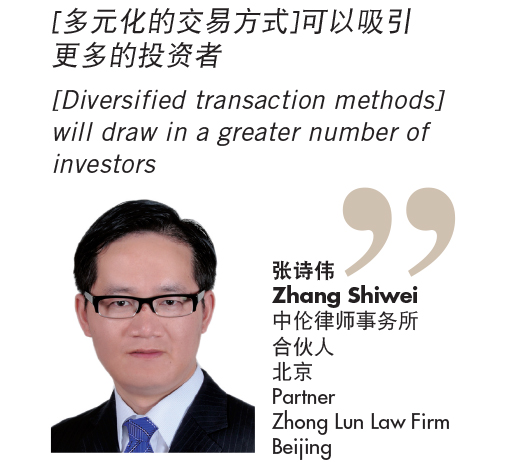
“This will draw in a greater number of investors to better develop the New Third Board’s entry and exit methods, and it may also attract a greater number of high-tech firms,” says Zhang Shiwei.
Zhang Xianzhong says that PE management firms are gradually listing on the New Third Board. As of April this year, several firms have listed since JD Capital paved the way, including China Science & Merchants Investment Management Group (CSC) and HEAVEN-SENT Capital Management Group. “Listing provides PE fund investors a way of executing off-market transfers. Further, the board has introduced private placement, which also provides management firms the possibility of using the New Third Board to do so”, he states.
Currently the exit paths available on the New Third Board are market-making, transfer by agreement, board transfer and M&A, and each has its own issues requiring notice. Ni Jianlin, a senior partner of SG & Co PRC Lawyers, says that, while market-making can be used for a high-value exit, it lacks liquidity. And for transfers by agreement, he notes, there is a limit on the number of shares that can be offered, with a relatively high offer threshold.
Ni points to recent examples of M&A exits such as Baidu’s acquisition of online ratings site Leftbrain and Tongding Interconnection Information’s acquisition of mobile internet marketing firm Raiyi. This method may reap higher returns on investment for the PE fund, he says, yet there remains uncertainty in it.
“This is especially the case with acquisitions that have come under strict supervision because the acquirer did not conform with regulatory rules, which could lead to losses in the M&A deal”, says Ni. A recent example is the acquisition of Xiangcai Securities by financial information provider Shanghai DZH (formerly Shanghai Great Wisdom), which was suspended pending investigation for not conforming to China Securities Regulatory Commission’s (CSRC) regulations on information disclosure.
At the end of May, Hezong Science & Technology became the 10th company to transfer from the New Third Board to the growth enterprise market (also known as the second board market).
Ni believes that, after a transfer is successful, a PE fund not only can exit with a higher value but also accelerate its exit plan. However, Ni points out the uncertainty lying therein: “To date, there have been no additional provisions regarding board transfers added to the laws and regulations, so the companies which have successfully transferred are merely individual cases.”
During the National People’s Congress and Chinese People’s Political Consultative Conference sessions in March, CSRC Chairman Xiao Gang responded to this issue, stating that transfers between levels in a multi-level market is a relatively complex issue. Xiao said that the CSRC is set to research and launch a pilot programme on it this year.
Financial supervision over companies on the New Third Board also needs to be strengthened. “The New Third Board’s registration system and marketized transaction mechanism has become a focal point for distribution of a great number of PE firms”, says Zheng. “But as the bubble in the New Third Board continues to rise, there needs to be more awareness of the risks.”
Kejie Law Office partner Fred Hao says, “One basically should still pay attention to the fundamentals of the invested company, such as the company’s governance, business achievements, and future growth, in order to be on guard against investment risks.”
New trends
“As far as raising capital is concerned, there are more and more types and industrial divisions among funds, and predominately they go within the industry to raise capital. With funding sources, there are some for companies whose business is outstanding in their industry or entrepreneurs investing in a certain segment of the industry”, says Fred Hao.
Zhang Shiwei believes that the traditional fund raising method of a founding partner network selling via bank is gradually fading out. Institutional investors are blazing new trails by building their own wealth administration centres, piggy-backing companies, drawing in industrial capital, issuing SME debt, and even enrolling into capital markets structured as general partners, he notes.
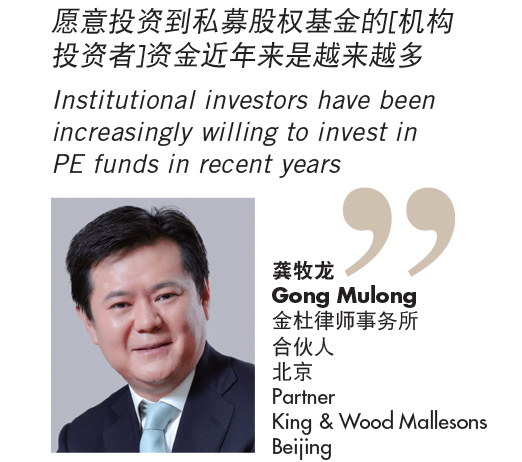
“No matter how you put it, institutional investors as a whole have been increasingly willing to invest in PE funds in recent years”, says Gong Mulong, a King & Wood Mallesons partner in Beijing.
Insurance funds have recently become one of the more active sources of PE capital. The State Council issued its Several Opinions on Accelerating the Development of the Modern Insurance Service Industry this past August, which permitted specialized insurance asset management institutions to establish private funds such as buyout funds, and pilot launches of fund management companies by insurers officially commenced.
In January, Sun Life Everbright Asset Management, an offshoot of the domestic insurer Sun Life Everbright, was approved to launch its first PE fund, which is expected to raise RMB 2 billion.
“Insurance agencies themselves have begun to establish dedicated private equity management companies to conduct their PE investment business, and they are on the market and have even established specialized entities to raise insurance capital”, says Zhang Xianzhong. “When raising insurance capital, PE firms must take note of whether they themselves satisfy regulators’ specific regulatory requirements for insurance funds investing in PE funds.”
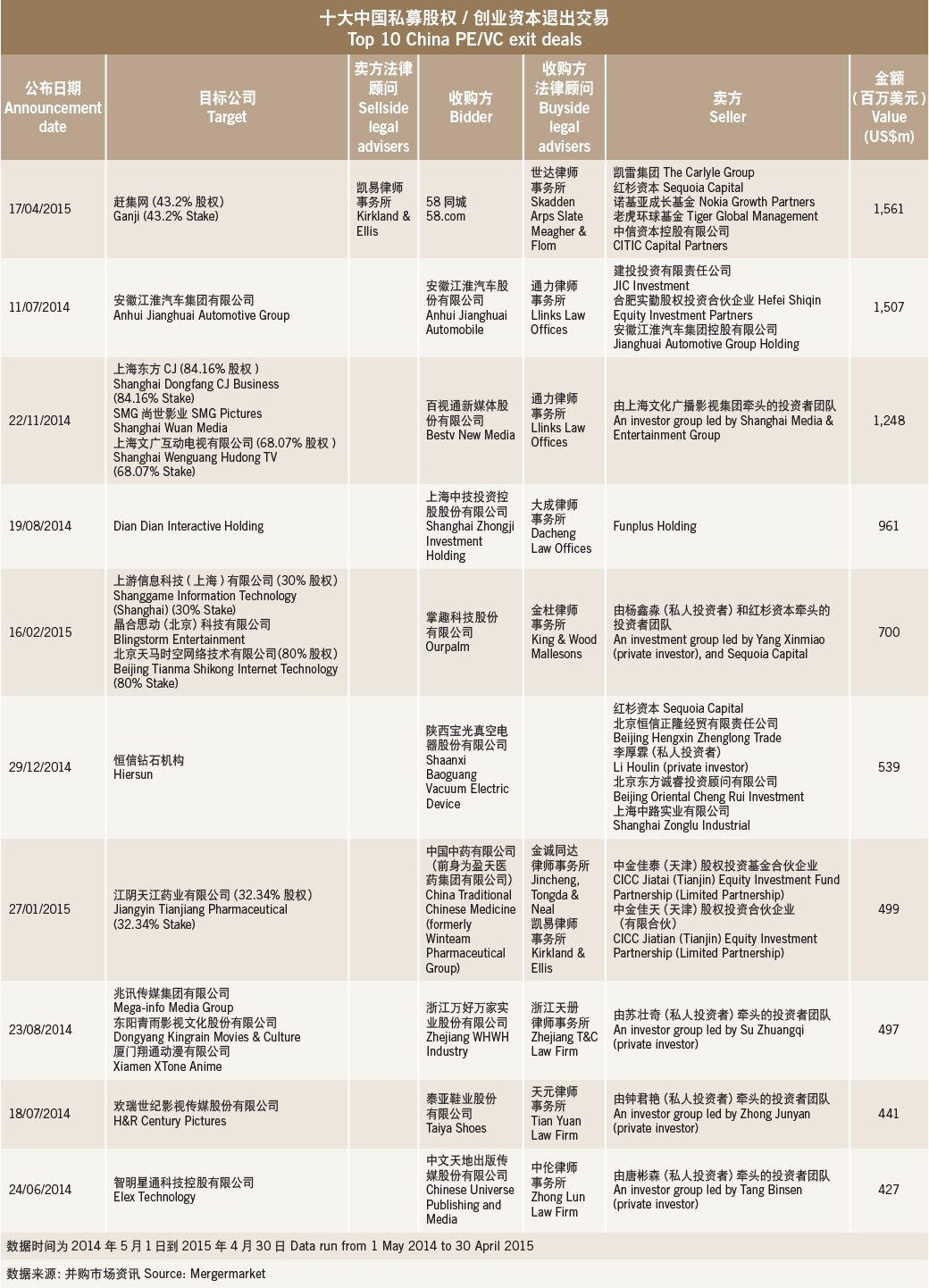
Sun notes a trend of insurance funds partnering with private equity funds to invest into healthcare, modern agriculture, retirement groups, and online services. “Their advantage lies in the relatively stable cash flow and larger amount of capital of the insurance funds, which is conducive to long-term investment”, he says.
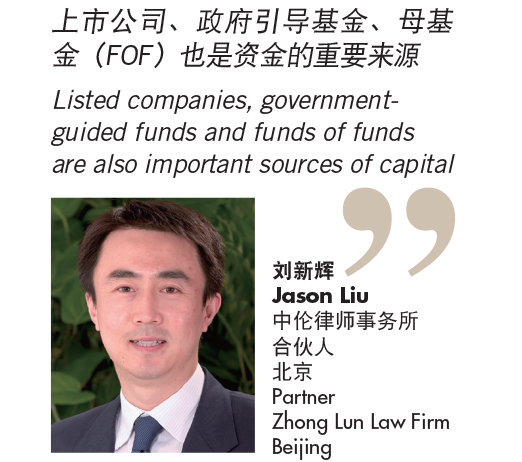
Liu states that, this year, Zhong Lun has participated in a number of cases where insurance funds and bank funds invested in PE/VC. “Listed companies, government-guided funds, and funds of funds are also important sources of capital”, says Liu.
Urban development funds and urbanization funds are also increasingly a new phenomenon. This past September, the State Council issued an opinion on managing local government debt which stipulates: “Financial platform companies will be stripped of their ability to finance the government; finance platform companies may not take on new government debt.”
Zhang Xianzhong points out that this means that financing urban construction projects via financial platforms is no longer viable for local governments, however it is also difficult to meet this demand through government bonds. “Many firms are seeing these investment opportunities and are moving into this area. There are even local governments that have established guiding funds, using them to leverage private investment”, he says.
However, Zhang adds, PE funds must take note of the regional risks and withdrawal channels when getting involved in urban development, and avoid becoming entirely dependent on land sales or local financings funds.
Contractual funds are also increasingly gaining interest in the financial sphere. “Compared with corporate or partnership funds, contractual funds eliminate the registration process, so establishing them is more efficient and effective”, says Zou Jing, a partner of Grandall Law Firm in Shanghai.
Yet contractual funds have not been widely used as of present due to the considerable regulatory ambiguity associated with the funds. “As contractual funds are predominately based on the rights and obligations agreed to by the fund contract parties, there are no statutory requirements for a public platform or notice, so there remain further improvements that can be made on the protection of investors’ rights”, explains Zou.
It is worth noting that, while there are innovations in PE such as contractual funds and funds on the New Third Board, yet, Liu points out, “legislation is lagging behind in terms of these innovations”.
Red chips are coming home
Jeremy Dai points out that, due to the recent hot activity on mainland capital markets, coupled with the uncertainty associated with VIE structures following the recently circulated draft amendment of the Foreign Investment Law, a great number of companies which have set up VIE structures abroad are considering dismantling them and returning to mainland capital markets.
“Some fund managers who actively have invested in USD funds via VIE structures have targeted this opportunity to establish RMB funds specifically to undertake investment opportunities following their return to the domestic capital market”, he says. “It should be noted in these situations that fund managers may be faced with conflicts of interest in undertaking the original investment projects in related USD funds overseas.”
Jason Wang, a partner of Han Kun Law Offices, adds that internet companies have a higher valuation on the A-share market and New Third Board due to their scarcity. “Considerable attraction is being given on domestic capital markets to the many internet companies that are about to dismantle their red chip structures listed overseas and are returning to [list in China on] the A-shares market or New Third Board”, he says.
 A pioneer of these red chip returnees is Baofeng Technology. Baofeng listed on 24 March with an opening price of merely RMB 9.43. Within two months, it hit the daily ceiling for stock price increases more than 30 times, and once topped RMB 300 – nearly 30 times the original price.
However, dismantling an overseas VIE structure and returning to China involves a number of issues, including access to foreign investment industry and choosing where to list. “For returning red chips, the main point to consider is how to convert its red chip structure into a Chinese structure at a relatively reasonable cost”, says Gong.
Further, they need to consider how to provide foreign investors with a reasonable exit, along with the tax costs of the restructuring process, Gong adds. Compared with foreign markets, there are some issues to be resolved in terms of compliance and company structure to list on the A-share market. In Gong’s view, the question of whether to return will depend on the situation of the company itself, and which market is most suitable for listing would need to be considered.
Keep these in mind
The draft amendment of the Foreign Investment Law has cast a dark shadow on overseas VIE structures, and creates a not insignificant problem for PE funds. Jeremy Dai explains that the amendment would identify overseas VIE structures as a form of foreign investment, so that they would lose their capacity to circumvent restrictions on foreign investment. “PE funds have the tendency to create protective measures to reduce potential legal risks that could result from losses in the VIE structure where that structure is maintained”, he says.
“PE funds may consider requiring in the investment agreement that, if the VIE structure is identified as invalid, the investor has the right to demand that the founder repurchase equity held by the investor at a pre-agreed price and ensure that repurchase goes smoothly, and provide other mechanisms to do so. At the same time, protective measures should be set up at the shareholder and board levels of the Chinese-invested company operating the VIE structure to avoid the investor’s subjective loss of control of the actual operations in the future once the VIE structure becomes invalid”, says Dai.
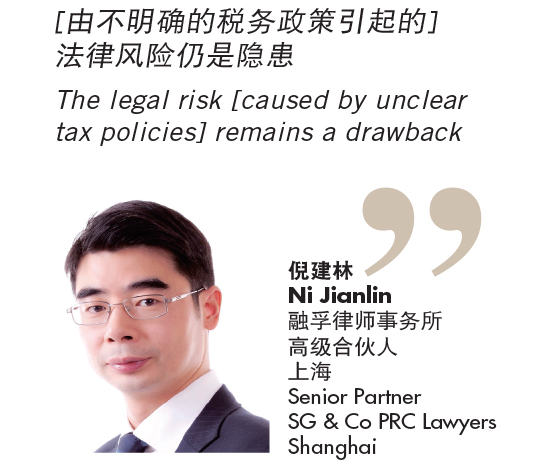
PE firms also are faced with the situation where current regulations are lacking in several areas. Ni says that there are still conflicts between the various regulatory authorities in identifying the nature of PE/VC funds. Further, local preferential tax policies for the funds may not be consistent with national policies. “In practice, PE/VC funds still enjoy tax benefits per the policies where they are registered, and central authorities have given no clear indication as to whether these policies are illegal. Yet it is undeniable that this legal risk remains a drawback”, he warns.
Certain investment agreement terms also face the risk of not being recognized by the judicature. “Terms agreed to by PE investors in an investment agreement, those on fixed income that are often a part of partnership negotiations, or those on guaranteed rates are generally not afforded the protection of the law”, says Jason Wang.
For example, the Provisional Measures for the Administration and Supervision of Privately-Raised Investment Funds sets out: “PE fund managers and selling institutions shall not make commitments to investors that investment capital is principal-protected or guaranteed with minimum returns”.
Jason Wang notes that there is a dual agency concern with information disclosure in PE/VC funds, and the agency relationship tends to produce asymmetric information. The Provisional Measures do stipulate that certain guidance on the investor’s capability to identify risks and on the format and information to be found in the affordability questionnaire and risk disclosure should be formulated by the AMAC depending on the characteristics of the various types of PE funds, he notes. However, he adds, “at present, the AMAC has yet to release rules specifically addressing information disclosure, therefore fund managers and investors generally will voluntarily make their own agreements regarding information disclosure”.
Zou explains that the Provisional Measures are departmental-level regulations and their authority is relatively low. “We would propose that the State Council accelerate passing administrative regulations on PE funds, which would raise the level of regulatory authority”, she says.
Tony Wang concludes that, in the vibrant Chinese capital market, it is the regulations that always lag behind. “The more cases where we see this occurring, the more we need to look to the various factors that have an impact on investment – the latest in CSRC’s regulatory thinking, developments on the market, Supreme People’s Court jurisprudence – to give a comprehensive judgment of the situation.”
[/ihc-hide-content]