














Despite political tension and cultural misunderstanding, Chinese investment in Latin America is moving beyond natural resources and up the value chain
By Alfred Romann
As far as deals go, this one was high voltage. In December last year, the State Grid Corporation of China paid US$1.8 billion for 3,200 kilometres of power transmission lines in Brazil. It was a big step for the largest electricity utility company in the world and a big deal for the many lawyers involved. It was also complex.
State Grid bought seven Brazilian electricity distribution companies from a consortium of Spanish operators. Uría Menéndez, a Spanish law firm with offices in Beijing and Latin America, worked on the deal that had, by the time of the announcement, been in the works for almost eight months.
The deal had been reached in principle almost a year earlier but plenty of negotiating on the terms needed to be done. It was during this process that contrasts in approach surfaced between the fiery Spanish and Latin American players on the one hand and their calmer Chinese counterparts, who rarely made independent decisions, on the other. There was also a language barrier, even though everybody spoke English.
[ihc-hide-content ihc_mb_type=”show” ihc_mb_who=”1″ ihc_mb_template=”2″ ]
The legal complexities of a deal involving a strategically important asset in Brazil, purchased from Spanish owners with finance from China, presented a series of challenges to the lawyers and accountants involved. Cultural differences also presented a challenge, perhaps even more than the legal difficulties, says Juan Martin Perrotto, managing partner of the Beijing office of Uría Menéndez.
For starters, says Perrotto, a government with a less relaxed attitude to defining and protecting its strategic assets might have been reluctant to sell transmission lines to a Chinese group – although it is worth noting that the lines were already owned by foreigners.
The deal also marked a sea change: a step up the value chain for Chinese investment. Rather than buying resources, the Chinese company bought the infrastructure to provide a service. “It is a second generation of [Chinese] investment,” says Perrotto.
But even though Chinese investors can often come up with cash and financing that more established players cannot, they may still have to pay a higher price, which Perrotto calls an “incertitude premium”. This is because sellers across Latin America are less familiar with Chinese investors than with investors from Spain or the US, and may be unsure of the background and pedigree of the people they are dealing with. Perrotto adds that the Latin American side may also need to “add some conditionality to the deal to cope with PRC government approvals that are required, after signing, to close the deal”.
Climbing the value chain
The focus of Chinese investment across the continent is undoubtedly still natural resources, and the largest economies remain China’s biggest trading partners.
“In countries like Chile and Peru, China has significant investments in sectors such as mining,” says Juan Guillermo Ruíz, a partner at Posse Herrera & Ruiz in Colombia. “In Colombia, the Chinese are involved in infrastructure.”
Humberto Medrano, a founding partner at Rodrigo Elias & Medrano in Peru, notes that “the most significant development over the last year is probably [China’s] increasing boldness in the acquisition of natural resources across the region.”
In 2010, China secured at least US$65 billion in contracts for petroleum projects across the region, including extraction, refining and infrastructure investments, according to Energy Tribune, a provider of energy-related information. Among recent deals, China National Offshore Oil Corporation (CNOOC) entered into a joint venture with Bridas Energy Holdings for US$3.1 billion. Bridas is an oil exploration company operating in Argentina, Bolivia and Chile. (Offshore law firm Maples & Calder acted for CNOOC and other law firms were involved, too: please see The deals of the year, China Business Law Journal volume 2 issue 2). Crude oil accounts for almost 15% of all exports to China from the region, and the figure is rising.
Often, China’s resource deals are closely linked to investment in highways, railway or ports, as China seeks to build the means to get resources from where they are extracted to the ports where they can be shipped.
Also significant, however, is a slow but steady climb up the value chain by Chinese investors, both state- and privately owned. The State Grid purchase is part of a clear trend for Chinese companies to invest in service providers and manufacturing companies.
Another example is a deal announced in March in which Chongqing Polycomp International bought a fibreglass reinforcement plant in Brazil from Owens Corning, a Fortune 500 company. This is the first Chinese acquisition in the sector, according to Mergermarket. Uría Menéndez and Perrotto worked with Chongqing Polycomp on this deal.
“There is Chinese investment in the area of technology, more specifically, in the telecommunications sector in Peru,” says in Lima. “Additionally, we have also seen the entrance of Chinese vehicles into the Peruvian market, which have been well received.”
Arturo Alessandri Cohn, a partner at Alessandri y Compania in Chile, agrees that there are certainly more higher-added-value investments across the region. “There are interesting investments in banking in Peru, infrastructure projects like railroads in Argentina and small telecoms companies in Chile,” says Cohn.
A one-way street?
One feature that has not changed much, however, is the direction of trade and investment. As a general rule, Chinese investors buy raw materials and assets in the continent while Latin America generally purchases finished goods from China. Few Latin American companies invest in China, or even sell their products in the Chinese market.
“We definitely do not have the same amount of investment from Brazil to China as the other way around,” according to Martim Machado and Roberto Vianna do R Barros, partners at Campos Mello Advogados, an independent firm with ties to DLA Piper.
This is unlikely to change any time soon, says Erik Bethel, managing director of Sino Latin Capital, a boutique investment bank set up in Shanghai. When Sino Latin’s three partners set up, they were hoping to provide a conduit for Latin America investment in China as much as for Chinese investment in Latin America.
More than two years on, they have all but set aside any thoughts of tapping deals originating in Latin America, directed at China. On the other hand, the firm has compiled what Bethel believes to be the most comprehensive database of China’s deal activity in Latin America.
Luciano Inácio de Souza, a lawyer at Sampaio Ferraz Advogados who specializes in international trade and antitrust, agrees. He describes Brazilian investment into China as “a small stream”.
Cultural differences
Rocio Martinez Hoursay, an associate at the Argentine law firm Mitrani Caballero Rosso Alba Francia Ojan & Ruiz Moreno, lists half a dozen high-level visits and delegations from Argentina to China that have taken place over the last year. But she notes that cultural differences still represent “a substantial challenge, both from a legal and managerial point of view”.
Francisco Soler Caballero, managing partner of the Shanghai office of Spanish law firm Garrigues, elaborates. “Although trade and investment are increasing significantly, people from the two sides don’t know each other very well. The cultural gap is even bigger than with Europeans or Americans,” he says.
Caballero also sounds a note of caution about the Latin American business and regulatory environment: “With obvious differences among the different countries, Chinese investors will encounter in Latin America a business environment that is not as open as the one they are used to facing in Europe or the US,” he says. He also notes that Latin American companies can be as straightforward in their business dealings as any other Western company – but that this in itself can be alien to Chinese businesspeople.
Cultural differences may be exacerbated by the fact that much of the Chinese investment in Latin America comes from state-owned enterprises, and goes into highly regulated industries. With investors who think differently from their private-sector counterparts, investing in industries with a high level of regulation, says Caballero, “the overall deal tends to be very challenging”.
Viewed from the other side, there remains a perception in Latin America that investment in China is difficult. “Treatment is not reciprocal, and investment in sectors considered to be strategic by Beijing is commonly not allowed,” says Cynthia Kramer, a lawyer at L O Baptista Advogados, a Brazilian law firm that specializes in international trade.
Embraer, a Brazilian aircraft maker, is an example. The company invested heavily to build a plant in China but was only allowed to produce one model for which there was limited demand. Production at the China plant has all but stopped, says Kramer.
But the IP firm Dannemann Siemsen in Brazil strikes a more optimistic note, pointing to positive developments in IP law and enforcement. In 2009, China’s Supreme People’s Court recognized a form of punitive damages for the infringement of intellectual property rights: “The Chinese government and judicial courts are currently seeking measures to repress piracy and ensure the enforcement of intellectual property rights, which may well encourage more Brazilian investment,” notes the firm.
Rising tensions
The unbalanced nature of the trade and economic relationship between China and Latin America has led to tensions which have, in the past year, become more marked.
Anti-dumping measures and protectionist policies in a number of Latin American countries have slowed the growth of economic and trade links, says Carlos Treistman, a partner at Morgan Lewis & Bockius, a US law firm that serves clients in Latin America from Houston and clients in China from Beijing. Among others, the firm is working with a Latin American airline expanding in China.
In Peru’s presidential election early this month, Ollanta Humala won on a nationalist platform which included tougher conditions for foreign investors in the oil and gas sector, and a possible windfall tax on mining activity.
China has not sat idly by but “is addressing the situation by engaging in the last year in diplomatic visits to Latin America with a particular focus in the execution of various investment and trade agreements,” says Treistman.
Since last October, China has lifted a number of restrictions on Argentine imports. Argentina, on the other hand, launched several anti-dumping actions against China in 2010. Eighteen such actions are before the Argentine Ministry of Industry and 31 anti-dumping duties are in force, says Tomás Araya, a partner at the Argentine firm M & M Bomchil. Argentina committed to recognizing China as a market economy in 2004 but has not yet passed this into law, so various barriers and sanctions remain in place.
Other countries have also become increasingly concerned about China’s dominance of their trade relationships. Even Brazil, the most powerful economy in the continent, is growing increasingly concerned.
“Several anti-dumping investigations involving products mainly imported from China have affected bilateral trade, more noticeably on shoes,” says Luis Eduardo Ribeiro Salles of Brazilian firm Barretto Ferreira Kujawski Brancher e Gonçalves. “A series of trade-related measures by the Brazilian government in reaction to the alleged artificial depreciation of the renminbi may be expected in the coming months.”
For Brazilian officials, the current value of the renminbi raises fears of de-industrialization, as cheap Chinese goods make their way to Brazil and allegedly discourage domestic makers.
“The regulation on imports of toys, for instance, has been made more stringent,” says Salles. “Brazil’s National Institute of Metrology Standardization and Industrial Quality may impose various certification requirements for electrical products such as fans, microwave ovens, audio and video appliances, among other items.”
In the first 11 months of 2010, Chinese exports to Brazil grew by 62% from a year earlier, says Zhao Xingjian, an associate at Diaz Reus & Targ, which has an office in Shanghai.
More than three-quarters of Brazil’s exports to China are commodities. China’s exports to Brazil, on the other hand, “comprise almost exclusively high-end manufactured goods such as televisions, LCD screens and telephones, which constitute 98% of all Chinese imports,” says Zhao.
For now, Brazil’s need for foreign investment, and the returns such investment can generate, are attractive to China and its US$2 trillion in reserves, says Christian Roschmann, a partner at Lefosse Advogados, which has a co-operation arrangement with Linklaters. Lefosse has worked with several Chinese clients including Wuhan Iron and Steel, COFCO, and Chery.
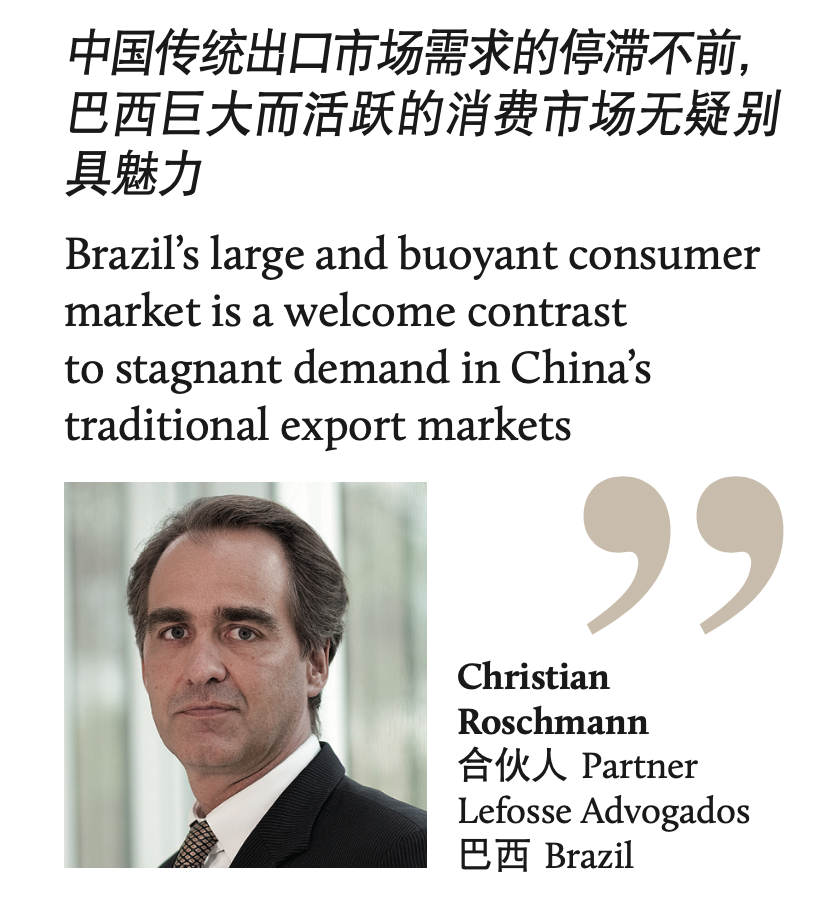 “Brazil’s large and buoyant consumer market is a welcome contrast to stagnant demand in China’s traditional export markets in the United States, Europe and Japan,” says Roschmann. “We expect construction markets in Brazil to grow strongly until 2014. High growth in the shorter term reflects the increased investment needed to host the FIFA Soccer World Cup in 2014 and the Olympics in Rio in 2016.”
[/ihc-hide-content]