



LinkedIn
Facebook
Twitter
Whatsapp
Telegram
Copy link

Even as regulation continues to increase, appetites in Asia for offshore investment continue to grow. China has long been a vanguard in this area, but other investors in Japan, South Korea, India and Australia, for example, are focusing more and more on further afield. Joanna Law reports

For Asian countries and investors who have their eye on tapping into foreign markets, offshore jurisdictions such as the Cayman Islands, British Virgin Islands (BVI), Jersey, Guernsey and Bermuda remain the most popular platforms. These offshore jurisdictions, with their relatively lax but efficient and transparent regulatory regimes, provide a favourable environment for Asian investors for doing business with each other via offshore centres.

“The M&A market continues to be active in Asia with Cayman, BVI and Bermuda remaining the top jurisdictions for offshore M&A transactions,” says Denise Wong, a partner at Walkers in Hong Kong. “We regularly advise on privatizations of Cayman-incorporated companies that are listed on the Stock Exchange of Hong Kong (SEHK). We receive a steady stream of mandates for fund formation transactions and we expect this to increase. The Cayman Islands remain the jurisdiction of choice for offshore fund formation,” she says.

On the equity financing side, Rachel Huang, legal manager at Ogier, says Cayman continues to be the most prominent choice for IPOs in Hong Kong. “A Cayman company as a holding company in the context of IPOs has long been familiar and accepted by the stock exchange and regulators in Hong Kong,” she says. “The legal infrastructure and expertise is readily available and well established in this area. Notably, we have also seen the use of Cayman structures by Chinese companies who seek for a listing in the [South] Korean stock exchange.”

David Lamb, a partner and co-chairman of Conyers Dill & Pearman in Hong Kong, says the first six months of the year have been particularly active. “For IPOs, the first half of 2017 has seen 53 Cayman companies launching on the SEHK, with their offerings totalling US$2.26 billion in value. The Hang Seng Index is currently over 27,000, its second-highest level since the global financial crisis, which should bode well for IPOs for the second half of the year. We are also seeing a number of our clients raising US dollar debt issuances directly or through MTN programmes,” he says.
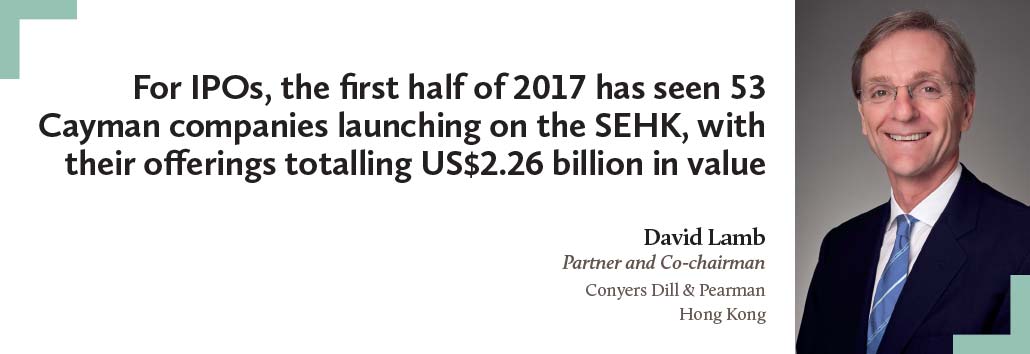
David-Lamb,-Partner-and-Co-chairman,-Conyers-Dill-&-Pearman

However, Lamb sees a decline in deal volume and deal value in both global and US M&A markets, driven by a fall in strategic M&A activity. “Consortium bids led by PE [private equity] have offset some of this decline,” he says. “Cross-border activity also decreased in deal volume. This is not surprising given the geopolitical uncertainties.”

[ihc-hide-content ihc_mb_type=”show” ihc_mb_who=”4″ ihc_mb_template=”2″ ]

In terms of trends for Asian countries using offshore jurisdictions in the past year, Wong observes:

  • Hong Kong-based private equity funds are increasingly seeking to utilise “capital call” bridge financing;
  • There has been continued growth in the restructuring space in the region, and in China;
  • Cayman and BVI special purpose vehicles (SPVs) are favoured for offshore bond transactions in Asia. SPVs incorporated in these jurisdictions can assist companies in Asia in raising finance from international investors;
  • There has been increased interest in Cayman orphan and charitable trust structures from Asian clients;
  • There has been an increase in shareholder activism, which has fuelled demand for Cayman, BVI and Bermuda advice in relation to shareholder disputes;
  • The use of Cayman Island LLCs has increased since the introduction of new legislation in July 2016.

Japan has a long history of using offshore structures, particularly Cayman Island structures, says Matt Roberts, corporate partner at Maples and Calder in Hong Kong. “On the funds side we are seeing the largest Japanese pension funds continue their push into alternative investments, particularly with respect to private equity, as they chase better returns than what can be offered in the Japanese domestic market,” he says.

Matt-Roberts,-Corporate-and-Funds-Partner,-Maples-and-Calder

As a result of diminishing returns in Japan, Roberts says that the Japanese pension funds competing with the major Western pension funds for stable assets that will provide a regular return and opportunities for capital growth and quality assets, such as infrastructure projects, are sought after for this purpose. “The Japanese institutions are building up their asset management expertise so as to be in a position to increase their capability to invest in foreign markets, and we expect that, as their expertise increases, this trend will continue to gain momentum as these funds are very keen to deploy some of the vast reserves of capital that they are currently holding,” he says.

The use of offshore structures is largely dictated by the domestic law in the jurisdiction where the economic activity takes place. Offshore structures make markets and cross-border investments more accessible and more efficient, and provide better returns for investors, leading in turn to more investment.

Roberts says South Korea and Vietnam have been active, with the Cayman IPO market continuing to build momentum in South Korea, and an increasing use of offshore funds focused on Vietnam. “We see Korea and Vietnam using offshore (Cayman) fund structures, most of these are PE fund structures to invest into PE projects in sectors such as real estate, infrastructure, healthcare and technology,” he says.

Meanwhile India also represents tremendous opportunity. Foreign investors into India usually invest via offshore structures in jurisdictions that have a double taxation agreement with India. “We are seeing a number of our clients look to increase their investment exposure to India as the government continues with its drive to modernize India’s tax code and foreign investment regime,” says Roberts.

Jude Scott, chief executive officer at Cayman Finance in the Cayman Islands, says he has seen more interest than in the past from Australian fund managers, who are looking at establishing Cayman funds to bring international investment capital into Australia.

The offshore (Cayman) hedge and private equity fund structures have been continued to be used by Australian asset managers for foreign investors and projects outside Australia, says Roberts. But he adds that within Australia, domestic Australian fund structures are mainly used for Australian tax and regulatory reasons.

Rachel-Huang,-Legal-manager,-Ogier

Cayman Island and BVI SPVs for offshore bond transactions are particularly favourable to Asian corporations. “SPVs incorporated in these jurisdictions can assist companies in Asia in raising finance from international investors” says Wong.

Huang says that Cayman Island and BVI SPVs are popular among Chinese companies in their overseas investment and financing. In September 2015, China’s government liberalized offshore bond issuances by abolishing the pre-approval requirement and replacing it with a pre-issuance registration system with annual quota control.

It also published policies to encourage direct bond issuances with proposed use of proceeds to support certain national initiatives, including the Belt and Road initiative. “These moves made direct issuance an easier and more attractive option for Chinese issuers than it was before,” she says.

Typically, the SPV will be the issuer, with Chinese companies’ onshore parent or overseas operations providing certain credit enhancement measures, such as direct guarantee or keep well undertaking. Huang says the quick turnaround time during the Asian working day, and the common law-based legal systems, have contributed to the popularity of these SPVs.

Cayman has also become a respected centre as a domicile of alternative investment funds, structured finance and financing transactions. Over many years, successive governments of the Cayman Islands and the industry have demonstrated the jurisdiction’s commitment to enacting local legislation needed to achieve this, and have given full co-operation to those international initiatives that Cayman believes also enjoy support from the international business community. For these reasons, many of the best managed hedge funds and private equity funds have funds based in the Cayman Islands that invest in projects (including large infrastructure projects) all over the world.

With recent hurricanes slammed through the Caribbean and causing devastating damage, many investors showed concern on the impact done on the offshore regions’ functionality. Law firms in the regions have sent out statements to clients updating their progress after the storms. “There has been no impact on the Cayman Islands,” says Roberts.

“The British Virgin Islands has been impacted by hurricanes Irma and Maria and our thoughts continue to be with our colleagues and friends in the BVI who have been through a horrible past few weeks. All of our BVI colleagues in the BVI are safe,” he says. However, there has been significant damage to homes and property, so many businesses have relocated from the BVI, together with their families, to other offices. The BVI government, including the BVI Financial Services Commission, and BVI community have been working hard to rebuild.

Denise-Wong,-Partner,-Walkers

In the past 12 months, both the BVI and the Cayman Islands have seen a number of legal and regulatory developments.

The Cayman Islands Department for International Tax Co-operation (DITC) recently released Guidance Notes and Updates on Common Reporting Standards (CRS). According to Wong, to comply with the CRS regulations that implement CRS within the local Cayman Islands framework, each Cayman Islands reporting financial institution must have written policies and procedures in place.

These policies and procedures must state, among other things, how that entity will address its obligations regarding due diligence, record keeping, notification of the required information and reporting to the Cayman Islands Tax Information Authority (TIA) via the Cayman automatic exchange of information (AEOI) portal, the appointment of any third parties, and co-operation with the TIA’s compliance measures.

“The CRS guidance notes make clear that the Cayman Islands reporting financial institution will need to have its own written CRS policies and procedures in place, even where the investment entity is delegating the CRS obligations to a third-party service provider such as an administrator,” says Wong. Where the entity is delegating the CRS obligations to a third-party service provider, the investment entity’s written policies and procedures should describe what functions have been delegated, the management/oversight of the delegation, and the performance of any CRS obligations that have not been delegated, she adds.

CRS and AEOI remain the most topical compliance issues for Asian clients. The DITC in Cayman has issued an industry advisory regarding CRS, US FATCA (Foreign Account Tax Compliance Act) and UK CDOT (Crown Dependencies and Overseas Territories International Tax Compliance Regulations). Companies should have already notified the TIA if an entity is a reporting financial institution or non-reporting financial institution under CRS, as the deadline of 31 July 2017 has passed.

Likewise the 31 August 2017 deadline has passed for submission of AEOI reports for the 2016 reporting period in respect of any reportable accounts, and to file a nil return in respect of those reportable jurisdictions for which it has no reportable accounts. In future years, the deadline to submit AEOI reports will be 31 May.

Companies should note the deadline of 31 Dec 2017 for completion of due diligence on pre-existing “lower value” individual accounts and pre-existing entity accounts under CRS. “Asian investors should pay attention to this, as this is a new development and will affect companies in Asia,” Wong says.

Cayman beneficial ownership

Following public consultations during 2016 and early 2017, legislation has recently been passed that requires Cayman Islands companies to maintain registers of beneficial ownership at their registered offices. The Cayman Islands Ministry for Financial Services, as the Cayman Islands competent authority, will establish a non-public platform that will allow it to search information on a company’s beneficial ownership provided by the company’s corporate services provider upon the request of specified Cayman Islands or UK law enforcement authorities.

“The Cayman Islands has had a world class beneficial ownership regime in place for over 15 years, which includes a mandatory requirement to collect verified, accurate and complete beneficial ownership information, with multi-level sanctions for non-compliance, both at the company and licensed corporate services provider (CSP) level,” says Scott.

He adds that the beneficial ownership technology enhancements will also mitigate the possibility of “tipping off” and will allow for enhanced search parameters. The data will be made accessible to both regulators and law enforcement agencies for appropriate requests through a central point of contact.

BVI beneficial ownership

The Beneficial Ownership Secure Search System Act, 2017 came into effect on 30 June. It requires each BVI licensed registered agent to establish and maintain a dedicated database of the BVI companies for which it acts. The BVI government is establishing a secure non-public electronic platform that will allow access to each registered agent’s database only by a designated person, from a single designated secure location within the BVI. Information will only be shared upon the certified lawful request of specified BVI or UK law enforcement authorities.

“The introduction of these central beneficial ownership registers is viewed as an appropriate and effective way to improve transparency in support of internationally adopted and practised standards, while continuing to protect the privacy of legitimate commercial interests in both jurisdictions,” says Catherine Ross, a partner at Forbes Hare in Singapore.

Meanwhile, The Limited Liability Companies (LLC) Law, 2016 of Cayman Islands came into force on 8 July 2016. Judy Lee, head of corporate at Appleby in Hong Kong, observes that an LLC is a hybrid entity, merging certain characteristics of a Cayman Islands exempted company with those of a Cayman Islands exempted limited partnership.

She says that the affairs of an LLC are not governed by memorandum and articles of association, but by its operating agreement, which must be governed by Cayman Islands law. As the Law in many instances defers to the operating agreement, members of an LLC have great flexibility in deciding on their LLC’s structure and the provisions under which it is to be governed.

“We believe many clients will embrace the LLC as the suitable form of business vehicle in appropriate circumstances, including the structuring of investment funds where the LLC is used as the general partner or the investment manager, corporate transactions requiring joint venture or special purpose vehicles and venture capital and private equity structures,” says Paul Cheuk, counsel at Appleby in Hong Kong.

Jude-Scott,-CEO,-Cayman-Finance

In the European market, the Channel Islands jurisdictions of Guernsey and Jersey have long served as established offshore financial centres used by Asian investors. For companies in Asia looking to acquire trophy assets, particularly in the UK, Jersey and Guernsey are popular choices due to a reputation for their high level of financial regulation and low-tax regimes, combined with their proximity to European financial markets.

“Guernsey’s reputation in the Chinese market is illustrated by the fact that it was home to the first ever renminbi-focused bond fund, which was established in 2007 as a protected cell company (PCC) by Stratton Street Capital,” says Wendy Weng, China representative at Guernsey Finance in Shanghai. The Guernsey-based International Stock Exchange also listed its first ever Chinese issuer in 2015, when China Cinda Finance (2014) II listed debt instruments on the exchange.

In March this year, Guernsey’s regulator, the Guernsey Financial Services Commission (GFSC), signed a Memorandum of Understanding (MoU) with the China Insurance Regulatory Commission (CIRC). Weng says the MoU will enable a flow of information between the regulators to ensure compliance with the relevant laws in each jurisdiction, thereby promoting “the integrity, efficiency and financial soundness of those doing business between Guernsey and China”.

It also means that the GFSC now has MoUs with all of China’s financial services regulators, including the China Banking Regulatory Commission and the China Securities Regulatory Commission. “As Chinese financial services firms are expanding, they are looking for a high-quality domicile from which to conduct their international business. The signing of this MoU is symbolic of the openness of Guernsey’s insurance sector to Chinese-led business,” Weng says.

Bermuda’s parliament in recent years has kept pace with fast-changing market demands. It has passed significant corporate legislation to keep Bermuda globally competitive as a domicile of choice. Ross Webber, chief executive officer and deputy chairman of Bermuda Business Development Agency, says the island is recognised for its leadership and proven record on co-operation and tax transparency by the Organization for Economic Co-operation and Development (OECD) the Financial Action Task Force (FATF), and G20 nations.

Upon recommendation of the OECD, Bermuda recently enacted the Registrar of Companies (Compliance Measures) Act 2017, which came into force on 24 March 2017. The act enhances the Bermuda Registrar of Companies’ regulatory, inspection and enforcement powers with respect to those books and records maintained by registered entities to ensure the entities are fully compliant with the governing requirements.

“The expansion of the registrar’s regulatory responsibilities will maintain Bermuda’s favourable OECD rating and further demonstrates why the jurisdiction has respected status as a leader in compliance and transparency,” says Wong.

Meanwhile, Bermuda is a low-tax jurisdiction, with zero income, corporate, withholding or capital gains taxes. “Our unique tax system was designed to support Bermuda’s infrastructure and the island does not differentiate between local companies and exempted entities in the way they are taxed; they are all treated equally,” says Ross Webber, chief executive officer and deputy chairman of Bermuda Business Development Agency.

Roberts says that investor appetite in Asia for better governance standards continues to evolve and is getting closer to those in the Western economies. “Companies need to juggle and run at the same time by watching and reacting to these developments, while at the same continuing to grow and develop their core businesses,” he says.

[/ihc-hide-content]

https://law.asia/cayman-continues-pre-eminent-global-offshore-jurisdiction/

LinkedIn
Facebook
Twitter
Whatsapp
Telegram
Copy link