












The evolution of the Insolvency and Bankruptcy Code is being closely watched by companies, creditors and the government for the part they hope it will play in alleviating the country’s stressed assets problem. Gautam Kagalwala reports
The Insolvency and Bankruptcy Code, 2016 (IBC), was widely anticipated among creditors for its ability to recover outstanding loan amounts, and lawyers, who see insolvency as one of the most promising practice areas. It received former president Pranab Mukherjee’s assent in May 2016, following which the corporate insolvency resolution provision came into effect in December that year. Under the code, the National Company Law Tribunal (NCLT) will hears cases relating to companies and limited liability partnerships, while debt recovery tribunals (DRTs) are for partnerships and individuals. The parliament is also debating the Financial Resolution and Deposit Insurance Bill, 2017, which will deal with banks and financial services companies that have become bankrupt. Once enacted, the laws together will address all kinds of failures and provide needed protection for the financial system.
The IBC is evolving legislation and its effectiveness is being tested at the NCLT and DRTs, and by extension the National Company Law Appellate Tribunal (NCLAT), Debt Recovery Appellate Tribunal (DRAT) and the Supreme Court in cases where parties are dissatisfied with their outcomes.
The law has been praised for providing linear processes and a time-bound resolution of insolvency proceedings, as well as preventing debtors from mismanaging affected business.
Areas of concern
Prior to the IBC, insolvency had been governed by the Companies Act, 1956/2013, the Sick Industrial Companies Act, 1985 (SICA), the Securitization and Reconstruction of Financial Assets and Enforcement of Security Interest Act, 2002 (SARFAESI), and the Recovery of Debt Due to Banks and Financial Institutions Act, 1993 (RDDBFI).
“The provisions of the Sick Industrial Companies (Special Provisions) Repeal Act, 2003, came into effect on 1 December 2016. The repeal act provides for repeal of the SICA and related matters,” says Satyajit Gupta, a principal, Corporate / M&A at Advaita Legal in Delhi, adding that there appears to be no legal impediment for cases being heard by a DRT and DRAT that were constituted under the RDDBFI Act to be initiated as new cases under the IBC.
Once the NCLT accepts the insolvency resolution application, a 180-day moratorium begins. “The new code allows for a moratorium period ordered by the NCLT on the commencement of the insolvency resolution process, which would stay all proceedings under the SARFAESI Act including enforcement of security,” says Akshat Pande, a partner at Alpha Partners in Noida.
He says the IBC has also amended provisions of the RDDFBI Act. “RDDBFI offers limited legal recourses when it comes to debt recovery by banks and other financial institutions. The IBC improves on these issues by the bestowal of rights on all kinds of creditors to issue insolvency proceedings against the debtor.”
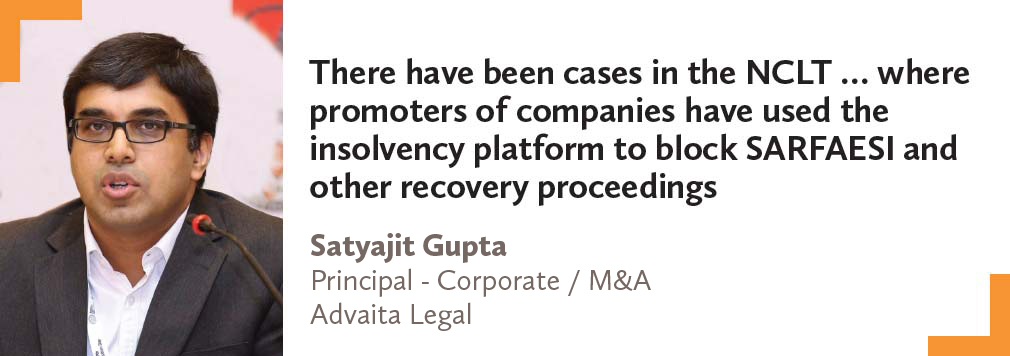
Gupta says the interactions of the IBC and debt recovery laws need to be addressed. The former provides for collective action while the latter is geared towards individual creditors. “There have been cases in the NCLT after the introduction of IBC where promoters of companies have used the insolvency platform to block SARFAESI and other recovery proceedings,” says Gupta. “It is critical that the provisions of SARFAESI are harmonized with IBC, so that the former act does not undermine the effectiveness of the latter.”
Cross-border insolvency is another area that needs to be addressed by the Insolvency and Bankruptcy Board of India (IBBI), says Sumant Batra, the managing partner at Kesar Dass B & Associates in Delhi. Many insolvency cases involve foreign creditors and a significant portion of the debt is in foreign currency. Foreign courts may not accept corporate insolvency resolution processes (CIRPs) approved by the NCLT, while the NCLT may not recognize orders from foreign courts.
[ihc-hide-content ihc_mb_type=”show” ihc_mb_who=”3″ ihc_mb_template=”2″ ]
“The IBC has two provisions that allow the government to enter into bilateral agreements with other countries to enforce the IBC’s provisions. However, without a comprehensive framework for cross-border insolvency, bilateral agreements are unlikely to be of much help in dealing with cross-border issues,” says Batra.
Professionals play pivotal role
The IBBI has so far registered 900 insolvency professionals (IPs) and the 11 benches of the NCLT across the country have admitted more than 200 cases. A large number of IPs are based in Mumbai and Delhi, where a similarly large number of cases are being heard. The IPs themselves are critical to the implementation of the IBC as they steer the company involved on behalf of the committee of creditors (CoC), which takes control of the company from the debtor. The IP has a challenging task and is accountable to the NCLT and diverse interests within the CoC while dealing with the evolving law.
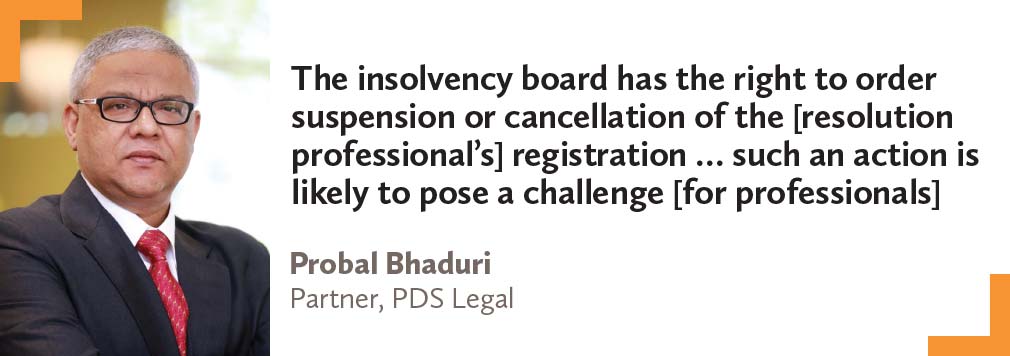
In the Synergies Dooray Automotive resolution case, Edelweiss Asset Reconstruction, a creditor, filed a complaint against the IP with the IBBI in September this year, saying the IP had conducted herself in a partisan manner. “The insolvency board has the right to order suspension or cancellation of his/her registration,” says Probal Bhaduri, a partner at PDS Legal in Delhi. “Such an action is likely to pose a challenge in the working of a resolution professional – foremost, their right to practise as an insolvency professional will be at risk. In the present case, Edelweiss has already preferred an appeal against the order before the NCLAT in September.”
Bhaduri explains that dissatisfied parties can file a complaint with the insolvency board against an IP under section 217 of the IBC. The insolvency board may then appoint an investigating authority to conduct an investigation against the IP. The impartial conduct of IPs is being gauged. However, personal qualities aside, the registered IPs themselves are acquiring the experience of conducting and closing the CIRP.
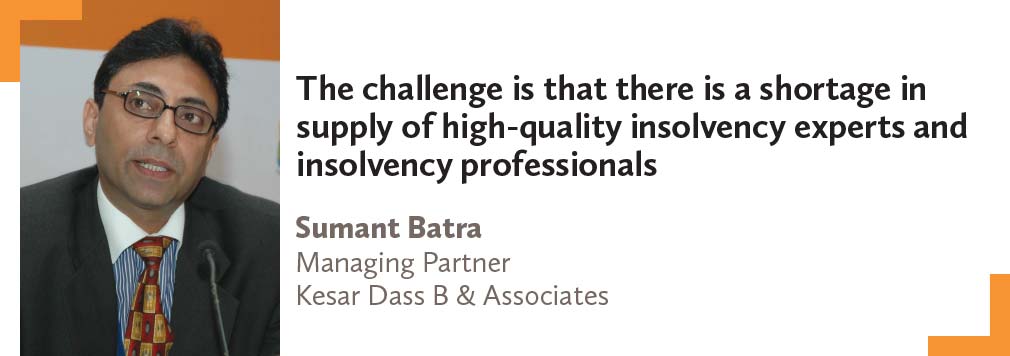
“Insolvency is the most sought-after practice area for law firms in the country,” says Batra. “The insolvency professionals are the biggest clients for the insolvency advisory practice. The challenge is that there is a shortage in supply of high-quality insolvency experts and insolvency professionals.”
Tanuj Sud, a partner at Gravitas Legal in Delhi, says that while India has sufficient infrastructure to train a high-quality pool of insolvency professionals, “the quality of insolvency resolution services would need to keep pace with evolving jurisprudence and commercial practices being adopted by the industry, the success of which can only be tested over a period of time”. Sud points out that the Indian banking sector has faced a lot of stress and resistance due to the government’s enhanced focus on recovery and stress redressal.
The stressed assets problem
Parliament passed the Banking Regulation (Amendment) Bill, 2017, during the monsoon session. The bill amends the Banking Regulation Act, 1949, by equipping it to handle stressed asset cases. The Reserve Bank of India (RBI) is empowered to direct banks to act in insolvency cases, the proceedings of which would be under the IBC.
The bill also replaces the Banking Regulation (Amendment) Ordinance, 2017, which was introduced by the government as a temporary law and promulgated in May. “The ordinance acknowledged the unacceptably high levels of stressed assets in the banking system, and also stated that the provisions of the IBC can be effectively used to address problems of non-performing assets (NPAs) by empowering the banking regulator to issue directions in specific cases,” says Gupta. He adds that public sector banks, which hold 88% of the NPAs, were hesitant to institute insolvency proceedings as they felt that the IBC was for liquidation of companies, which would yield lower returns for them. But, with the government and the RBI’s further support, they will be more confident.
The RBI in its Financial Stability Report released in June said that the banking stability indicator had worsened between September 2016 and March 2017, with a deterioration in asset quality and profitability. The gross NPAs of scheduled commercial banks were expected to rise from 9.6% in March 2017 to 10.2% by March 2018. The risk profile in March 2017 showed that the telecom sector had the largest debt and negative profitability. On the other hand, the power, construction, and iron and steel industries were affected by relatively high leverage and interest burden.

“The IBC has emerged as one of the most important tools at the hands of the financial institutions, and both the RBI as well as the government are making all possible efforts in establishing a robust banking regime using this tool,” says Pande. He adds that the RBI had referred 12 corporate debtors, with debts of more than ₹50 billion (US$763 million) each, for insolvency proceedings under the IBC. Similarly, the RBI directed banking institutions to resolve 55 high-value cases of bad loans within six months to decrease the extreme levels of the NPAs by finding solutions under the IBC.
Sud says the backlog of NPAs is too deep and intrinsic to be immediately addressed by the IBC. But on a more optimistic note he concludes, “When we are hopefully able to look back with pride on how the economy has been cleansed of this problem, the Insolvency and Bankruptcy Code will be one of the standout measures to which we will attribute this reformation.”
[/ihc-hide-content]