






LinkedIn
Facebook
Twitter
Whatsapp
Telegram
Copy link

Global antitrust enforcement is growing in complexity as M&A activity climbs beyond record levels and businesses face closer scrutiny from increasingly sophisticated authorities, writes Vanessa Ip

Increasing internationalization has been a long-running theme in global antitrust enforcement. In Clifford Chance’s Global Antitrust Trends 2016 report, the law firm reported that global antitrust enforcement would invariably trend towards increasing complexity. The firm echoes this sentiment in its 2017 report, The Antitrust Horizon, predicting that for antitrust enforcement and merger control, the global trend will be towards proliferation and complexity, in terms of both procedure and substance. The report identifies two themes that will dominate the outlook for global businesses, including the propagation of new technology and the recent rise in protectionist rhetoric among many political leaders. “The former will bring new antitrust challenges and disputes, while the latter may result in greater political intervention in cross-border deal-making and more disputes over subsidies,” the report says.

According to Antoine Winckler, a partner at Cleary Gottlieb Steen & Hamilton in Brussels, “The increasingly global nature of transactions has further led to continued collaboration and co-ordination with other antitrust agencies around the world.” As regulation increases and antitrust authorities become more sophisticated, companies need to be more stringent and reinforce their compliance regimes to avoid being caught by regulatory sanction and scrutiny.

According to practitioners in the US, one of the most significant developments in the past 12 months has been the increasingly aggressive approach to mergers being taken by the Department of Justice (DOJ) and the Federal Trade Commission (FTC).

Janet McDavid, a partner at Hogan Lovells in Washington, observes that US merger control authorities are becoming more litigious. “[There has been an] increased willingness of both the FTC and DOJ to litigate matters that cannot be resolved in a way they think is satisfactory,” she says. “As a result, both agencies now have multiple matters in litigation. Both agencies have been insisting that parties to merger investigations put substantial and meaningful remedy proposals on the table before the agency will start to discuss the proposed remedy. The agencies have a view of what is needed to resolve their concerns and will not waste time considering inadequate remedy proposals.”

In its Competition/Antitrust Global Market Outlook 2016 publication, Linklaters reported that FTC and DOJ policies on merger remedies have become so strict and demanding that merging parties may ultimately be forced to abandon their transactions in cases where “the economics no longer make sense”.

But Jonathan Jacobson, a partner at WSGR in New York, says increased merger enforcement will have a minimal but positive effect on foreign investment, “at least to the degree that foreign investors are buying US companies they compete against”.

European Union

There have been significant developments in relation to antitrust laws and enforcement in the EU in the past year. With regard to cartels, while the European Commission (EC) has continued to enforce leniency applications, it has also imposed the largest cartel fines to date, totalling €3.6 billion (about US$4 billion).
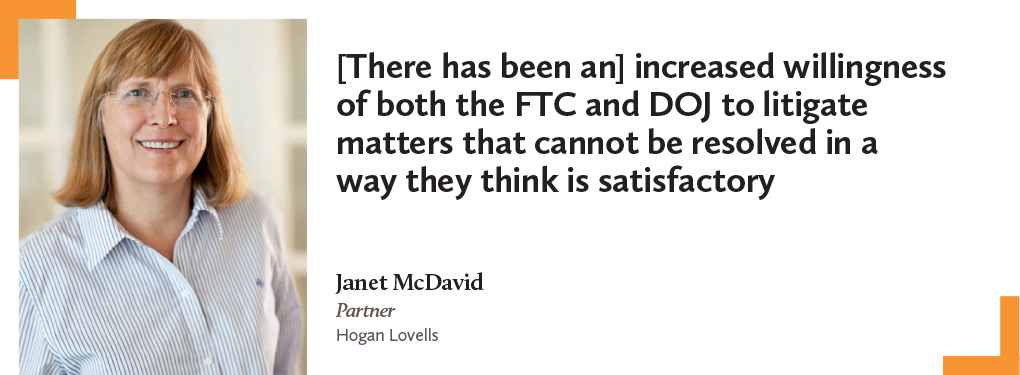
Janet McDavid, Partner, Hogan Lovells

Merger notifications have also reached a record high. According to Antoine Winckler, this is due to the high level of M&A activity in 2015, which resulted in the highest number of merger notifications to the EC since 2008. While merger control will often be an important consideration for high-profile investments and M&A, Fiona Carlin, a partner at Baker McKenzie in Brussels, warns that certain features of European merger control laws can mean that a mandatory merger filing is required in less obvious situations.

[ihc-hide-content ihc_mb_type=”show” ihc_mb_who=”4″ ihc_mb_template=”2″ ]

“The EC recently adopted an approach that has potentially far-reaching implications for how transactions involving state-owned enterprises [SOEs] should be assessed for the purposes of EU merger control,” she says. “When assessing the planned joint venture between China General Nuclear Power Corporation [CGN] and EDF, the commission controversially considered that the activities and turnover of other SOEs active in the same business sectors, i.e., energy and nuclear sectors controlled by the China’s State-owned Assets Supervision and Administrative Commission [SASAC] were attributable to CGN for the purposes of its review.”

Alastair Mordaunt, Partner, Freshfields Bruckhaus Deringer

In this case, “CGN’s turnover in Europe was not enough on its own to trigger an EC filing, but only once the turnover of other relevant SOEs were considered,” explains Alastair Mordaunt, partner and Head of the Hong Kong competition practice at Freshfields Bruckhaus Deringer. “The takeaway for SOEs is that they need to consider both the turnover and activities of other SOEs in their sector when assessing first whether their acquisition triggers an EU filing, and second the impact on competition arising from it. From a practical standpoint, this adds further burden on what is already a relatively difficult and often time-consuming information gathering process.”

Foreign investors are also not often sensitive to areas of antitrust enforcement that are different from the US system, says Winckler. “In particular, EU enforcement policy is often viewed as more complex and rigorous in areas such as ‘vertical’ contracts i.e., distribution (particularly in the online arena), or abuse of dominance. Obviously the commission’s tight control over state subsidies granted by national governments is also specific to the EU.

“Interestingly, with no foreign investment regulations at the EU level, European companies have remained attractive for foreign investors, including from China. Chinese outbound investment in Europe has continued on record high levels, resulting in an increasing number of transactions involving Chinese entities, including SOEs, reviewed by the EC. Notably, following the German government’s recent reopening of the review of the acquisition of Aixtron, a semi-conductor equipment supplier, by Grand Chip Investment Fund, a Chinese investor, there has been an initiative to call for a Europe-wide safeguard clause to stop foreign takeovers of firms where technology is deemed strategic for the future economic success of the region.”

Asia-Pacific

According to a 2017 report by Berwin Leighton Paisner (BLP) titled Key Trends in Hong Kong and ASEAN Competition Enforcement, Association of Southeast Asian Nations (ASEAN) member states have committed to enacting national competition laws as part of their drive to develop economic growth and establish a level playing field for competition across Southeast Asia.

James Marshall, antitrust and competition partner at BLP in London, says there is a clear commitment among member states to have competition regimes in place and imbue the association with a culture of effective enforcement.

“It is clear that companies doing business across Asia will face active competition law regimes and enforcers in almost all key jurisdictions,” he says. “The scope of competition laws and the activities of competition agencies are expanding at pace. Companies active across East and Southeast Asia in 2017 and into the future should expect the active enforcement and expansion of competition law to continue, and should ensure that their Asian businesses have adequate compliance policies in place, and that key staff on the ground are fully aware of the importance of their competition law obligations.”

In the past 12 months, Indonesia’s Commission for the Supervision of Business Competition (KPPU) has been stepping up its merger control enforcement with, for the first time, the imposition of fines for late notification in two transactions involving foreign investors, says Tasdikiah Siregar, Jakarta head of TNB & Partners in association with Norton Rose Fulbright Australia.

“On the behavioural front, bid-rigging conduct remains a clear enforcement priority but the KPPU is gradually stepping up its enforcement actions against other cartel-like practices, including in cases involving foreign companies,” she says.

Looking forward, Siregar says the Indonesian government has conveyed its plan to conduct a regulatory overhaul of Indonesia’s antitrust and competition law (Law No. 5 of 1999).

“Despite strong criticism and objections from the business community to strengthening the KPPU’s role, the government is still moving to revise the 1999 law having issued an initial draft bill. The draft bill introduced revisions which would, among other things, give the KPPU: (a) increased investigative powers; (b) the ability to impose heavier fines; and (c) a broader supervisory role on merger control.” There is no specific timeline for passage of the bill through parliament.

Sharon Tan, Partner, Zaid Ibrahim & Co

In Malaysia, Andre Gan, managing partner of Wong & Partners in Kuala Lumpur, describes the past 12 months as “a headline-grabbing year” for the Malaysia Competition Commission (MyCC).

“The June 2016 decision against container depot operators and an IT services provider was basically in respect of a hub-and-spoke cartel, which is an antitrust concept with very few precedents in other jurisdictions,” he says.

“MyCC also issued its first final decision on abuse of dominance against MyEG Services for discriminatory practices in managing renewals of online foreign workers permits.”

According to Sharon Tan, a partner at Zaid Ibrahim & Co in Kuala Lumpur, the MyCC has continued its focus on investigating cartels. “Most notably, the MyCC issued a proposed decision against the General Insurance Association of Malaysia [known locally as PIAM] and its 22 members for alleged fixing of trade discounts on parts and hourly labour rates,” she says. “The MyCC has proposed financial penalties in the aggregate of 213 million Malaysian ringgit [about US$50 million], the highest fine ever proposed by the regulator.”

In terms of the overall landscape of competition law in Malaysia, Tan says that the Competition Act 2010 is generally applied, but some sector regulators have jurisdiction over competition regulation in their sectors. For example, “the Malaysian Aviation Commission, established in 2016, has purview over commercial regulation in the aviation sector and was given authority over competition matters in that sector”.

Andre Gan, Managing Partner, Wong & Partners

In the Philippines, the Philippine Competition Law was enacted by congress on 21 July 2015. According to Francis Lim and Eric Recalde, partners at ACCRALAW in Manila, although the law is “shaping up”, the Philippine Competition Commission (PCC) is still finding its foothold, given that competition law is fairly new in the nation.

The PCC recently provided a handful of issuances, in the form of regulations, clarification and memorandum circulars, mainly focusing on merger control. But only time and practice, say Lim and Recalde, will provide greater insight into how the PCC carries out its mandate.

In Singapore, Marshall of BLP says the city-state is in many respects the regional leader in enforcement and policy. Singapore’s competition law and the Competition Commission of Singapore (CCS) celebrated their 10th anniversaries in 2015. A public consultation on the CCS’s amendments was held in late 2015, and the updated guidelines came into force on 1 December 2016.

In late 2016, the CCS finalized the first comprehensive review of its guidelines. Bill Reid, partner and competition practice head for Asia-Pacific, and partner Alyssa Phillips, of Ashurst in Brisbane, say the revision “sought to provide clarity to businesses and consumers about how the CCS administers and enforces its competition laws”.

Among various changes aimed at making the laws easier for business and consumers to understand, the CCS has made amendments to streamline procedures for filing notices to seek guidance or a decision, says Marshall. “A new ‘fast track’ procedure, akin to the European Commission’s settlement procedures, where parties who admit breaching competition law will be granted a 10% reduction in penalties, came into force on 1 December 2016.”

Reid and Phillips add that while the new procedure has not yet been used, the reform is intended to enable the CCS to issue timely decisions, while creating various efficiencies throughout the investigative and enforcement processes.

In Thailand, on 24 March 2017, the draft Trade Competition Act (2017) was approved by the National Legislative Assembly (NLA). According to partners Pornapa Thaicharoen and Ampika Kumar, of Baker McKenzie’s Bangkok office, the act will replace the current Trade Competition Act (1999), and is expected to come into effect in August or September 2017.

Key amendments under the act include: (1) the spin-off of the Office of Trade Competition Commission into an independent organization separate from the Ministry of Commerce and consisting of full-time commission members; (2) the inclusion of state-owned enterprises within the ambit of trade competition laws, with the exception of those operating in accordance with the laws, Cabinet resolution or state policy deemed necessary for the stability of the state or for the public interest; (3) the introduction of administrative penalties for softcore cartels and unfair trade practices; (4) the recognition of single economic units for the purpose of determining dominance of a business operator; and (5) the inclusion of merger control mechanisms.

Thaicharoen and Kumar add: “It is expected that the level of enforcement would be improved. It is anticipated that the promulgated law would not specifically affect foreign investments but will affect business operators in the market as a whole, especially those with significant market power.”

Kaori Yamada, a partner at Freshfields in Tokyo, says the Japan Fair Trade Commission’s (JFTC) activities in the past could be characterized by two aspects: “(1) moving along with more aggressive overseas regulators; and (2) various system reforms to match the new direction of their enforcement.”

Yamada says that the JFTC has been increasingly keen to investigate areas of global attention, as opposed to its traditional focus on domestic initiatives.

She adds that with other authorities increasingly interested in the IT/IP areas, the JFTC has also updated its IP guidelines to address the latest global discussion on FRAND (fair, reasonable and non-discriminatory terms).

Kaori Yamada, Partner, Freshfields

“The JFTC has also been in extensive discussions on various system reforms, including the introduction of enhanced due process measures, the update of penalty calculation rules to allow more discretion to the JFTC to reward companies’ co-operation, and the introduction of a commitment system originally triggered by the TPP.

While system reform discussions remain ongoing, Yamada says it is clear that the reform will bring the Japanese systems closer to the EU rules. “Overall, the expectation is that the JFTC’s enforcement will inevitably become something more aggressive and more international.”

In China, antitrust enforcement is developing at a rapid pace. Clifford Chance reported that in 2015, antitrust fines reached RMB7 billion (about US$1 billion) representing a year-on-year increase of 400%.

Zhan Hao, Managing Partner, AnJie Law Firm

According to Huang Wei, a partner at Tian Yuan Law Firm in Beijing, 2016 was very active for the National Development and Reform Commission (NDRC). “It has fined seven pharmaceutical companies in two cases, both relating to horizontal monopoly agreements, and fined a leading domestic home appliance company for its vertical monopoly agreement conduct [fined by Shanghai Municipal Price Bureau],” he says.

Zhan Hao, managing partner at AnJie Law Firm in Beijing, says for China’s antitrust public enforcement, “industries that are closely related to consumer welfare bear more risk of becoming a priority for enforcement. Currently, the antitrust enforcement priorities rest with the pharmaceutical and medical device, auto, shipping, household appliances, insurance and public utility industries.” Zhan adds that there has been an increasing number of high-profile antitrust private litigation cases. “The issues involved in the disputes have become more diversified than before, including, but not limited to, the essential facility doctrine, injunction and royalty calculation for Standard Essential Patents [SEPs], de facto SEPs, refusal to deal, and horizontal monopoly agreements.”

In terms of antitrust enforcement in China, practitioners agree that foreign investors tend to underestimate the potential risk of private antitrust litigation and do not devote enough attention to familiarizing themselves with investigation procedures adopted by the NDRC and State Administration of Commerce and Industry (SAIC).

Kevin Wang, Partner, CMS China

Huang Wei observes that foreign investors may fail to notice antitrust risks in respect of vertical non-price-related monopoly agreements, may not accurately evaluate their market power, and may not devote enough attention to antitrust risks that relate to miscellaneous abusive activities.

“The antitrust enforcement agencies in China have a right to find market dominance abuses activities not explicitly prohibited by the Anti-Monopoly Law [AML],” he says. “For example, in the Tetra Pak case, the SAIC found loyalty rebates could constitute antitrust violations even though the AML does not explicitly prohibit it. Therefore, in designing a new business arrangement which tends to exclude or restrict competition, especially those that have been regulated in other jurisdictions, a firm with market power must be especially cautious.”

In case of investigations, “foreign investors need to understand the importance of communication with the Chinese anti-monopoly enforcement authorities and utilize the local expertise to overcome the cultural differences”, says Kevin Wang, partner and head of competition at CMS China in Shanghai. But the same goes for Chinese businesses investing overseas.

In general, co-operation and communication between antitrust enforcement agencies in different jurisdictions are increasing, posing more challenge to companies’ compliance work, says Zhan. Now is the time for foreign investors to re-assess antitrust risks globally and strengthen their compliance structures in time.

[/ihc-hide-content]

LinkedIn
Facebook
Twitter
Whatsapp
Telegram
Copy link