







The Belt and Road initiative dwarfs the Great Wall of China, and pretty much anything else on earth, in its perceived magnitude. In the first of a special series of articles, Andy Gilbert looks at the germination of the initiative and traces its growth so far
If the whole is greater than the sum of its parts, then the One Belt, One Road (OBOR) initiative is undoubtedly the biggest infrastructure project ever conceived. Six economic corridors running through Asia, Europe and Africa, connecting vibrant economies of East Asia at one end with developed Western Europe at the other. A massive upgrade of the region’s infrastructure: roads, railways, ports, power stations; interconnected via more than 65 countries covering almost two-thirds of the world’s population, one-third of global GDP, and a quarter of all goods and services worldwide. Even Aristotle might have raised an eyebrow.
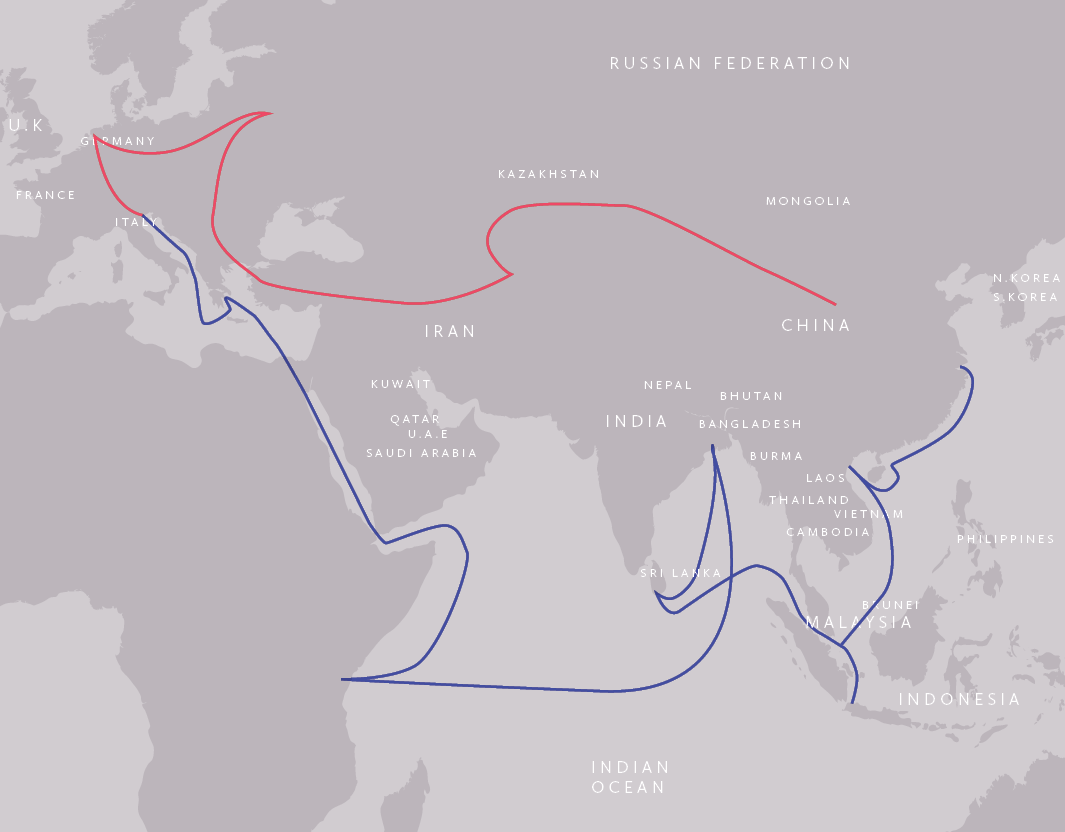
But what exactly is OBOR, which has more recently, and perhaps more accurately, been labelled the Belt and Road initiative? In terms of infrastructure, it’s perfectly tangible. A significant development strategy launched by the Chinese government to create a modern day Silk Road Economic Belt and 21st Century Maritime Silk Road, promoting economic co-operation among countries along its land and sea routes.
In other ways, however, it’s perhaps not quite what it seems. Layered beneath the millions of tonnes of concrete lies China’s push to take a bigger role in global affairs, its need to export excess production capacity in areas such as steel manufacturing and infrastructure construction, and so expand its political influence, internationalize the renminbi, and kick-start its economy amid slowing growth in exports and fragile domestic demand.
“OBOR is a concept rather than any detailed plan,” says Ronald Sum, a Hong Kong-based partner at Troutman Sanders. “On the commercial side, the OBOR initiative is predominantly to promote trade and investments among various OBOR countries. On the non-commercial side, it is the ultimate integration of different systems – economy or otherwise – within the OBOR countries.”
It’s certainly not without controversy, or scepticism at the very least. Some China watchers have called the initiative financially unsound and unsustainable, with a price tag in the region of US$8 trillion. Certain projects, almost entirely financed by Beijing, have even been likened to Chinese economic aid rather than bilateral investments, with all the resulting influence cynics would point out that brings.
[ihc-hide-content ihc_mb_type=”show” ihc_mb_who=”1″ ihc_mb_template=”2″ ]
Chinese Foreign Minister Wang Yi has dismissed comparisons of the initiative to the US-sponsored Marshall Plan, which gave billions of dollars of economic support to help rebuild Europe following World War II, but also to try to exert its influence while stemming the spread of communism. The Belt and Road initiative is “the product of inclusive co-operation, not a tool of geopolitics, and must not be viewed with an outdated Cold War mentality”, said Wang.
However it’s viewed, there has already been strong consolidation of the framework for the initiative. “Importantly, it is now clear that the groundwork has been laid and ‘stress tested’ through actual projects’ initiation, development, financing and operation,” says Carolyn Dong, the Beijing and Hong Kong-based head of energy – China (finance and projects) at DLA Piper. “The key institutional framework and corresponding funding bodies have been established and Chinese corporate momentum is now all firmly in place behind the initiative.”
The Belt and Road will not only connect regions, but connect with the past. The original Silk Road, a network of major trade routes, is believed to have existed for more than 2,500 years, but was formally established during the Han dynasty (202 BC-220), originating from what is now Xi’an and ending in the Mediterranean, linking China with the Roman Empire. It reached its height during the Tang dynasty (618-907), but declined during the rule of the Mongol empire (1271-1368) as political powers along the routes became fragmented.
When the Ottoman empire boycotted trade with the West in 1453, the Silk Road was effectively closed and merchants were forced to take to the sea. For the next 100 years or so, this Age of Discovery led to worldwide interaction – perhaps even the beginning of globalization.
And it was in the spirit of globalization that, in September 2013, the original OBOR concept was introduced by Chinese President Xi Jinping during a visit to Kazakhstan, where he suggested that China and Central Asia co-operate to build a Silk Road economic belt. The following month, in a speech before the Indonesian parliament, Xi proposed building a tight China-ASEAN community, and offered guidance on constructing a 21st Century Maritime Silk Road – sea ports and routes – and establishing the US$100 billion Asian Infrastructure Investment Bank (AIIB) based in Beijing to finance new construction and promote regional interconnectivity and economic integration. (The bank has already loaned more than US$2 billion, most recently to finance projects in Indonesia and Bangladesh.)
High-level considerations
China’s developers and lenders face high levels of legal risk associated with the Belt and Road initiative. Sean Prior, a Singapore-based counsel at Mayer Brown JSM, outlines the main areas where commercial lawyers are likely to be called upon to add value.

Country risk analysis: Each country will differ significantly in its legal structure and approach to key questions such as: (1) Can a Chinese investor own 100% of a project; (2) Can it import Chinese labour to carry out construction and operation? And if so, to what extent; and (3) How regularly do regulations change, and do they protect or exempt existing projects? These types of questions must be answered before an investor can even get into the technical requirements of how to enter into joint ventures, contract effectively, obtain finance, and so on. Good lawyers will also explain what actually happens on the ground, and whether that differs from what the rules are on paper. This upfront analysis is essential to any investment.
Structuring: A Chinese investor will want to know how to structure its investment to maximize tax benefits, bilateral treaty coverage and corporate and group efficiencies. Lawyers in the region should know which structures work and will be able to explain them, their alternatives, and the risks each option carries.
Financing and credit enhancement: Depending on the investment and the jurisdiction, there are significant numbers of financing structures and credit enhancement options that Chinese companies can take advantage of, including multilateral development agency cover, export credit agency involvement and insurance. Each set of options carries its own risk profile and pricing. Lawyers are expert at assessing and implementing these options.
Robust contracts and dispute resolution: Once the country risk, structuring and other high-level considerations are settled, investors will need strong, robust documentation that complies with all local requirements and international best standards. They will also want to be comfortable that they have chosen the most effective dispute resolution forum that suits the country and the investment.
–
Xi later announced that China would contribute U$40 billion to set up the Silk Road Fund to provide investment and financing support for infrastructure, resources, industrial and financial co-operation, and other projects in countries along the Belt and Road routes. There is also a US$100 billion New Development Bank, a funding source for BRICS countries.
Support for the Belt and Road initiative has also been pledged by other Chinese banks, also a framework agreement has been reached between the Asian Development Bank and China’s central government to foster financing of Belt and Road projects, and talks have been held between China and the EU on the co-operation between the European Fund for Strategic Investment and the Silk Road Fund in Belt and Road countries.
The initiative’s five major goals are policy co-ordination, facilities connectivity, unimpeded trade, financial integration, and people-to-people bonds, according to China’s National Development and Reform Commission. But successfully implementing these goals naturally comes with challenges and risks, legal and otherwise, says Dong from DLA Piper. “Overcoming these risks requires investors and enterprises to undertake thorough due-diligence exercises and form robust partnership and joint-venture arrangements,” she says. “More importantly, success will depend on enterprises finding the right partners and having the right support networks providing a thorough understanding of local conditions, regulators, market players and, more generally, ‘ways of doing business’ in both China and the foreign host jurisdictions.”
On-the-ground presence and knowledge of suitable partners and relevant contacts – both for foreign parties in China and for Chinese parties in foreign jurisdictions – is a prerequisite, stresses Dong. And the legal role is “crucial” in this regard, says Sean Prior, a Singapore-based counsel at Mayer Brown JSM, adding that legal risk is the most critical type of risk that Chinese developers and lenders will face when moving into Belt and Road countries.
“One regular issue with investing in so many different countries is the risk of regulatory uncertainty and change,” says Prior. “Large-scale projects that the OBOR initiative is targeting are inevitably highly visible politically, and regulations in Southeast and Southern Asia have become increasingly politicized.
“There is no magic bullet to solve this risk, since it is closely linked to the election cycle in most countries. China is probably better placed to forge strong relationships with the government of the day in any particular Asian nation: it is capable of, and will lobby strongly for, sensible regulation.”
Du Yilong, the managing partner of Latham & Watkins’ Beijing office, also cautions Chinese companies that they should be fully aware of the geopolitical environment, because many of China’s neighbours are undergoing complicated political, economic and social changes.
“The issues facing OBOR transactions are typically complex and multijurisdictional,” he says. “The countries along the OBOR are at different stages of legal maturity, meaning that companies will have to be able to adapt to local conditions and formulate good practices to suit the local markets.”
Chinese investors will need to be advised how regulations are used and interpreted in various countries. Helena Chen, a Beijing-based partner at Pinsent Masons, says legal challenges will inevitably differ from jurisdiction to jurisdiction. “Some jurisdictions may have restrictions on foreign ownership of key infrastructure; some may have restrictions on importing foreign workers; some may require the substantive law of works and services contracts to be executed within a jurisdiction to be the law of that jurisdiction,” she says. “Some jurisdictions may require disputes arising from construction projects in that jurisdiction to be seated locally.”
Yet another challenge is the incompleteness, uncertainty and sometimes inter-conflicting provisions in some of the countries’ legal frameworks, adds Chen, and all such legal issues may require Chinese investors and contractors to find ways around them.
To implement the Belt and Road initiative, the legal framework will need to be developed on three levels: funding of projects; international treaties, whether bilateral or multilateral; and creation of on-the-ground project documentation, according to Paul Starr, a Hong Kong-based partner at King & Wood Mallesons.
“On a global and regional level, the legal work that must be achieved to successfully implement the initiative will be around ensuring free movement of people, goods and funds across Belt and Road countries,” he says. “Currently, the most comprehensive way to do that is entry by states into free-trade agreements, such as multilateral investment treaties [MITs] or bilateral investment treaties [BITs].”
King & Wood Mallesons has looked at the investment treaty network across the Belt and Road countries and identified more than 50 separate BITs and a number of MITs. “While still far from being implemented, a single ‘super-treaty’ covering all Belt and Road countries would be the most impactful way to implement the initiative, as it would limit the legal restrictions on cross-border movement of people, funds and goods,” says Starr.
Certainly, trade barriers – taken in a wide context – pose some of the main obstacles to the implementation of the Belt and Road initiative. These are barriers such as inadequate infrastructure, trade tariffs, and complicated and inefficient customs clearance procedures – although the free-trade agreements China has entered into, involving more than 20 Belt and Road jurisdictions, will help overcome many of these hurdles.
“The existence of different legal systems and business practices across the various OBOR countries is an important issue,” says Wei Jun, managing partner at Hogan Lovells in Beijing. “Many of these legal systems are not sophisticated or supportive of foreign investment. They may be inefficient or unreliable. There is therefore a pressing need to achieve policy co-ordination among the various OBOR countries, and to establish a common set of principles, rules and standards.”
Wei says there is also an inherent risk of breach of contract, especially in underdeveloped countries where there is poor accountability and a lack of efficient enforcement measures or a credible judicial system. In such cases, investors could rely on the protections offered by the relevant treaties signed between China and most of the Belt and Road countries, and the related dispute resolution mechanisms – such as the recognition and enforcement of tribunal awards under the International Centre for the Settlement of Investment Disputes Convention – and bring claims directly against Belt and Road governments to avoid the local courts, a process that could last decades.
The number of disputes will inevitably increase as more Belt and Road projects get under way. Yang Ing Loong, a partner in the Hong Kong office of Latham & Watkins, says almost all of the international arbitration cases they handle out of Hong Kong have a China element which falls within the broad ambit of OBOR.
“The OBOR has a wide variety of legal jurisdictions and systems, and the main legal challenges are to find a compromise in terms of getting disputes resolved,” he says “Potentially arbitration offers the best compromise but one also runs into issues of different governing laws of contracts and different stages of development in terms of the support given to arbitration.”
Wei says there needs to be an efficient way to manage the disputes, “whether through arbitration at well-established arbitration centres – like the Hong Kong International Arbitration Commission or the Singapore International Arbitration Centre – or through the creation of an OBOR-dedicated dispute resolution body.”
Ensuring confidence in the legal systems across Belt and Road routes will be a challenge, but the legal framework throughout the countries in which investors take an interest must be secure and trustworthy, says Starr. “Most parties are not thinking of potential disputes when they are at the stage of negotiation and contracting,” he says. “Yet this is the time that parties need to start thinking about engaging dispute-resolution lawyers to ensure that if a dispute does arise later down the line, there will be a reliable dispute mechanism to resort to in a secure and trustworthy forum.
“A challenge that lawyers involved with OBOR projects need to consider is the fact that these projects will often involve multiple contracts as well as multiple parties to a single contract. The types of parties that could be involved include sovereign states, public or state-owned entities, foreign and offshore companies, etc. Therefore, it is essential that at the time of contracting, parties incorporate compatible clauses across all project instruments, using framework agreements where necessary. Forethought and harmonization of clauses across agreements can help prevent legal disputes arising in the first place.”
There is already some harmonization of arbitration laws involving OBOR countries, with more than half adopting the United Nations Commission on International Trade Law (UNCITRAL) Model Law in their domestic arbitration laws. And Denis Brock, the Hong Kong managing partner at O’Melveny & Myers, points out that existing arrangements are likely to be adequate in the majority of cases.
“What we have in place at present is a fairly sophisticated existing arbitral regime,” says Brock, a council member of the Law Society of Hong Kong and a moderator at its upcoming 12 May conference titled The Belt and Road: A Catalyst for Connectivity, Convergence and Collaboration. “Do we need a new arbitration centre to service the initiative? No, I don’t think so. Do we need more treaties? No, we have the New York Convention [on the Recognition and Enforcement of Foreign Arbitral Awards], which facilitates as between the 160-odd signatories,” although not every Belt and Road country is necessarily a signatory, he adds.
The success of Xi Jinping’s vision of a modern-day Silk Road will ultimately depend on the interaction between all the countries through which it passes, and of course on the legal profession, which is playing a key role. “China should keep pushing through the necessary legal reforms and policies that are needed to facilitate OBOR, but the co-operation of OBOR countries is essential and substantial work remains to be done from their side,” says Wei from Hogan Lovells.
The Belt and Road initiative certainly throws up a plethora of opportunities for everyone, but it is the lawyers who are on the front line, says Sum, from Troutman Sanders. “The legal profession must lead the way to create a sound legal platform in all the OBOR countries,” he says. “With understanding, trust and a mutually acceptable legal system, trade and investments will flourish, benefitting the economy and all walks of life. This is a long-term goal.”
[/ihc-hide-content]
Riding the silk road E-highway
The Belt and Road may be the land-based infrastructure of the Silk Road Economic Belt and the ports and shipping routes of the 21st Century Maritime Silk Road, but a third avenue – the Silk Road e-highway – is likely to become perhaps even more important, as e-commerce increasingly facilitates most of the trade along its routes.

At the forefront of this is China’s Alibaba Group, the world’s biggest e-commerce company, whose B2B and B2C platforms are aiming not only to facilitate trade but also to educate the newest players who are likely to take advantage of the Belt and Road initiative.
“Our in-house lawyers play a significant role in this regard,” says Cindy Hui, senior legal counsel at Alibaba Group. “For our lawyers it’s about coming up with the structures, with the direction, understanding the limitations of each country in terms of international trade, research on customs laws, tax laws, consumer protection, trade barriers, anti-trust laws, anti-competitive laws.”
Overcoming the language barriers between markets and understanding local customs and methods is also key. “In terms of what the legal challenges are, when we try to break into local markets there are obviously existing local players,” says Hui. “So how do we collaborate with them or understand the market and make a proportion of market share for our businesses? This is a legal challenge because we need to understand, without being a local, what the restrictions are, such as tax restrictions and customs restrictions, so we can make our businesses successful and scalable.”