














Expertise, experience, reputation and communication skills are among the top indicators when engaging law firms, according to China’s in-house counsel – with price quickly climbing the ladder of priority. Kevin Cheng reports
Nobody enjoys going through tough times, but it does bring out the most tenacious, creative and resourceful sides in people. China’s reinvigorated post-pandemic consumption, the biggest contributor behind 5.5% year-on-year GDP growth recorded in the first half of 2023, stands in contrast with the continuing international trade slump, with year-on-year exports sliding 14.5% in July, the sharpest decline since February 2020, and foreign direct investment (FDI) dropping to a 25-year low at USD4.9 billion in the second quarter.
Companies, whether directly affected or not, are compelled to reconsider their near-future strategies and troubleshoot entire operations for unwarranted risks, questionable expenses and many signs of non-compliance amid the firmer regulatory grip, particularly in relation to the protection of data and personal information, as well as their transmission across the border.
General counsel and their in-house legal teams play a crucial role in these endeavours, as the need for stability and predictability becomes paramount. They understand, perhaps better than most, that constrained budgets don’t automatically translate to improved efficiency – not without dedicated research, delicate business moves, and the sheer will to scrutinise every rulebook, system and business relationship, even those long held untouchable.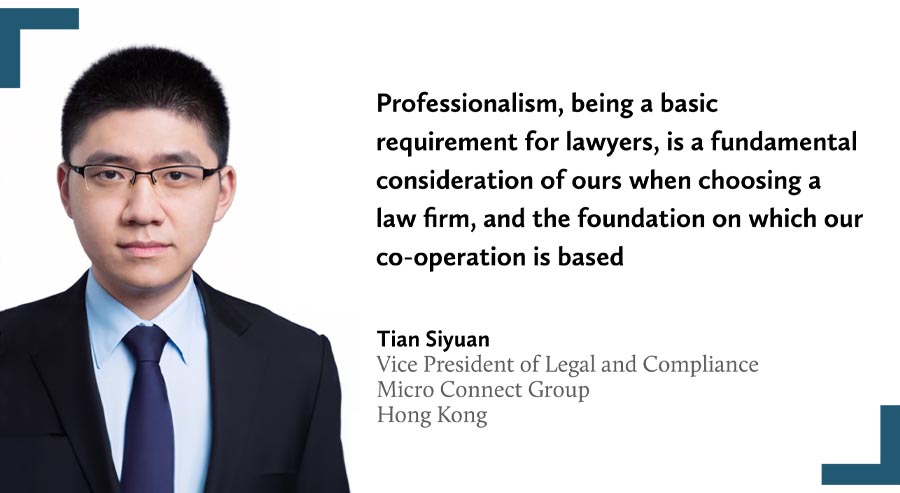
Law firms are no exception to the great shuffle, but then again, they are hardly strangers to having to fight to prove their value.
When it comes to picking out the most suitable firm to work with, there is no one-size-fits-all solution, and sometimes personal preference, corporate culture or a history of co-operation trump even the ace cards of other candidates. But in general, law firms embodying the following qualities tend to see their odds at making the cut dramatically improve:
- Expertise and proven track record in needed areas;
- Effective communication and strong network;
- Consistency and long-term availability;
- Good reputation and credible market recognition; and
- Reasonable price tag and flexibility in fee arrangements.
Knowledge for hire
External legal services continue to be most heavily sought after for resolving disputes, facilitating significant deals and advising on complex capital market projects. They serve to fill a gap, either because the in-house team requires reinforcement in certain areas, or lacks sufficient manpower due to a surge in workload. Additionally, some tasks, such as representation in court or drafting an underwriting agreement for an IPO, can only be performed by external practitioners.
When asked about desired qualities in a law firm, expertise is often the foremost requirement that comes to the mind of an in-house counsel, and there is little mystery as to why.
“Professionalism, being a basic requirement for lawyers, is a fundamental consideration of ours when choosing a law firm, and the foundation on which our co-operation is based,” says Tian Siyuan, vice president of legal and compliance at Micro Connect Group, a Hong Kong-headquartered investment platform focused on providing funding for micro and small businesses in China.
Experience is another coveted trait, and a history of past success can be very convincing. Feng Lin, general counsel at China Resources Capital Management (CRCM) in Shenzhen, is willing to grant more consideration to firms with experience in fund businesses similar to its own, as familiarity can lead to greater efficiency provided there are no conflicts of interest.
But it is not always a simple matter of looking up the record books, as a lawyer’s performance is not always directly tied to a win/loss outcome. Yang Xingfang, the Tianjin-based chief legal officer at China Network Television subsidiary Future TV, pays attention to a candidate lawyer’s past statements and court strategies, as well as the ability to find a way out of unfavourable situations and turn the tide.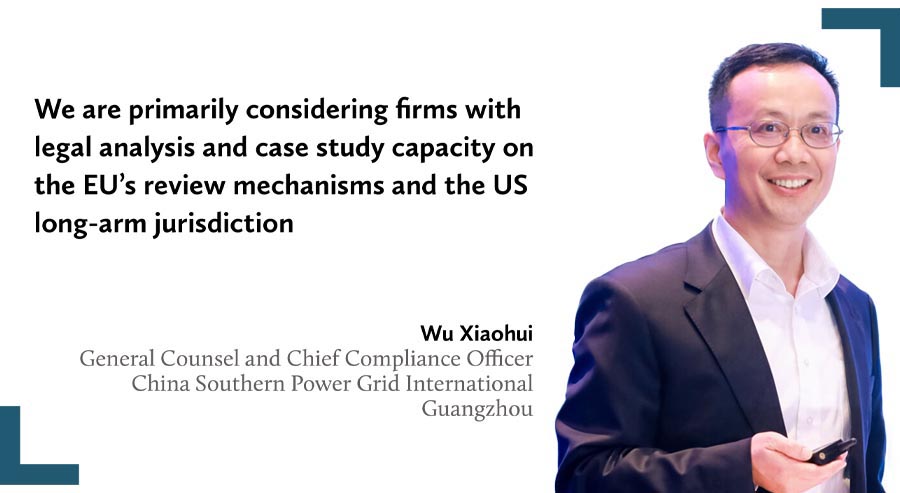
“The win or lose of a case is not necessarily the most important thing, as some cases are not meant to be won,” she says. “What matters more to me is the lawyer’s performance during the lawsuit, his/her way of thinking and legal perspectives when confronted with complex problems.”
Like other commodities, legal services may see a hike in value when clients face exceptionally difficult situations, and only a select few can be counted on to break through the barrier.
Wu Xiaohui, the Guangzhou-based general counsel and chief compliance officer at China Southern Power Grid International (CSGI), cites law firms with a global service network as valuable for a company engaged in cross-jurisdictional M&A projects requiring thorough due diligences and complete mapping of legal risks.
“We are primarily considering firms with legal analysis and case study capacity on the EU’s review mechanisms and the US long-arm jurisdiction,” says Wu. He points out the new Regulation of the European Parliament on foreign subsidies distorting the internal market, in effect since July 2023, and the US blocking China International Marine Container’s acquisition of Maersk Container Industry, as major red flags indicating the enormous challenges facing outbound Chinese companies.
Expressing a similar need for legal services targeting overseas businesses, Zhang Siqi, the general counsel at EEO Group, a Beijing-based education software-as-a-service provider, says the value of a legal adviser to cross-border dealings may be augmented if they can provide more integrated services and help the company achieve its commercial goals.
Her call for “integrated services” resonates well with Zhang Hantao, the general counsel at China National Nuclear Corporation Overseas (CNOS) based in Beijing, who hopes to see one-stop-shop legal services from a law firm that can last through the life cycle of a project.
“For legal issues involving many practice areas, we hope that through the firm’s internal management and team co-ordination, sufficient resources would be in place to efficiently tackle these complications,” says Zhang.
Others prefer a more divided, modular approach. Huang Chaohuan, general manager of legal and compliance at Dah Chong Hong, a Hong Kong-based conglomerate and wholly owned subsidiary of CITIC, shares that he screened the company’s lawyer pool this year, expanding it along the lines of specific industries, practice areas and geographic locations.
Confident in the professional capacity of most lawyers, Ge Mengying, the Beijing-based general counsel and data compliance officer at TalkingData, is on the lookout for the extra spark – business acumen.
“In an investor-dominated market, lawyers representing a company need to be able to make business-savvy judgments,” she says, “such as how important a given matter is to the company, and which clauses must be kept intact in negotiations.”
Received, read, replied
When legal issues arise, law firms are expected to provide timely, conclusive and feasible game plans, which cannot be achieved without smooth two-way information flow and a keen understanding of client needs in the given moment.
Stressing the importance of communication costs, Zhang Hantao of CNOS expects the firm to “provide tailored legal services taking into account [our] corporate nature, management features, main business, risk appetite and operating styles”. With fluctuations in global politics and the economy, and greater prudence required for controlling compliance risks, Zhang says standards have been raised for a law firm’s response time.
Players in relatively new, fast-growing markets tend be more sensitive to the speed and quality of information exchanged. Tian, of Micro Connect, pays extra attention to how well external counsel fit with the in-house team, in addition to their level of expertise and timeliness of feedback. “Smooth and constructive co-operation can also do wonders to the outcome of the in-house tasks,” he says.
While there is no understating the importance of fluent, efficient and to-the-point communication with the company, its value extends beyond that between the service provider and the client.
“Effective communication between the law firm and the government is a new requirement under a strict regulatory system,” says Beijing-based Pang Xiaomei, the general counsel at Sohu, a leading Chinese internet company. In an era of surging technologies such as 5G, big data and AI, Pang believes that a high-quality legal service must be built on understanding the commerce and the client’s business.
When evaluating lawyers for potential court action, Yang, of Future TV, not only takes note of their abilities to compose and deliver convincing statements or responses, but also how well they can communicate with the judge.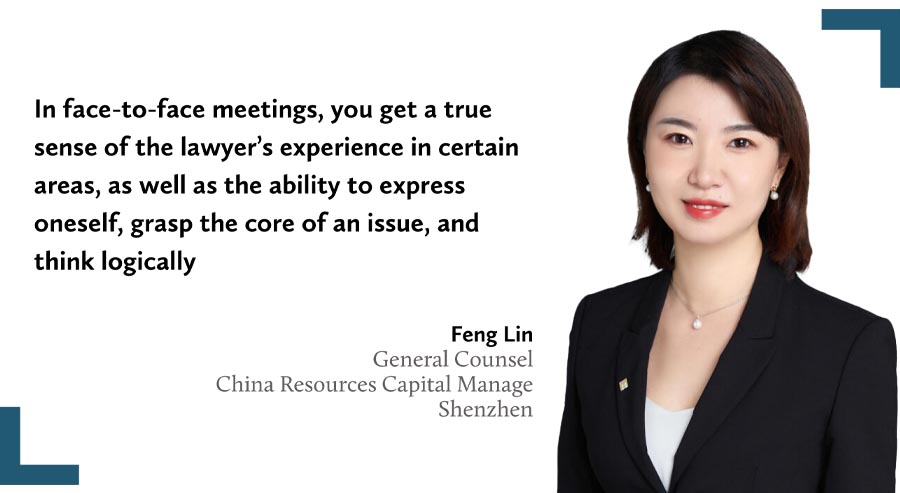
She explains that a sharp lawyer can pick up on the judge’s concerns and misgivings. After court, he/she may continue professional communication with the judge by phone or email. In some cases, where the lawyer is eloquent and approachable, the judge may even take the initiative to contact him/her in order to learn more about the case.
“I consider the ability to communicate with a judge to be a vital part of a lawyer’s overall qualities,” she says, stressing the importance of familiarising judges with industry practices and case-specific contentions of interest, which often go beyond cold, hard legal provisions.
For the long haul
Picking out a law firm is no trifling matter for in-house legal teams, as the selection process can be gruelling and time-consuming, especially if bidding is involved. Unsurprisingly, they would prefer that lawyers making the cut can be counted on for more than a few sessions.
Consistency is highly valued by Future TV’s Yang, who requires the assignment of two core lawyers for long-term co-operation, and does not accept arbitrary assignments from the law firm. She observes that law firms operating under quasi-corporate management mode tend to be able to mobilise the resources of the whole firm more flexibly, enabling them to provide timely and effective legal services for urgent or complex projects.
Jiang Wenlu, the Shanghai-based general manager of the legal department of Sinochem International, laments that some of the more active international firms in mainland China are pulling out their local offices, moving their talent to Hong Kong, Singapore or back to their home headquarters.
Absence of a local office in China deprives potential clients of the chance to communicate face-to-face, forcing them to remotely contact their head offices across jurisdictions and time zones, which is relatively inconvenient for all parties involved.
On the brighter side, Jiang believes the exodus of international firms is complemented, and in some ways indirectly prompted, by continual strides made by prominent “red circle” firms.
“Over the years, these leading domestic firms have attracted lots of talent from international firms,” he says. “Now the quality of their services has caught up, these firms are beginning to edge out the market, owing to greater familiarity with the Chinese language and culture.”
Nevertheless, Jiang encourages international firms to retain Chinese offices in key cities.
Time to whip data into shape
The Cyberspace Administration of China’s (CAC) eagerly awaited Measures on Standard Contract for Personal Information Export came into effect on 1 June 2023.
They coincide with long-anticipated guidelines on filing the standard contract for export of personal information, one of the only four lawful pathways provided under the Personal Information Protection Law (PIPL).
The standard contract option is open to companies that do not require going through stricter security assessment. A grace period is granted to rectify all existing cross-border exports of personal information along the lines of the standard contract, which must be completed by 1 December 2023.
The clock is ticking
The signals are clear. Gone are the days when lawyers and in-house counsel must convince their clients or colleagues of the gravity of data compliance.
Pang Xiaomei, general counsel at Sohu, cites the importance of being prepared. She began establishing the leading internet brand’s internal data compliance system early on – paying heed to all experience learned from the process – so her team would be well prepared to meet the new regulations.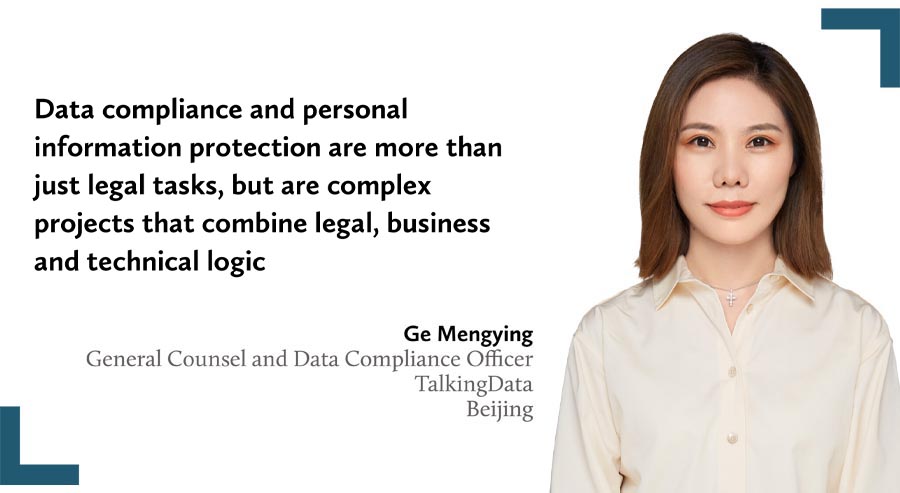
“Since the release of the Measures for Security Assessment for Outbound Data Transfer, we set up special compliance and self-assessment systems for data export, and we did not wait until we had actual data to export,” she says.
“These steps laid the foundation for better sorting out the daily data flow, promoting standardised data management, and protecting the rights of data subjects.”
Ge Mengying, general counsel and data compliance officer at third-party data intelligence service provider TalkingData, says her team performs a data compliance assessment for each new product that launches each week, analysing if there is a need to revise the privacy policy, or fulfil the duty to inform.
Owing to their data expertise, Ge’s team is frequently consulted not only by their own company in relation to potential risks, but also its clients and suppliers.
The explosion in data awareness coincides with the gradual refinement and enrichment of relevant regulations, interpretations and guidelines, making the protection of data more viable both in practice and enforcement.
The head of legal at a multinational healthcare company, who prefers not to be named, observes that just a few years ago many companies were still unsure of exactly what to do, and therefore adopted a wait-and-see tactic.
However, pieces of the puzzle have largely fallen into place in the past two years, he says. But there are still gaps to watch for, such as the specific security review criteria of cross-border data transmission.
On the bright side, several big names in the market like Mazda, Sephora, Hyundai Motor, Focus Technology and Guotai Junan Securities have been greenlighted by the CAC for data export after a security review, injecting some confidence and reassurance into the market.
Help doesn’t come easily
Consumer product companies often rely on massive user data to devise marketing strategies in order to gain or maintain dominant market positions.
But they face a dilemma: do they take a hit in terms of manpower and financial resources to process this data in-house, or transfer the data to a third party specialised in the function? And if choosing the latter, what are the potential risks to the users, the company and, in extreme cases, the nation?
Ge says that TalkingData, along with many companies, would greatly benefit from some kind of automation tool able to conduct risk assessment for large amounts of data.
Until such a tool is widely adopted and market-tested, can they rely on third-party professionals such as lawyers to perform such a task? The answer is a resounding yes. In fact, many law firms are making a point of attracting data-proficient talents, or setting up new offices with data-related services as a hot new direction.
However, not all bases are covered, and law firms may find the information gap in corporate data a challenge rather difficult to surmount.
Yang Xingfang, chief legal officer at internet television streamer Future TV, considers data compliance a task more suitable to the in-house team, chiefly because it likely involves trade secrets such as the internal work process, and the collection and categorisation of data, which can only be properly handled with more intimate knowledge.
“We may not be able to explain all business details with the lawyers, which means they would be analysing our data at a disadvantage,” she says. “When it comes to this kind of legal work, no detail is too small.”
Data-specialised lawyers are engaged by Yang to provide training and interpretations on laws, ministerial regulations and normative documents. But when it comes to actual work, such as the classification of data security level, the team usually handles that internally.
Ge agrees that data compliance is more efficient when handled in-house, as companies tend to exert high demand in efficiency, and it may simply take too long to properly explain the underlying business and operating nuances to an external team.
“Data compliance is more than just a legal task, but is business-oriented and requires in-depth understanding of our business and technology,” she says. “In-house counsel are clearly more informed in this regard.”
You must be a
subscribersubscribersubscribersubscriber
to read this content, please
subscribesubscribesubscribesubscribe
today.
For group subscribers, please click here to access.
Interested in group subscription? Please contact us.
你需要登录去解锁本文内容。欢迎注册账号。如果想阅读月刊所有文章,欢迎成为我们的订阅会员成为我们的订阅会员。