











Vandana Chatlani reflects on a tragedy that has shocked the world and left a nation and a legal community in mourning
The end of November saw a three-day massacre that the Indian and international community cannot, and will not, forget. At 10pm on Wednesday 29 November, a group of heavily armed terrorists stormed two of Mumbai’s best-known hotels as well as several other prominent locations in the city including Chhatrapati Shivaji Railway Terminus, Cafe Leopold, Cama Hospital and Nariman House.
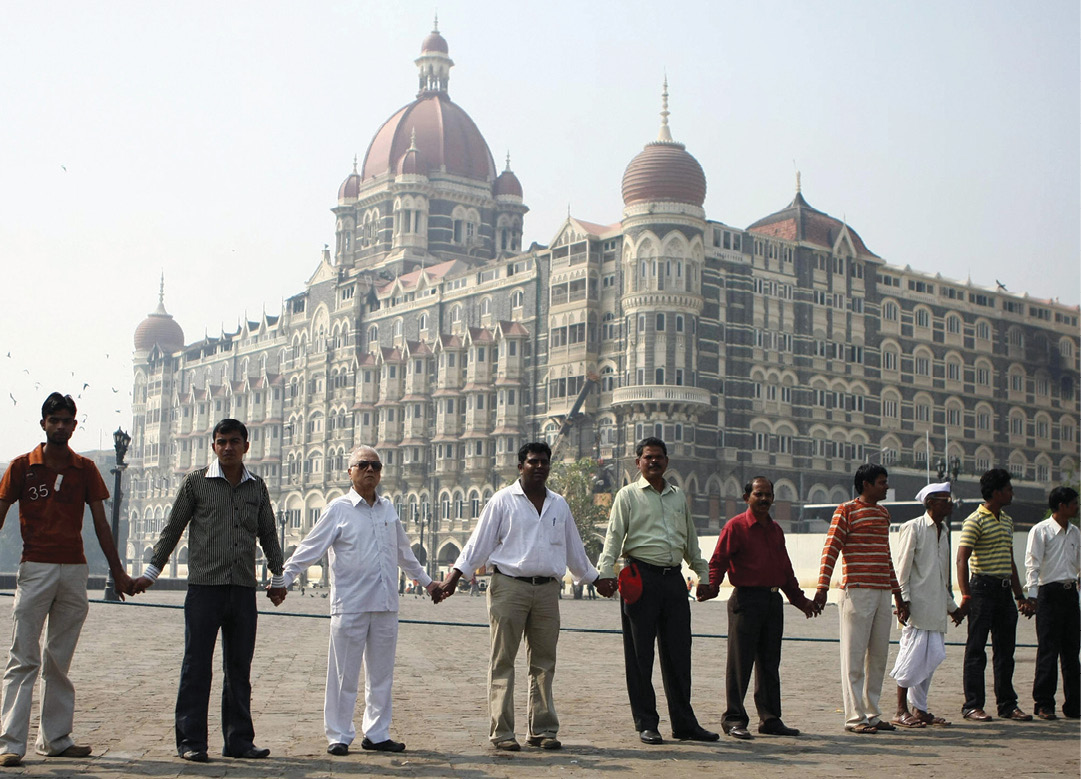 The group of 10 attackers targeted locations popular with international visitors and locals alike. Armed with hand grenades, rifles and revolvers, they fired indiscriminately, killing dozens of people instantly.
[ihc-hide-content ihc_mb_type=”show” ihc_mb_who=”3″ ihc_mb_template=”2″ ]
Many other innocent victims were either trapped in their rooms at the Taj Mahal and Oberoi Trident hotels, or held hostage by gunmen for as long as 48 hours.
The carnage finally ended on Saturday 2 December, after the deaths of over 160 people, including India’s anti-terrorist squad leader, Hemant Karkare.
Tragic loss
Among those killed by the terrorists was Anand Bhatt, a senior partner at Mumbai-based law firm Wadia Ghandy & Co. He was about to celebrate his 60th birthday.
A highly respected professional, lovingly referred to as “Anandbhai”, Bhatt will be remembered for his professional stature, sharp intuition and legal prowess.
“Professionally, I have been in situations where I would have loved to see him lose, but one could never have anything short of the highest professional regard for him,” says Somasekhar Sundaresan, a partner at J Sagar Associates. “Less than a week before he died, I was keen to have him as the escrow agent for a sensitive acquisition transaction that I was involved in. Even his professional detractors would say Bhatt should always be trusted to do the right thing. He was always an able candidate for any fiduciary role.”
“We all knew Anandbhai very well,” says Preeti Mehta, a partner at Kanga & Co. “In the recent past, I had occasion to interact with him on the other side and I must say that it was a wonderful pleasure. Anandbhai was a dear friend to many of us at Kanga.”
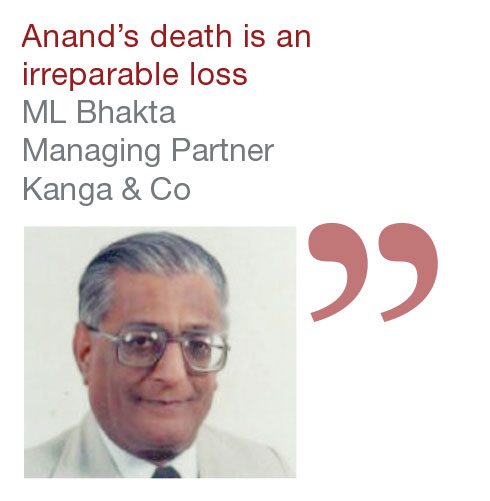
ML Bhakta, the managing partner of Kanga & Co, elaborated on this friendship: “Anand Bhatt was a great lawyer and was a good friend to all of us at Kanga. Above all, he was a great human being.
“Anand’s death is an irreparable loss.”
Tales of courage and survival
Many others were lucky enough to escape with their lives, but endured a terrible ordeal nonetheless.
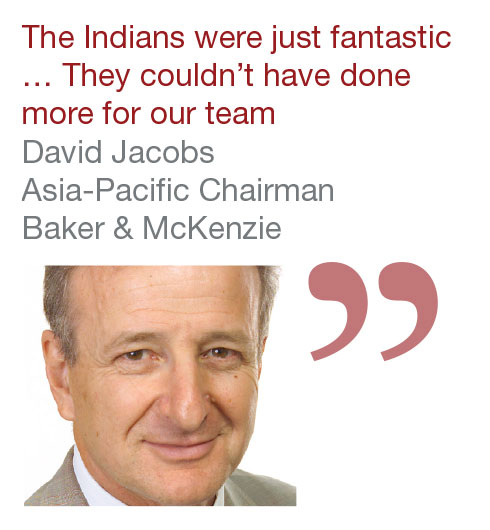
David Jacobs, Asia-Pacific chairman at Baker & McKenzie, had just arrived at the Trident hotel when he heard the first few explosions. He was visiting Mumbai for a conference jointly organized by his firm and Mumbai-based Economic Laws Practice.
Jacobs hid in his hotel room for 41 hours, communicating via Blackberry with friends, family, and the firm’s security advisers. He was finally rescued by commandos on Friday.
Despite his ordeal, Jacobs is certain India will still be an important focal point for the firm. “From Baker’s perspective [the attacks] don’t in any way diminish our commitment to India. We still see it as an important, thriving market and a wonderful place,” he says. “We do need to think of how we’ll do things operationally, but I don’t think it’s going to have a huge impact in the long term on India.
“The Indians were just fantastic,” Jacobs continues. “They couldn’t have done more for our team. The commandos were unbelievably brave. One of the nicest things that I will never forget as long as I live was, as I passed one commando as I was being released, and I said to him, ‘Thank you’, he looked at me and said, ‘Sir, you don’t need to thank me, it is my duty.’ I thought, what an amazing thing to say.”
Mark Abell, a partner at Field Fisher Waterhouse, was equally impressed with the local support he received while he and his colleague Christopher Jackson were trapped for 40 hours at the Trident, where Abell had been scheduled to speak at a maritime law seminar.
“I led a very charmed existence for two days”, Abell tells India Business Law Journal, reflecting on the fate of many others who were unable to make it out alive.
“In a way, being a lawyer probably saved my life. We’re all trained to deal with situations where we have to come up with a solution, work under pressure, and find a practical way forward.
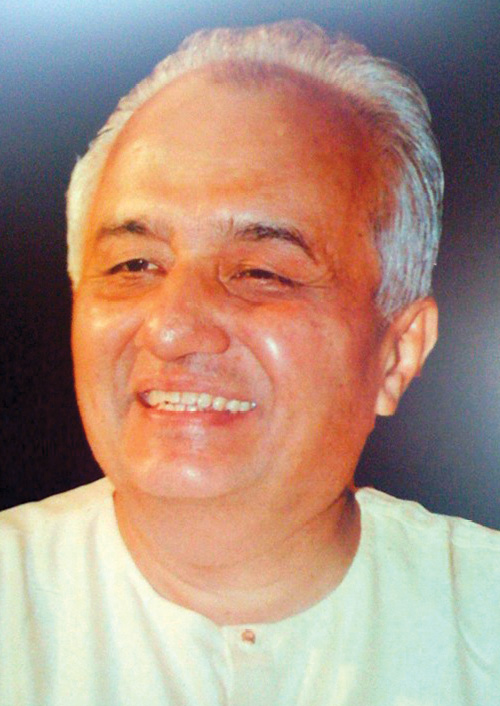
lost his life in the Mumbai attacks.
“Looking back I think I treated it like any lawyer would treat any business situation. I used my Blackberry and mobile phone to communicate and I had over 2,000 emails in those 40 hours.
“The Indian legal community was absolutely fantastic. Words fail me. Their generosity and courage was overwhelming. They were constantly supplying me with information about what was happening, they were giving me emotional support, practical advice. They were just absolutely tremendous.
“I’ve practised law for 25 years around the world in China, Japan, Europe and the US, and I have to say the Indian legal profession stands out in my mind for their generosity, courage and indomitability. All these people weren’t going to be cowed by what was happening, and that was very, very striking.
“I think Mumbai and the Indian legal profession can hold their head up high. They can be very, very proud of themselves. I’m very proud to have friends and colleagues who acted in that way,” continues Abell.
“This has not shaken our confidence or faith in the Indian market or in our clients. We will continue more than ever to work in the Indian market. We’re doing that because it’s a good business proposition, but also because it’s the very least we can do for all of our friends and supporters who were there for us.”

International condemnation
In the aftermath of the attacks, Mumbai was filled with sadness, grief and outrage. Protestors poured onto the streets, demanding a response from political leaders, some of whom were accused of being apathetic, irresponsible and slow to take action against perpetrators. The attacks were condemned by leaders around the world.
Cyril Shroff, managing partner of the Mumbai office of Amarchand Mangaldas, has launched a public interest litigation on behalf of the Society of Indian Law Firms, calling for reforms to the police force. Part of the petition reads: “The subject matter of dealing with these threats has been reviewed from time to time, but little or no coherent reform has emerged. Nor have the required investments in equipment, training and infrastructure been made.
“The delay in implementation of such measures has over a period of time had an impact on the effectiveness of our security agencies.”
Business as usual
It is unclear how the terrorists managed to seize control of the two hotels and conduct their killing spree over such an extended period of time. “It was clearly an intelligence failure”, says Steve Vickers, president and CEO of International Risk, a risk mitigation and investigation company based in Hong Kong.
Vickers is also quick to point out that business must continue as normal.
“One of the goals of terrorism, apart from death and destruction at the time, is to prevent us from going about our ordinary business and to disrupt government. So we should be really careful not to play into terrorists’ hands and let that happen. I’m a really great believer in business as usual,” says Vickers.
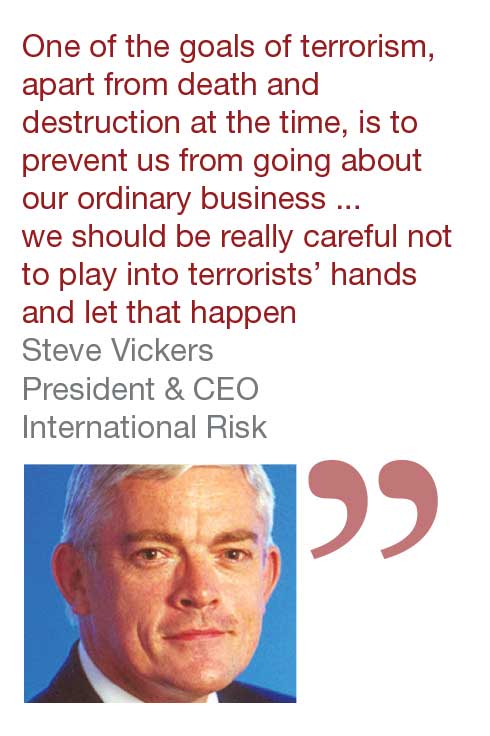
“20-20 hindsight is a wonderful thing. But you show me a government that could deal with eight simultaneous incidents going on at one time. Yes, it was a classic failure of intelligence, but the guys on the ground did their best and deserve a bigger pat on the back.
“The rest of us need to carry on with business as usual. People should be mindful but life must go on. I hope the Indian government is mindful, when introducing measures, that the primary thing is accurate and timely intelligence, not slowing down the economy to keep terrorists happy.”
[/ihc-hide-content]
For more reflections on the Mumbai attacks, see Leader, and Inbox.