






Chinese products sold in the United States have been at the centre of some high-profile legal action over safety. China Business Law Journal asked Steven Napolitano, a partner at Skadden Arps Slate Meagher & Flom in New York and a specialist in product liability, about the issues and strategies to minimize risk
CBLJ: Exports of manufactured goods to the US form a major part of China’s economy. How much should Chinese manufacturers worry about product liability litigation in the US?
Steven Napolitano (SN): There is a negative perception of Chinese products in the US, and there has been some very high-profile product liability litigation. The most prominent issue in the product liability realm right now is the Chinese drywall situation, which has garnered a great deal of attention in the US from both plaintiffs’ lawyers and defence lawyers. (Please see Chinese drywall manufacturers face litigation on page 51.) This drywall litigation is very much fuelling the idea, following on the heels of the lead in toys situation and some of the other scares, that we are getting products from China that simply are not safe, not up to the standards that we expect of our products in the United States. It is a real issue, and it is something that will make it that much harder for Chinese companies to defend the safety of their products.
CBLJ: Who is at risk of a lawsuit in the US in relation to this kind of product liability issue? Is it the Chinese manufacturer of the product, or is it the importer/exporter, or the distributor, or the retailer?
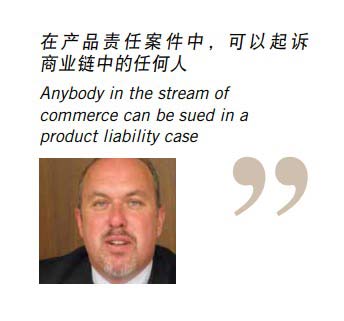
SN: It’s everybody. A basic tenet of US product liability law is that anybody in the stream of commerce can be sued in a product liability case, beginning with the designer and manufacturer of the product, and including any party that was involved in distributing or selling the product. Sometimes even trade associations can be brought into litigation.
[ihc-hide-content ihc_mb_type=”show” ihc_mb_who=”1″ ihc_mb_template=”2″ ]
CBLJ: What is the legal basis for including so many parties?
SN: The primary theories upon which product liability cases are brought are negligence and strict liability, with failure to warn or improper warning as a third category of cases. The theory of strict liability in the US was codified in a scholarly journal in Restatement 402A. Any party that is involved in the sale of a product can be held strictly liable if that product is defective or if it injures people or injures property.
CBLJ: What does strict liability mean in practice?
SN: The meaning of strict liability is that it is not fault-based. Negligence is the theory by which you judge the behaviour of a company. You ask yourself whether the behaviour of that company was up to the standard you would expect from a reasonably diligent company. Strict liability does not look at conduct at all. If you are in the chain of distribution of a defective product, you could have used all the care in the world and you still could be held liable.
CBLJ: Are product liability lawsuits brought at a federal level in the US, or at a state level?
SN: Both. From a defence point of view, I think what concerns companies the most are the state court cases. There are certain regions of the United States that are hotbeds of product liability litigation, and have been for many years. Parts of Texas, the Gulf coast and some other jurisdictions like Madison County, Illinois, come to mind. These are jurisdictions with elected judges, and they are widely considered to be unfavourable places for corporate defendants. Those parts of the country tend to have very large jury verdicts, and judges that appear at times to be overly sympathetic to the plaintiffs and not to the defence counsel.
CBLJ: Would the products involved need to be sold in those particular jurisdictions?
SN: There has to be a jurisdictional basis to sue in one of those places. But if a company sells products widely in the US, a product liability plaintiff will not have a difficult time establishing a jurisdictional basis in any one of those areas.
The risk to Chinese companies
CBLJ: What is the risk of somebody in the US filing an action against a company that is incorporated in China, and manufacturing in China?
SN: It would depend on whether a plaintiff in the United States can exercise personal jurisdiction over the Chinese company. Before a foreign-based company can be brought into a court in the US, the plaintiff must be able to establish that they have a basis for jurisdiction. The jurisdiction test is typically an assessment by the court of the degree to which the Chinese company, for example, has purposefully availed itself of doing business in a particular state. One of the jurisdictional points that is always important to keep in mind is that jurisdiction is judged on the basis of each individual state. The question is not whether a Chinese company is doing business with the United States broadly speaking, but whether in the particular state where the company has been sued, the company has done business to the extent that it would be fair to require it to come and litigate in court.
CBLJ: But surely it is difficult for a plaintiff to serve a notice on a defendant located outside the US?
SN: Yes. It has traditionally been difficult for plaintiffs’ firms in the US to effect proper service of process, or even to determine who exactly they should serve notice on, in a foreign country. Often it is very time-consuming and it can be very expensive. If there are sufficient defendants present in the United States, they can be much easier to go after. Oftentimes, plaintiffs go for the lowest-hanging fruit. If there was a New York-based company which was a distributor for a Chinese manufacturer, that company would be much easier to acquire jurisdiction over. In the 20-plus years I have been involved in product liability cases, the US plaintiffs’ bar has not focused a great deal of their attention on going after foreign companies since it has been so much easier to pursue the companies that are physically in the United States. But that is likely to change going forward. It certainly is possible, and it has happened in some cases, that foreign-based manufacturers have been found to be subject to jurisdiction in the US.
CBLJ: And clearly if a Chinese company had established any kind of subsidiary in the US, that would be a prime target?
SN: That would absolutely be a prime target. Oftentimes what we have seen in litigations is that while the foreign parent and the US subsidiary may both be named as defendants in the case, if the plaintiff in the US can establish a jurisdictional basis over the subsidiary company, they may just be happy to proceed on that basis.
CBLJ: And if Chinese companies acquire US companies, is it something they will need to watch out for?
SN: Very much so. That’s a whole separate category. I do a lot of work on transactions where companies are considering buying into the United States, and you have to use the highest level of diligence to make sure that you are not acquiring, or importing, a product liability issue. Just look at the asbestos situation, which is the longest-running mass tort in the United States, now going into its fourth decade. Companies have come into the United States and have bought other companies, and they have not realized until afterwards that they have bought a company that in fact has an asbestos issue. That is a very difficult situation, particularly for private equity investors, for example. They may want to float the company, or they may want to turn it and sell it in a few years. If you find out too late in the game that you have bought a company that has an asbestos taint, you will have a great deal of difficulty selling that to somebody.
CBLJ: If somebody in the US succeeded in serving a notice on a Chinese entity in China, what would that entity have to do?
SN: If a complaint was served in China on a Chinese company, that company would have to make a decision whether or not to appear in the litigation in the United States to defend itself. Historically, in China as in many countries, people have often simply ignored legal complaints from the United States. That has gone on in many countries for many years. But if there is a sufficiently large litigation, and if the plaintiffs’ bar in the United States is aggressive enough, eventually they will seriously pursue a foreign company. It happened, for example, in the asbestos litigation where there were some very strong attempts to reach some foreign entities. In that situation, a Chinese company would be well advised to get US legal counsel and to understand the complaint and understand what their options are. Simply ignoring a complaint, or a number of complaints, or thousands of complaints, is not without great risk.
CBLJ: But for a Chinese company to choose to defend itself rather than ignore litigation would be difficult if the company didn’t have a permanent presence in the US.
SN: It would be very difficult. But ignoring the problem would subject any US subsidiaries, or suppliers or distributors, to a high degree of risk. If the American plaintiffs cannot achieve jurisdiction over the Chinese company, they will focus on the other parties in the chain of distribution. I think that is what is happening in the drywall litigation. It’s easy for an American consumer to sue the suppliers and the distributors and the companies that are in the United States. It is much harder for them to pursue a Chinese corporation.
CBLJ: Class actions are a well-known feature of the law in the US. Are they relevant to product liability cases?
SN: Class actions are a very big part of US legal practice. They were the great danger for many years, for example, an asbestos class action, or a class action of injured people. But in recent years it has gotten very difficult to have a personal injury class certified as a class. Ultimately in a class action the inquiry, whether you are in state court or a federal court, is going to try to identify how much commonality exists [among plaintiffs], versus how many unique issues. Where unique issues predominate, and where there are various different laws that need to be applied, defendants have had great success convincing courts that those cases should not be class actions. So we don’t generally have asbestos personal injury class actions, for example. There are some drywall class actions – right now there are probably over 50 of them – so somebody will try to certify those.
CBLJ: What do you mean by “certify”?
SN: Certification is the process whereby you go to a court and file your case as a class action, but until the court issues an order certifying that this is in fact a class and this case will proceed as a class, it is not formally a class action lawsuit. So if I as an individual brought a class action against a company, I would say I was representing all the purchasers of a certain product, and at some point there would be a hearing on class certification, and the judge would have to look at all the facts and make a legal determination as to whether the case can in fact proceed as a class action. And that fight for class action is something that my department is involved in every day of the week. Oftentimes that is the make or break issue for a litigation, is class action going to be certified or not.
CBLJ: But you seem to be suggesting that class actions are going out of fashion.
SN: I mentioned that personal injury class actions are very hard to certify in the United States right now. But there are other theories that they could be based upon, like consumer protection statutes or nuisance law. The plaintiffs’ bar is very well funded, it is very smart, it is very hard-working and they are constantly coming up with new and novel theories to try to get a class action certified.

CBLJ: And how would an individual benefit from bringing a class action?
SN: There is not a lot of pecuniary gain from being a named plaintiff. I would honestly say that it is of much greater interest to the plaintiffs’ lawyers to have a class action. Class actions are not tried very often in the United States, and given the risks to the companies involved, most of them are settled. Also we have had great success getting class actions dismissed before trial. Once you get a ruling that it is in fact not a class action, the risk to the company decreases markedly.
Strategies to minimize risk
CBLJ: What practical guidance would you give, either to a manufacturer in China, whether it be a Chinese entity or a subsidiary of a foreign multinational, or to an importer/exporter or anybody else who is actually at risk of this kind of litigation?
SN: There are a number of different points to make. One point involves the structuring of your business affairs and dealings in the US. If you have an American subsidiary, or if you deal with American suppliers, you have to be very diligent about those relationships. You can be indemnified by the parties that you deal with in your contractual documents. If you are selling products into the United States you can make it very clear with the parties you are dealing with that if there are any safety issues or any injuries stemming from these products, they will indemnify you against any loss. Those sorts of relationships are respected in the United States if they are negotiated at arm’s length.
Chinese drywall manufacturers face litigation
Since the spring of 2008, numerous lawsuits have been filed in various US jurisdictions, at both state and federal level, concerning drywall manufactured in China. It is alleged that the drywall releases sulphurous gases that corrode copper piping and wiring and irritate human eyes and sinuses. Drywall is a building material consisting of pressed sheets of gypsum, which is commonly used in the construction of interior walls and ceilings. Millions of square feet of the allegedly faulty drywall were used in homes and commercial buildings in the US, mostly between 2004 and 2006, affecting thousands of buildings and their
occupants.
The drywall in question was allegedly made from waste material from coal-fired power plants, which can emit sulphur dioxide and hydrogen sulphide. When the gases mix with moisture in the air, sulphuric acid is produced. As well as causing corrosion, the acid is said to emit the smell of rotten eggs, affecting the eyes, sinuses and breathing of people in the buildings.
It is estimated that this drywall was used in up to 100,000 homes in the US, during the tail end of the building boom and the reconstruction that followed Hurricane Katrina.
The pending lawsuits name as defendants China-based drywall manufacturers Knauf Plasterboard Tianjin (and its German parent Knauf GIPS) and Taishan Gypsum, as well as a number of drywall suppliers and distributors, developers, builders and installers. Complainants allege that the defendants violated consumer protection and trading laws by concealing the danger of corrosion. They also allege that because of the defendants’ negligence, the plaintiffs suffered not only physical but economic harm, as they were forced to meet the cost of repairs, and also face a reduction in the value of their homes. The complaints typically include a combination of the following allegations: negligence and negligence per se, strict liability, violation of state consumer protection and trade practices laws, breach of express and implied warranties, breach of contract, private nuisance, and fraudulent misrepresentation and concealment.
In addition to seeking class certification in some instances, the complaints typically seek compensatory damages for repairs, relocation costs and the replacement of personal property; statutory damages; equitable, injunctive and declaratory relief; environmental and air monitoring; medical monitoring; disgorgement; punitive damages; and interest, fees and costs.
Use of the drywall appears to have been concentrated in Florida and Louisiana. However, in addition to individual and possible statewide class actions encompassing building owners and occupants in those states, actions encompass plaintiffs from other states, and some of the possible class actions are nationwide in nature. Manufacturers and other entities in the distribution chain also face lawsuits filed by construction companies, which include allegations that use of the drywall has damaged builders’ reputations and seek compensation for replacing the allegedly defective product.
You also need to be aware of how you conduct your daily dealings with your subsidiaries. In the United States, corporate formalities are recognized. If you have a subsidiary in the United States that is doing business, then if that business is properly documented, and if the subsidiary is a separate company that is functioning as an independent corporate entity – albeit one with some direction from a foreign parent – then its separate identity should be respected. The simple fact that a non-Chinese subsidiary is subject to jurisdiction in the United States does not mean that its Chinese parent will be.
On a product liability front, obviously you have to use the highest degree of care that you possibly can in the manufacture of your product. You have to document the safety of your product. You have to conduct testing. You have to have independent people come in to assess the product. You have to document every step of the process. We always tell our clients to assume that someday your documents are going to be exhibits in a courtroom, they are going to be up on an overhead projector and somebody is going to explain the processes whereby you manufacture your product. If somebody else is manufacturing the product for you, what procedures are in place to monitor that process, to make sure it is being done carefully? Is there quality control? How are you guaranteeing that there is no contamination? How do you deal with recall situations when they happen? All of these processes need to be established at the beginning of the process, because once you have a product crisis it is too late to put protocols and operating procedures in place. So from the day a product is conceived until the day it leaves your factory or your subsidiary, you have to constantly be thinking about how you will defend the safety of your product and how you can show people that you were diligent. Obviously in a strict liability case your actions may not carry the day, if the product is ultimately deemed defective, but still you will want to be able to tell your company’s story, and not having documents or processes or procedures in place is really not acceptable in the United States. Whether it is the foreign parent or the US subsidiary, somebody will need to stand up in court and say “we sell a safe product, and here’s how I know it is safe”.
CBLJ: Do you have any specific guidance for importers and exporters, as opposed to manufacturers?
SN: I would tell them that they need to understand very clearly what they are importing and exporting. It is not a defence in most United States lawsuits to say “I didn’t know my product was defective”. There are certain state laws that in certain instances will hold an innocent importer or exporter not to be liable, but in many cases if it is a strict liability situation the importer will be held liable as well. So understand the product. If you are not comfortable with the safety of what you are selling and if you do not understand the product, perhaps it would be best not to sell it.
CBLJ: What are the possible outcomes of a lawsuit? Is it just damages, or is there more to it than that?
SN: In the US we generally don’t have criminal liability for product safety issues. But civil damages can run very high. We have punitive damages in the United States, which I am sure most of your readers have heard of. Compensatory damages are supposed to put somebody back in the position where they would otherwise have been if it were not for the tort in question. Compensatory damages are not what keep general counsel up at night. What gives people sleepless nights are punitive damages, which can be very capricious. Punitive damages are basically a jury lashing out at a company and trying to punish it. While there have been some important Supreme Court decisions in recent years putting some limits on punitive damages, there still can be very large punitive damages awards.
CBLJ: Where a huge sum is awarded as punitive damages, does that all go to the plaintiff?
SN: Yes, that will all go to the plaintiff and some of it will go to the plaintiffs’ lawyer as well. Plaintiffs’ lawyers like punitive damages very much. It’s not a situation where it goes to the state or into a fund. So if somebody receives a US$20 million punitive damages award, it’s US$20 million to that person. Another issue is that in many states in the United States, you cannot insure against a punitive damages award. There are courts that will hold that that is against public policy. The last time I checked the courts split fairly close to evenly. But that’s something you always need to check, because a US$25 million punitive damage award that is insured is one thing. A US$25 million punitive damage award that you have to pay out of your own pocket is something else.
CBLJ: Aside from punitive damages awards, can companies take out insurance against a product liability claim?
SN: It is vital for a company doing business in the United States to have the proper levels of insurance, and the proper kinds of product liability insurance. Insurance is what allows companies to sleep at night. You will encounter litigation in the United States, regardless of what you make. And some of that litigation may be frivolous, and some of it may have no factual basis in reality. But it is costly to defend, and you have to defend it, and it is just imperative to have the proper insurance in place.
We talk to clients all the time about recall insurance. The typical CGL policy in the United States – comprehensive general liability policy – does not cover product recall expenses. Oftentimes your insurer will give you the option of buying some separate recall insurance, and depending on the line of work that you are in it may be advisable to buy that. The cost of a recall can be great.
Documentation crucial in product recalls
CBLJ: When do recalls happen, and who ends up paying the bill?
SN: Under the Food, Drug and Cosmetic Act, which governs food and pharmaceutical products in the United States, very few product recalls are mandatory. There are only certain particular types of products that the government requires you to recall immediately. But often what happens with food products, for example, is that the government will ask you to do a voluntary recall. We have had contamination issues in the United States with food products ranging from spinach to pork, and when there is a health scare, the government will work with the company and it may become clear that a recall is appropriate. If the company is diligent and if it is respectful of its customers’ rights, it will probably effect a recall. Recalls are an increasing concern to companies in the US. They are very expensive. They can be very time-consuming, very disruptive to business, and sometimes they can go on for a very long time. It is imperative to identify what the product is that has to be recalled, and figure out exactly where that product is. Throughout the recall, the company has to be very careful to document all steps of the process, and be able to establish that the recall was effective. And if there is a recall situation in the United States, you can be almost certain that there will be product liability litigation that will follow. That’s what our experience has been with our clients.
CBLJ: So a recall doesn’t necessarily solve your problems?
SN: It doesn’t, and that’s one of the reasons why a recall can be very perilous. You have to be very careful when you do it. You have to appreciate the fact that all the actions that you are taking may someday be judged in a court of law with respect to whether they are reasonable or not. It is always easy for somebody to say you should have moved faster, or you should have thrown the net wider, or you should have had provisions in place ahead of time so that this never could have happened. It’s very difficult, and the involvement of product liability lawyers is obviously crucial in that kind of a situation.
Discovery fraught with danger
CBLJ: Could you explain something about discovery in US litigation: what is it, how does it work, and who does it?
SN: Discovery is a great deal of what American lawyers do, for better or for worse. Essentially, as soon as a lawsuit is filed, you can engage in a discovery process, which means that you want to discover the facts that support your lawsuit. There are many different discovery tools. There are written interrogatories. There are document requests. There are depositions of company officials, where you have an opportunity to sit down under oath and question a company official, often for many hours. It is the document discovery that is very costly. Plaintiffs’ lawyers appreciate the fact that it is difficult and costly to engage in discovery, and they can ask for many, many categories of documents. If they are palpably improper or irrelevant, you can go to court and try to get a motion to limit discovery, but generally courts in the United States are of the mind that discovery is very broad. It has always been so, and the advent of electronic discovery has just made things so much more complicated.
Ready for action?
Manufacturers, designers, distributors, exporters and others involved in selling products into the United States should prepare for the likelihood of product liability litigation. China Business Law Journal offers the following summary of its discussion with Steven Napolitano.
-
Seek indemnification for the cost of product liability lawsuits from other parties in the chain of distribution. -
Thoroughly document transactions between parent companies and their US subsidiaries, to help establish that the subsidiaries operate as separate entities. -
Take the highest degree of care possible in the manufacture of the products. -
Document every step of product testing and product safety. -
If contracting manufacturing to another party, establish adequate quality control procedures. -
Understand the product to be sold, and any potential safety issues. If you don’t understand it, it may be better not to sell it. -
Buy adequate insurance cover, including product liability and product recall insurance. -
In any product recall, carefully document all steps taken to show that the recall was effective. -
Train employees to take care in communications. Assume that every email written could be an exhibit in a trial. Just one bad email can be devastating.
CBLJ: Is it really that bad?
SN: Yes. It is always terrifying to non-US lawyers when they come to understand the ramifications of the discovery process in the United States. Discovery in a lawsuit can go on for years. In a complicated lawsuit it is not unusual at all to have many years of discovery, and millions and millions of pages of documents. I have been involved in litigations where we have had hundreds of depositions, and this is all costly, it is all disruptive to the company, and it has to be handled with great care. One of my jobs in most of the cases I am involved with is to try to put reasonable limitations on the discovery process. But with respect to documents, the bottom line is that tremendous amounts of information are discoverable. Not only is it very costly, it’s also fraught with so much danger.
CBLJ: Is there anything that companies should do to minimize the potential damage?
SN: We tell our clients all the time to be so careful in emails, to train their employees in what kind of things should be put in emails and what kind of things should best be discussed in person. In every litigation I have been involved with, when I trawl through my own client’s documents I inevitably find documents that are written very poorly, or that are written in a very inflammatory way. The person writing may just have been having a bad day and they may not have appreciated what they were writing, but a single bad document can make or break a litigation. One bad email can be devastating, for example, if it is from an important person at the company and they are commenting on product safety or consumer well-being. At law school there’s always an example from an ancient case where the head of a company said “oh, it’s a dollar more to put that safety control on the machine, I don’t want to do that”. When those kinds of documents come to light in court, where you have a terribly injured person or maybe the widow of someone who was killed, it is very hard to defend. But practically, it’s difficult for companies too. You must assume that every email you write is going to be an exhibit in a trial. It’s difficult to live that way, but you really have to.
CBLJ: And just to clarify: discovery doesn’t have to be ordered by the court?
SN: It does not. It is largely a voluntary process. Or I should say it is not court-ordered. The parties work it out themselves. And it goes without saying that in most US litigations you do not recover the cost of discovery from the other side. Unlike in many other legal systems, parties bear their own costs of discovery. We have litigations that go on for years and years, and sometimes if you are victorious there are some very small amounts of costs that you can recover from the other side, but they are not significant in the grand scheme of litigation.
The final point about discovery I should make is that oftentimes in litigation in the United States, courts will impress upon a foreign company the cost of having its own documents translated into English. And that can be a tremendous expense. We have had German clients who have gone through that and have had to bear the cost of translation of reams of documents. That is not a good situation to be in.
[/ihc-hide-content]