








More Chinese parties are using legal means to resolve disputes, while foreign parties are becoming increasingly receptive to using China as a dispute resolution platform. Why are more parties agreeing to disagree, both at home and away? Vanessa Ip reports.
Times are busy for litigators and arbitrators. China’s dispute resolution market is evolving and internationalising at a feverish pace, owing to the sheer volume of China-related business around the world and the country’s maturing economy, now the second-largest in the world. Both domestic and international arbitration institutions have been busy updating their rules to stay abreast of market trends. The Supreme People’s Court (SPC) has also been proactive in addressing public and investor concerns through a number of new initiatives designed to bring the country’s legal system further in line with international standards.
More business, more disputes
Observers agree that China’s increasing influence as an economic power is a key driver behind the growth of China’s dispute resolution market. According to Yang Ing Loong, a partner at Latham & Watkins in Hong Kong, “the PRC market is generally maturing, which means that the Western companies doing business in China, the Chinese companies doing business in China, and also Chinese companies doing business outside of China, are all maturing and internationalising at a very quick pace,” he says. Flowing from the increase in China inbound and outbound investments, it’s perhaps inevitable that “there will be more disputes, and those disputes would end up being resolved in China”, says Thomas So, a partner at Mayer Brown JSM in Hong Kong who sits on the council of the Hong Kong Institute of Arbitrators.
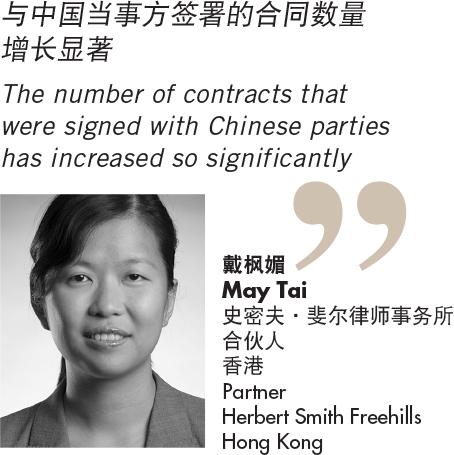
May Tai, a dispute resolution partner at Herbert Smith Freehills in Hong Kong, comments: “The number of contracts that were signed with Chinese parties has increased so significantly that only a small percentage of that needs to go to dispute before everyone is very busy with dispute work.”
[ihc-hide-content ihc_mb_type=”show” ihc_mb_who=”1″ ihc_mb_template=”2″ ]
But it’s not just lawyers who are busy. Arbitration centres and local courts are seeing their dockets fill up with a growing number of cases initiated by Chinese and foreign parties. The Beijing Arbitration Commission (BAC) reported an increase in new filings of over 1,500 per year in the past 10 years. This can be attributed to recent efforts made to internationalise service offerings, which have led to “more investors being prepared to use China as the dispute resolution platform than before, as the standard of dispute resolution service providers has improved over the years,” observes So.
Yang Guang, a partner at Lantai Partners in Beijing, adds: “Some international companies may still not be confident about China’s judicial environment, but an increasing number of international companies have changed their opinions. The judicial justice of China has been recognised by the international community. The courts and arbitration centres in China are fair and reliable.”
Home and away-from-home advantages
But not all agree. The main concern for international companies involved in disputes arising from cross-border deals or business co-operation “remains the perceived lack of efficiency and independence of the judicial system in China and Chinese arbitration bodies,” says Keith Brandt, a partner in Dentons’ litigation and dispute resolution practice in Hong Kong. “Their preference is often international arbitration in a neutral jurisdiction, such as Hong Kong or London.
[ihc-hide-content ihc_mb_type=”show” ihc_mb_who=”1″ ihc_mb_template=”2″ ]
“A related concern is the difficulty in enforcing a favourable judgment or award against Chinese companies because more often than not this would also trigger the judicial process in China. Ironically, the solution to these concerns may well lie in agreeing to arbitration in China to be administered by prominent bodies such as the China International Economic and Trade Arbitration Commission (CIETAC), in which arbitration rules are pegged to international best practices, and where Chinese courts in supervising these arbitrations had ordered interim asset or evidence preservation relief in appropriate cases.”
To address public and foreign investor concerns, courts and arbitration institutions have been scurrying to improve their service offerings, which has led to “foreign parties being more and more receptive to the idea of submitting their disputes to arbitration commissions in China as the rules of arbitration used by PRC arbitration commissions are getting more and more international,” says Cheung Kwok Kit, a CIETAC arbitrator and partner at Deacons in Hong Kong.
For example, in late 2013 the BAC proposed new draft rules, which have been passed by the BAC committee with scheduled effect on 1 April 2015. According to BAC’s secretary general, Lin Zhiwei, the most significant changes have been made with respect to the arbitral tribunal’s discretion, user-friendliness (which includes party autonomy, procedural flexibility and cost-effectiveness), and further internationalisation of the rules.
“More international approaches have been adopted, especially those from global arbitral institutions, including consolidation of arbitrations, joinder of third parties, and emergency arbitrators,” he says. “Additional conveniences are also provided in international cases, where the arbitral tribunal will be the decision maker on interim measures, with separate payment of administrative fees and arbitrator’s fees available if so agreed by the parties.”
The Shanghai International Economic and Trade Arbitration Commission (SHIAC) is an arbitration institution that is making waves in the field. There has been ongoing uncertainty in China arbitration following the splitting-off of SHIAC and the Shenzhen Court of International Arbitration (SCIA) from the sole and original CIETAC.
The troubles started in April 2012, when CIETAC issued new arbitration rules, which provided that any cases arising under CIETAC’s standard arbitration cases would be administered by CIETAC Beijing alone. Soon afterwards, the two sub-commissions renamed themselves and declared their independence, each publishing its own set of arbitration rules.
Due to these developments there have been continued obstacles and uncertainty concerning the validity of arbitration clauses, and the enforcement of arbitral awards rendered by SHIAC and SCIA, notes Jiang Jiang, a partner at Hylands Law Firm in Beijing. “Things have become more complicated after inconsistent decisions made by different local courts in cases with similar situations, particularly in cases where the parties fail to enter into any new arbitration agreement to designate SHIAC or SCIA as the arbitration institution,” he adds.
For these reasons Zheng Xilin, a Beijing-based partner at AnJie Law Firm, recommends that parties avoid choosing the previous sub-commissions of CIETAC as there is “still plentiful room for uncertainty in the nature and legality after their so-called independence”. This uncertainty is even “fuelled by the inconsistency in decisions of different local courts. In this case, if the parties still prefer CIETAC to handle their disputes, my suggestion is that they specify [in their clause] their option as the Beijing headquarters of CIETAC, because the legality of the headquarters and the enforceability of their arbitral awards can be guaranteed,” Zheng says.
In light of the inconsistencies among various local courts, the SPC issued the Notice on Certain Issues Relating to Correct Trial on Cases of Judicial Review on Arbitration (Fa [2013] No. 194), which requested that local courts implement a “level by level” reporting system when reviewing objections to the validity of an arbitration agreement and enforcement of an arbitral award, explains Jiang. “We believe this system will give clearer and uniform guidance on judicial review of the jurisdictional dispute among the CIETAC institutions by local courts.”
SHIAC appears to be making serious attempts to get things right. In April 2014, SHIAC officially released the China (Shanghai) Pilot Free Trade Zone (FTZ) Arbitration Rules, which came into force on 1 May 2014. To date, SHIAC has accepted 12 cases under the FTZ rules, totalling RMB350 million (US$57 million).
The FTZ rules, which consist of 10 chapters and 85 articles, “have implemented and improved a series of advanced features of international commercial arbitration”, notes Wen Wanli, vice chairman and secretary general of SHIAC.
The FTZ rules recently achieved validation through a landmark victory in a CIETAC-related case concerning a jurisdiction dispute. Representing the case, Martin Hu, of Martin Hu & Partners in Shanghai, said: “The Shanxi Provincial Higher People’s Court (SPHC) has issued a ruling in favour of the arbitration clause, instead of the local court jurisdiction. There was an arbitration clause in the contract in dispute. The local court argued that the arbitration clause had some technical problems as a result of the CIETAC-split disputes between Beijing and Shanghai. It contended that it was not effective, whereby the local court should have the jurisdiction. The intermediary court supported the lower court.
“Though it’s a procedural matter [our firm] thought it would be a disaster if the court allowed things like this to happen. So we appealed to the SPHC, which retried the case, eventually handing down a very detailed ruling in favour of the arbitration clause instead of the local court jurisdiction. This ruling is very helpful, technically. In a way, it shows that the SPHC has followed the SPC’s general direction as material to defeat an arbitration clause.”
The decision in the case, Hu says, is significant for two reasons: it establishes that a final ruling on a challenge to jurisdiction may be retried; second, it reflects the prudent stance taken by the SPC on the validity of arbitration agreements.
Greater transparency in judicial proceedings
According to Melody Wang, a partner at Fangda Partners in Beijing, practitioners and foreign companies in China are recognising the changes taking place “in terms of the structure of the legal system, laws and regulations and government enforcement actions”.
“This is largely driven by the current administration’s efforts to provide more transparency in enforcement and judicial proceedings, as well as its efforts to address a lot of the concerns of both the public and foreign investors in China,” she says.
On 21 November 2013, the SPC issued the Provisions of the Supreme People’s Court on the Online Issuance of Judgment Documents by People’s Courts, requiring the release of all effective people’s court judgments on the website of Judicial Opinions of China.
Consequently, “because the judgments have to go online and will be subject to public scrutiny, judges will have to give [plausible] reasons in their judgments,” says So. “This will indirectly push up the standard of judgments in civil cases, hence demanding higher quality from judges and the requirement that judges be seen to be acting more impartially,” he says.
Charles Qin, a partner of Llinks in Shanghai, says when the judgments were not open to the public “it did happen before that courts in different locations made different decisions on the same kinds of cases”.
Qin says the online release of court judgments enables involved parties and legal counsel to search for the results of similar cases on their own, which imposes pressure on the courts and judges. “The court decisions are now directly under the eyes of the public, which can make the courts more circumspect in rendering their rulings, and the parties in litigation can thus expect to get a more fair and just treatment,” he says.
But Terrence Wong, a partner at Hogan Lovells in Hong Kong, believes there is still a proviso. “Under the civil law system in China, court judgments do not have binding effect the way they do under the common law system,” he notes. “Therefore, strictly speaking, Chinese court judgments are for reference only and may not even be persuasive in the common law sense, which adopts the doctrine of precedence.”
Preceding the judgments online initiative, since late last year the SPC had begun issuing a series of guiding cases. From April of this year, the SPC made it clear that it would issue guiding cases on a more regular basis. “This will certainly be a very effective tool for the SPC to give guidance and precedence to lower courts on the issues that may not be appropriate to issue judicial interpretation yet,” says Melody Wang.
Brandt adds that “whilst there remains no formal doctrine of precedent in China, the significance of past decisions is evolving and changing. For present purposes it is fair to reflect that the value of past judgments is subject to the tendency of the Chinese courts to remain closely guided and bound by the SPC’s rulings and interpretations.”
Nonetheless, there is no denying that arbitration and dispute resolution in China is becoming more reliable, with Chinese and foreign parties displaying greater willingness to participate in the process, both inside and from outside of China.
In the past, says Yang from Latham & Watkins, “the trend was that disputes, especially international arbitration, tended to be resolved outside of China. But as China becomes more mature as a legal market, a number of disputes are also getting resolved in China, under the rules of CIETAC or BAC, for example.
“Chinese lawyers are in turn getting better at handling disputes with an international dimension,” he adds.
Though ongoing reform is a step in the right direction, Brandt warns that “litigants remain subject to other shortcomings in the judicial process”, including inefficiency and local protectionism. “That said, ultimately addressing the perceived other shortcomings in the Chinese judiciary will also undoubtedly play a measurable, we believe, potentially significant role in assisting litigants in China.”
Utilising defence mechanisms
“Chinese companies have traditionally been affected by Confucian thinking and have tended to try and avoid legal battles,” says Wong. “But what we are seeing is that more Chinese companies are willing to engage in the dispute resolution process, both informally via mediation and formally via court proceedings and arbitration.”
Potentially influenced by a host of significant wins by state-owned enterprises in international arbitration and litigation proceedings, Tai at Herbert Smith Freehills says in the past year Chinese parties “are behaving more like you would expect any multinational to behave”.
“In the past, Chinese companies were less willing to use arbitration and litigation processes in order to defend their rights,” she says. “But now, they are much less wary of being claimants in the proceedings and understand that in order to defend your rights, sometimes you have to be the one to bring an action.”
According to the Sylvia Tee, director of arbitration and ADR, Asia, for the International Chamber of Commerce (ICC), instances for the settlement of disputes without going through an adjudicative process are numerous, and include quicker and cheaper resolution and the option for parties to preserve and continue their business relationships despite their differences. “These advantages, she says, “are even more acute to the Chinese business community, which has a heavy emphasis on consensus building and the preservation of business relationships”.
The Hong Kong International Arbitration Centre (HKIAC) has found that the most frequent users of its services are mainland Chinese parties. Of 260 new arbitrations in 2013, 81 cases were fully administered by HKIAC – a 20% increase from 2012. According to HKIAC, Chinese courts have not refused to enforce any of its awards in the past five years.
On 1 November 2013, HKIAC introduced a new set of administered arbitration rules. Some of the new features are intended to enable parties and arbitrators to deal with complex disputes cost effectively and efficiently. More recently, in August 2014, HKIAC updated its model clauses to include specific wording to prompt parties to consider designating an appropriate law to govern their arbitration agreement. The initiative has been welcomed by practitioners in the field, who feel that the addition of an express choice of law to govern the arbitration agreement is forward thinking and desirable, as it helps avoid subsequent uncertainty, potential disputes, unintended court intervention and legal costs.
“Users want a cost and time-effective method of resolving disputes and this is what we have been able to deliver by establishing the new rules,” says Chiann Bao, the secretary general of HKIAC. “[The new model clause] prompts companies to consider including the law of the arbitration agreement in its dispute resolution clause. By including such a line its dispute resolution clause, parties could prevent significant disputes involving which law should govern the arbitration agreement.”
Having set a high standard, the China Maritime Arbitration Commission (CMAC), conceived as a sister of CIETAC, has announced plans to open its first branch outside of the mainland, in Hong Kong.
“CMAC had long thought of going overseas to provide its premium maritime arbitration services to mainland Chinese companies who have already, or are going to ‘go global’,” says Wang Wenying, secretary general of the CIETAC Hong Kong Arbitration Centre. The decision to choose Hong Kong was straightforward, he adds, given the geographical and legal privileges it enjoys, its position as an international arbitration, logistics and maritime hub in the Asia-Pacific region, access to a large pool of experts, as well as Hong Kong’s “international vision that also understands China very well”.
Future outlook
The future for dispute resolution in China looks bright with compliance, infringement and anti-monopoly actions predicted to provide the biggest opportunities for growth. “This year, compliance will be the most important development for dispute resolution lawyers as law enforcement authorities are active in investigations against various companies, including MNCs [multinational companies],” predicts Ariel Ye, a senior partner in King & Wood Mallesons’ arbitration and dispute resolution practice group. “We’re also seeing an interesting issue on how regulators will treat lawyers involved in these types of matters. The second aspect is infringements affecting a company’s reputation in new media, which will be a big challenge.”
Melody Wang, at Fangda, says: “The new niche in the market is going to be non-contentious, regulatory, compliance and government involvement type work. This is partially due to the recent proactive government enforcements and actions taking place in a lot of sectors in China such as anti-monopoly, anti-corruption and privacy actions.
“I don’t see any reason why the government would want to discontinue these efforts, therefore these kinds of actions are going to be a big concern and focus. Compliance will be one of the hardest areas for companies, especially Chinese and overseas MNCs to grapple with, but they represent the biggest growth area for dispute resolution work in China.”
Among the administered arbitrations by HKIAC in 2013, 47% of the disputes arose in the commercial sector, followed by corporate matters (27%) and maritime matters (11%). HKIAC has also witnessed an increasing number of disputes arising in the intellectual property and private equity sectors. Meanwhile, CMAC reports that it is administering more diversified maritime cases than ever before.
Chinese parties are becoming increasingly sophisticated in handling disputes both on and off their home turf. However, according to Jessica Fei, a partner at Herbert Smith Freehills in Beijing, “on the ground, as practitioners we still have to dedicate a significant amount of time in working with Chinese companies to help them understand how international arbitration and litigation works, the related risks, and how to safeguard their legal rights by pursuing their interests through dispute resolution processes.
“It’s still a growing process but we are seeing a lot of Chinese companies that are not afraid of engaging in dispute resolution. Overall, there is a new understanding that Chinese parties are more open to taking matters proactively into their own hands.”
[/ihc-hide-content]