












Franchising with the help of a local partner may be a foreign investor’s key to unlocking India’s retail market
The retail sector in India is heavily protected from direct foreign investment. This is especially so for multi-brand retail, despite recent moves to liberalize it. As a result, the most attractive market entry strategy for many foreign retailers is one which involves a third-party relationship.
Single-brand retailers face no restrictions on their ability to hold shares in an Indian company. Nevertheless, experience shows that direct investment in the Indian market is not for the faint-hearted or those with capital or resource restraints. Despite its great commercial promise, India can be a hostile environment for foreign retailers that are not “chaperoned” by an Indian partner. Local operators jealously guard their domestic market through a cocktail of legal, logistic, political and commercial devices, some of which can be kindly described as exceedingly robust and would generally not be permitted in markets such as the US and the EU.
There is no denying that some aspects of India’s retail market can create problems for US companies under the Foreign Corrupt Practices Act and British companies under the Bribery Act 2010. Add to that restrictions on the import of textiles and a judicial system that is slow, expensive and at times unpredictable and it may be easier to understand why few foreign retailers go it alone in India.
Highs and lows of joint ventures
Joint ventures are sometimes used by foreign retailers entering India. These can make it much easier for foreign retailers to exploit the Indian market if the local partner has the appropriate expertise, capital and connections. However, the bigger, wealthier and better connected the local partner, the more difficult it will be if the joint venture breaks down, and the reality is that retail joint ventures do not have a record of being particularly long lived in India.
Ending a joint venture can be a protracted, expensive and testing process, partly because of legal restrictions on the number of shares that can be held by foreign retailers, which unbalance the terms of the joint venture. Mismanagement, bribery and the laundering of “black” money through the joint venture may result in a range of criminal offences not only in India but also in the UK and the US, adding to the difficulties.
In 2011 the government proposed to allow large international supermarket chains and other multi-brand retailers to enter the Indian market without an Indian partner, but had to withdraw the proposal due to vigorous opposition from political parties, middle men involved in retail trade and small family businesses. As a result, direct investment in multi-brand retail remained prohibited for foreign retailers with the exception of wholesale cash-and-carry operations, until new measures were announced this month.
[ihc-hide-content ihc_mb_type=”show” ihc_mb_who=”3″ ihc_mb_template=”2″ ]
Single-brand retail
The single-brand retail sector was opened up to foreign direct investment in 2006, when foreign companies were permitted to hold up to 51% shares in an Indian company, subject to the following conditions:
- Products sold had to be of a single brand only;
- Products had to be sold under the same brand internationally;
- Only products which were branded during manufacturing were covered;
- The foreign investor had to be the owner of the brand and not just a licensee;
- Consent for the investment had to be obtained from the government.
Coffee break
Rudi Selles and Seshani Bala, global legal counsel and international counsel at Gloria Jean’s Coffees in Sydney, talk to India Business Law Journal about their experience of franchising in India
Gloria Jean’s Coffees has over 1,000 outlets across 42 markets worldwide.
When the company first considered entering India, it found two strong local brands – Barista and Cafe Coffee Day. “In terms of international competition, there wasn’t a lot,” says Rudi Selles, the global legal counsel at Gloria Jean’s Coffees. “Costa was there and we’d seen what they had done and thought we could do better. We wanted to position ourselves at the Costa end, but we recognized the need for significant price sensitivity – a benchmark set by our local rivals.”
Choosing the right blend
Gloria Jean’s looked for potential Indian master franchise partners using the Australian Trade Commission and local brokers, as well as through franchise shows and marketing.

The company talked to several candidates before narrowing its selection to two, of which Citymax Hospitality India was one. Citymax is a subsidiary of the Landmark Group, a company based in the Middle East that focuses on retail in that region and in India. As part of the franchise due diligence process, both candidates submitted details about themselves, their plans, their expertise and other business interests, and explained their projections in terms of building and rolling out the Gloria Jean’s brand.
In addition, Gloria Jean’s carried out business, corporate and legal due diligence. “We consulted Deacons – now Norton Rose – in Australia, DSK Legal in Mumbai and PwC and Grant Thornton in India,” says Selles. “We used Indian law because we were satisfied that it upholds contracts and franchising arrangements and that we could rely on local enforcement of key contractual principles.”
The master franchise agreement is a standard template that the company circulates fairly early on in the process. “This involves a letter of intent where we negotiate the broad commercial parameters, followed by a memorandum of understanding where we grant exclusive negotiation rights for a period – so we agree not to talk to anybody else,” explains Seshani Bala, international counsel at Gloria Jean’s Coffees. “We receive a deposit payment for that as a sign of good faith. Then we send the candidate the master franchise agreement, which we’re willing to negotiate to some extent.”
Division of labour
Gloria Jean’s eventually selected Citymax to be its master franchise partner in November 2007, awarding it the exclusive right to develop the coffee brand in India. Gloria Jean’s agreed to provide systems, tools, methodology, assistance and training, while Citymax was to provide capital, human resources, expertise in real estate, and experience in running coffee houses.
Selles explains that a unique aspect of the master franchise agreement was the requirement to arrange local roasting in India because of the high import duties on coffee. “There were some structural issues in the approvals that we needed in order to get goods into India, which meant that we had to look at that supply chain process quite carefully.”
Although the negotiations took a fairly standard course with the usual issues around withholding tax and some other elements, there were times when the Indian party appeared to backtrack just as it was on the verge of finalizing the deal. “Various times I thought we were close to signing,” says Selles, “but then some new issues were raised.”
One core question raised by Citymax related to its position at the end of the initial franchise term. Gloria Jean’s franchise agreements are valid for 10 years, but due to the size of the Indian market, the company extended the term to 15 years.
“Citymax asked us what would happen if, at the end of the term, they decided not to continue as a master franchise partner, but had managed to build up Gloria Jean’s Coffees’ business in India,” says Selles. “It’s an interesting concept to raise because we don’t see our business ending when the master franchise relationship ends. We would be left with a number of our coffee houses in a market which we can continue through sub-franchisees, corporate stores, etc.”
Selles says Gloria Jean’s ultimately agreed to recognize the Indian party’s investment in establishing a support office and the coffee business and guaranteed that this would be sellable to a third party coming in. “We’ve used that as a precedent to handle franchise agreements in Turkey and Azerbaijan, where the same issues arose,” Bala adds.
Sourcing and strategy
Gloria Jean’s Coffees opened its first Indian outlet in Mumbai in March 2008 and currently has 25 outlets across Delhi, Karnataka, Maharashtra and Tamil Nadu. Despite its success, there have been hurdles.

Citymax moved its support office from Mumbai to Bangalore in late 2008 and early 2009, losing some of its senior managers along the way. “We provide a certain amount of free training to the initial senior management of our master franchise partner,” says Selles, “but we maintain that any substituted or new senior managers need to also be trained. So we had to deploy more resources for that.”
A major commercial challenge for Gloria Jean’s was developing the right pricing model and obtaining local sourcing for products used in its coffee houses. “We have certain products which are supplied on a global basis – the key one being coffee – except in India where we have local roasting,” says Selles. “We also have some regional suppliers, so for example, in terms of paper cups, we have a Chinese company which supplies globally.
“We try to rely on regional, commercial treaties like ASEAN to try and get preferential treatment between regions, but other elements, such as food, are sourced entirely locally. With food, we give guidance in terms of what could work and Citymax would provide input based on sourcing and what actually works. We monitor this closely to ensure products are sourced from properly certified suppliers that adhere to food safety standards.”
Gloria Jean’s monitors and evaluates its financial performance in India on a quarterly basis. It provides an operational score for individual outlets and on a consolidated basis, identifying opportunities and problems which can then be remedied.
A taste of India
Selles believes anyone going into India needs to be sensitive to the cultural nuances and the way business is done and work within those parameters. “I think we always understood the market metrics – rental costs are high in India, labour cost is lower and there’s got to be a balance,” he says. “From a business standpoint, the challenges are pretty well known – competing with local businesses, trying to create traction for your international brand and creating a point of difference in your stores. We can’t compete with the local brands and we can’t pretend to be one. At the same time, we don’t want to be a five-star brand where we are exclusive only to a very small percentage and a handful of outlets. We want to be affordable and grow our presence in India.”
The position was further liberalized on 10 January this year, when the government allowed foreign retailers to increase their shareholding in an Indian company involved in single-brand retail from 51% to 100%. However, additional onerous conditions were imposed for foreign investors seeking to hold shares beyond 51%.
The foreign party had to source at least 30% of the value of products sold from Indian small industries/villages and cottage industries, artisans and craftsmen. “Small industries” is defined as industries which have a total investment in plant and machinery not exceeding US$1 million. Quality control and other logistical issues therefore eroded the impact of these reforms for many foreign retailers.
Complex tax and intellectual property planning structures also reduce the impact of the reforms as the foreign investor had to be the owner of the brand.
A lack of clarity around what constitutes a single-brand retailer creates further difficulties. The requirement that only products which are branded during manufacturing are covered causes problems for companies which source goods produced at different factories and then send them for branding at a separate unit. A good deal of lobbying is still going on behind the scenes and so retailers contemplating direct investment into India face ongoing uncertainty.
Multi-brand retail: New opportunities
On 14 September, the Indian cabinet decided to permit foreign direct investment (FDI) in multi-brand retail, but the exact terms and conditions attached to this policy have not yet been released officially through a notification by the Ministry of Commerce’s Department of Industrial Policy and Promotion. The multi-brand retail sector in India mainly refers to large supermarket chains. Large international retail chains such as ASDA, Carrefour’s, Tesco, etc., have been waiting years to be able to hold shares in an Indian company which can open supermarkets that can sell directly to the public.
News of the cabinet’s decision has generated great excitement among some retailers and their advisers, but it may be that their enthusiasm is a little premature. The devil will be in the detail and the detail is not yet clear.
There have been other false dawns. The government decided on 24 November 2011 to allow FDI in multi-brand retail, but had to defer their policy decision due to strong opposition from various political parties including members of the coalition and local vested interests (such as middlemen and small family businesses).
So what detail is required? Conditions will be attached to any foreign retailers to invest in the multi-brand retail sector. Several have been discussed, but none yet decided. Those which have been discussed so far include:
- A foreign retailer can hold a maximum of 51% of shares in an Indian company
- Foreign investors require approval from the Foreign Investment Promotion Board
- A foreign investor would need to make a minimum investment of US$100 million
- 50% of the investment has to be used to develop back-end infrastructure (cold storage, food processing, manufacture, etc.) within three years
- Outlets have to be located in cities with a population of at least 1 million
Another area of great uncertainty is that each state government will be able to decide whether to allow FDI in multi-brand retail in their state and state laws will be applicable. There are 28 states and seven union territories in India. This may not be as bad as it sounds because the state governments which have so far opposed the policy will not be able to obstruct international supermarket outlets from opening and operating elsewhere in India. Retailers can always go to states that are welcoming.
It is not yet possible to confirm whether these conditions will feature in the policy due to be announced or whether significant modifications will be made.
Foreign retailers cannot yet assume that they can now establish themselves in India without difficulties.
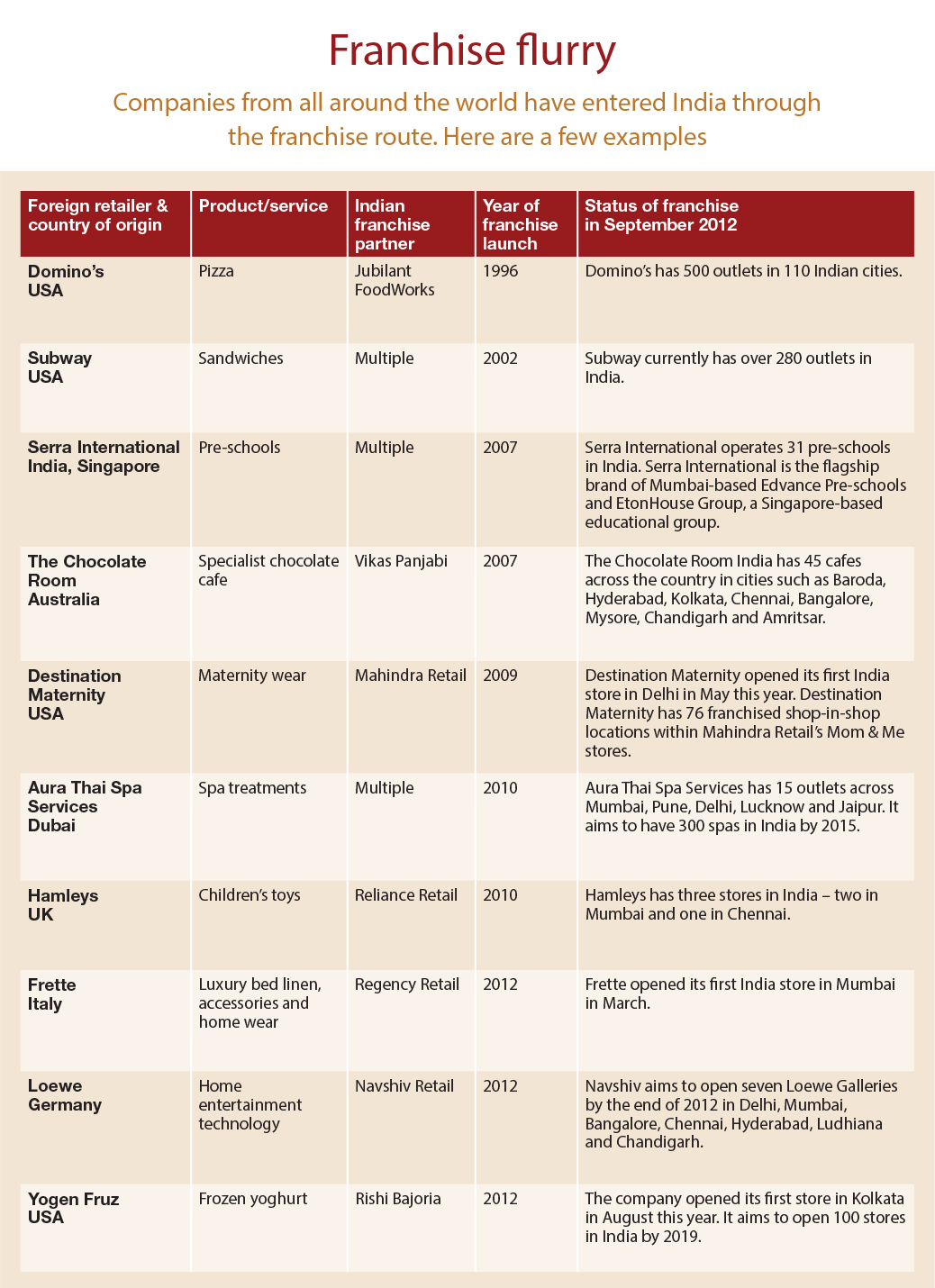
Going the franchise way
Perhaps because of these undeniable difficulties, many retailers entering the Indian market choose to do so by way of a franchise arrangement – sometimes combined with a manufacturing or retail joint venture or other equity arrangement. This is especially so since 2010, when restrictions on royalties and other forms of payments that Indian franchisees are able to make in foreign exchange were removed.
The structuring of franchising or licensing arrangements in the retail sector in India requires careful consideration and must take into account not only the diverse cultural, religious, linguistic, political and economic differences in the country but also the myriad of legal restraints and requirements that affect retailers. Nevertheless, with the right advice, retailers can develop and implement an effective strategy for the Indian market using a franchising or licensing-based approach.
Expertise and negotiation
The first challenge is finding a developer that has the experience and expertise in retail and the resources to develop the brand on a national, rather than regional basis. Naive franchisors are often unaware of the cultural, religious, historical, political, ethnic and economic differences among different parts of India and are thus easily misled by potential developers that oversell themselves and their ability to deliver national coverage. This often results in the franchisor having to renegotiate or terminate the franchise several years on – a process which is only sometimes successful but always time consuming, expensive and diverting.
Once a suitable developer has been identified, the commercial terms need to be agreed. Indian developers often try to over-negotiate every last term of the agreement resulting in the process being excessively protracted and expensive. More importantly, it can result in key quality control and support provisions being over-diluted. As a consequence, the quality suffers, eventually resulting in a falling out between the franchisor and developer.
IP and competition
Protecting the franchisor’s brand can sometimes cause problems if the franchisor does not have trademark rights in India when the deal is being negotiated. Common law rights can be relied on but that may present problems.
India’s competition law is likely to lead to some disputes as a franchisor’s desire to impose vertical restraints on the developer could be seen to be anti-competitive. This has not been a problem so far, but these are still early days for the Indian competition law.
Choice of jurisdiction
The choice of law and jurisdiction is often an issue of some debate. Local developers prefer Indian law and the jurisdiction of the Indian courts but franchisors usually insist on their local law and jurisdiction, citing the slow progress that court cases make in India.
Compromises tend to result in the choice of arbitration and the law of a place with a reputation for more speed, such as England or Singapore, although the Indian party often pushes for Indian arbitration. Technical issues about the enforcement of foreign judgements and the application of Indian public policy can also complicate matters.
Perhaps one of the greatest concerns for foreign franchisors entering the Indian market is their ability to enforce post-contractual non-compete provisions against a former developer. The Indian courts are often perceived to be slow to act and relatively unsympathetic to foreign brand owners, meaning that it can be difficult to get an injunction before damage to the brand has been done.
This is therefore a major topic of discussion during the negotiations.
In summary, franchising offers foreign retailers a good way of entering the Indian market, but it is not without challenges. Franchisors wishing to use this route into the subcontinent need to obtain expert legal advice from lawyers with a strong track record of taking franchises into India.
[/ihc-hide-content]
Mark Abell is a partner at Field Fisher Waterhouse in London.