













The recent stock market volatility has drawn listed companies’ attention to securities disputes as a possible solution, with regulators recognizing Shenzhen’s innovative dispute practice.
Liu Xiaochun and Zhou Yi share Shenzhen’s experience
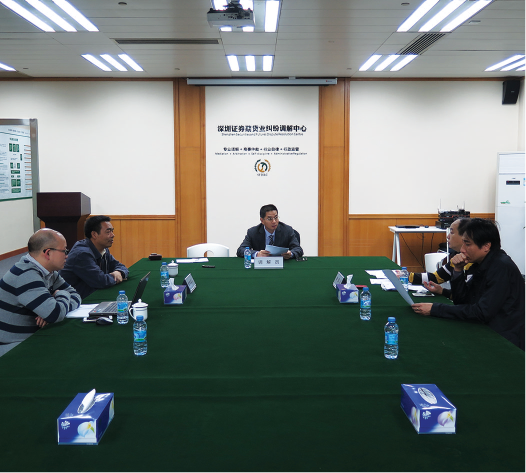
Soon after Shenzhen Securities and Futures Dispute Resolution Centre (SFDRC) was established, China Securities Regulatory Commission (CSRC) chairman Xiao Gang sent out a notice for members’ attention – the SFDRC was a development to follow. Xiao noted during a later visit to SFDRC that its four-tiered resolution model, integrating professional mediation, commercial arbitration, professional self-discipline and administrative regulation, was important for settling capital market disputes.
 Most securities disputes between listed corporations and investors are settled via litigation. Relying solely on litigation for dispute resolution is not necessarily the ideal choice for listed companies, however. The cases are procedurally complex and require considerable money, time, manpower and material resources. In addition, confidentiality is not protected as the trial proceedings and results are public, which can influence the reputation and image of the listed company.
[ihc-hide-content ihc_mb_type=”show” ihc_mb_who=”1″ ihc_mb_template=”2″ ]
Judges may not possess the requisite knowledge and experience to ensure a quality judgment due to the specialized nature of the disputes. The courts may lack the resources to deal with the cases – the complexity as well as vast influence of these cases will undoubtedly take over too many of the court’s resources.
Securities disputes between investors and listed companies are usually initiated due to false statements, insider trading, market manipulation and other securities violations of listed companies resulting in losses for their investors. They generally are highly specialized.
Securities disputes often involve numerous investors, and the total claim amount may be very large. The disputes often attract considerable public attention.
These disputes are not only of interest to the parties, but also affect the operation and management of the companies themselves, and may even influence social stability. In addition, resolution may become ensnared in a complicated situation on account of the lag within the legal system and the particulars of the stock market.
Listed companies and investors involved in these disputes thus generally demand (1) fewer requirements to commence dispute resolution; (2) securities professionals facilitating the resolution; (3) convenient, flexible and efficient procedures; (4) that the procedure be and remain confidential; (5) affordable and effective results. SFDRC’s resolution model provides a method of achieving these demands.
Mediation case study
What follows is a case study wherein SFDRC resolved a securities dispute between a listed company and its investors using its model. In April 2014, a dispute arose due to false statements involving the listed company and more than 9,800 investors across the country. The amount of the claim was nearly RMB 100 million (US$15.6 million). In July that year, major shareholders of the company set up a special purpose compensation fund and invited SFDRC to help design and execute the compensation plan.
The compensation plan provided various solutions to resolve disputes between the listed corporation and the investors, including mediation and arbitration. If the investors accepted the compensation plan, they would be deemed to have reached a settlement. Otherwise, SFDRC could initiate a mediation process, or investors could reach an arbitration agreement with the corporation and then initiate arbitration in Shenzhen Court of International Arbitration (SCIA).
SFDRC background
With an eye on the demands of Chinese capital markets, the Shenzhen Court of International Arbitration (SCIA, also known as the South China International Economic and Trade Arbitration) drew on US experience to initiate and coordinate the establishment of the Shenzhen Securities and Futures Dispute Resolution Centre (SFDRC) with China Securities Regulatory Commission Shenzhen Regulatory Bureau, Shenzhen Stock Exchange, Shenzhen Securities
–
SFDRC persuaded the majority of investors to accept the compensation plan. Yet some investors were unwilling to accept the plan and filed for mediation with SFDRC. Mediators managed to help these investors and the company reach settlement agreements via phone and video conferencing and on-site mediation.
Integrated resolution model
Our legal framework currently lacks a method of resolving securities disputes by mediation or arbitration only. Mediation groups are short on professionalism – e.g. no professionals serve as mediators on public mediation committees – and impartiality – e.g. external parities seldom trust an industry association’s mediation body. Even where the mediation results in a settlement, it can be reversed due to being unable to be enforced by law.
Arbitration does not have issues with professionalism or impartiality, and arbitral awards are enforceable. However, its prerequisite is a valid arbitration agreement between the parties. Many parties to securities disputes were refused arbitration due to lacking an agreement.
China, unlike the US, does not currently permit self-regulatory groups for securities to set up their own arbitration bodies to resolve disputes between members or between members and investors. In order to improve the mere mediation or mere arbitration model, SCIA and other organizations drew on US experience, to create the first capital market dispute resolution model in China.
The model’s four-tiered approach joins the forces of mediation institutions, arbitral institutions and professional self-discipline groups, e.g. securities regulatory authorities, Shenzhen Stock Exchange, the Securities Association. The effectiveness of the model is aided by its arbitration, self-discipline and regulatory mechanism.
The result of SFDRC mediation under this resolution model can be secured by subsequent arbitration in SCIA. Parties can enforce a mediation settlement voluntarily. They can also apply to SCIA for an arbitral award according to the settlement. This award can be recognized and enforced in China and in the 155 state parties to the New York Convention.
Professional self-discipline and administrative regulation also ensure the effectiveness of the settlement. In the cases where one party does not execute the settlement or the award following mediation, the other party or SFDRC can report them to the competent professional self-discipline groups or regulatory authorities, which will record it in the credit system. The self-discipline groups and regulatory authorities are able to then penalize them accordingly.
The requirements to enter into mediation are easy to meet in SFDRC’s resolution model. The mediation can be launched when both parties apply for mediation together, or when one applies for mediation and the other consents. Mediation proceedings remain confidential, protecting parties’ commercial secrets and reputation.
The cost of dispute resolution is low as well. There is no cost for mediation of disputes between small- and medium-sized investors and listed companies. SFDRC also has an online application system available to parties to upload application materials in light of the cross-regional nature of securities disputes. SFDRC, through the assistance of Shenzhen Stock Exchange and its networks across China, has full use of a remote video conference system. This makes long-distance mediation accessible to parties and mediators, reducing the cost of dispute resolution between remote investors and the listed companies.
SFDRC has stipulated the procedures, methods, time limits and other aspects of the model under its Mediation Rules. The rules in particular set out that the proceedings be flexible, efficient and convenient.
As a neutral third party, SFDRC earns the parties’ trust and reliance, especially from investors. All mediators are experts active in the capital markets and are familiar with the rules and practices of the industry. They thus are able to contribute tailored solutions to resolve securities disputes. The equity transfer agreement should set out all important covenants between the transferor and transferee. These may include, for instance, the number of shares, prices, time and manner of delivery, rights and obligations of the transferee as per the JV contract and the target company’s articles of association.
[/ihc-hide-content]
Dr Liu Xiaochun is president of Shenzhen Court of International Arbitration and vice chairman of Shenzhen Securities and Futures Dispute Resolution Centre. Zhou Yi is a senior case manager of SCIA and the assistant of SFDRC’s secretary-general