







As the internet evolves, companies and regulators often find it hard to keep up. But keep up they must if their business is to remain their own, or their regulation is to remain effective. Richard Li and Joy Jiao report
From the moment it intruded on our calm and quiet lives, the internet has been a truculent servant, often demanding as much of our time as it saves, and offering as much financial ruin as opportunity to the unwary.
Its overwhelming popularity and rapid development has changed traditional lifestyles and challenged entrepreneur and lawmaker alike to keep up with its incessant pace in order to protect intellectual property (IP) rights and avoid the many entanglements of wiley infringers.
“Limited by the characteristics of the industry, internet companies cannot fully filter and vet all information on their network platforms, especially to tell in much detail whether such information violates the civil rights of others,” says Frank Liu, a partner in the Shanghai office of Jincheng Tongda & Neal. “If internet companies were required too strictly to perform its duty of care, it would not only lead to direct conflict with regulations, but also have a negative influence on the development of the internet industry.”
Zhang Hui, a partner in the Beijing office of ZY Partners, says that as products and operation modes of websites are developing, the forms of infringement on the internet are also constantly changing. “Features of the internet such as virtualization, digitalization and openness make IP infringement easier, more frequent and more difficult to find,” she says.
Zheng Yanling, another partner at ZY Partners in Beijing, has noted that some websites have started to use “safe harbour principle” as an excuse to avoid legal risk through various product modes such as BBS (bulletin board system), online communities for information sharing, search functions, links, network disks, player software, cloud storage and P2P (person to person) downloading software.
[ihc-hide-content ihc_mb_type=”show” ihc_mb_who=”1″ ihc_mb_template=”2″ ]

“Doing business on WeChat provides a more powerful and covert platform for promoting and selling infringing products, and e-commerce platforms such as Taobao.com and JD.com have also made it easier to sell infringing products and avert legal responsibilities, and more difficult to collect evidence for rights protection,” she says. “As people get used to the free material and convenience provided by the internet, copyright infringement and violations of other IP rights have gained more tolerance, or even support, from the internet users.”

There is a new type of infringement with the increasing use of social media, says the China legal director of a marketing expansion service company. “For example, our client is authorizing our company to use one of their trademarks for marketing and sale in China. However, recently we found that someone else, without due authorization, in the name of our client, used that trademark on the WeChat platform, the most frequently used social media in China.”
As online trade in goods continues to develop, companies need to pay more attention to infringement on the internet. “The internet has bred the surge of our workload to attack online counterfeiting, especially due to the frequent occurrence of using counterfeit domain names to set up sales sites and e-commerce platforms to sell counterfeit goods,” says Sean Ke, the Greater China director of IP & litigation at NXP Semiconductors.
![]()
Liu believes that companies should not give any tolerance to online infringements of domain names, trademarks, patents or copyrights, but should crack down on such infringements and strengthen rights protection.
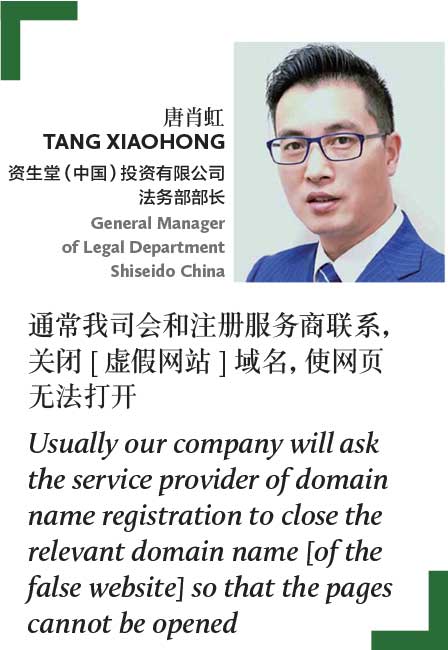
Tang Xiaohong, general manager of the legal department at Shiseido China, says some cosmetics websites that sell smuggled Shiseido products use his company’s registered trademark as domain names and make their websites similar to Shiseido’s official website in order to deceive consumers. “Usually our company will ask the service provider of domain name registration to close the relevant domain name so that the pages cannot be opened,” he says. “If the domain name is registered abroad and the server is also located abroad, we will apply to the Asian Domain Name Dispute Resolution Centre (ADNDRC) for arbitration, and take over the ownership of the domain name after winning the dispute.”
Tang says there are also some copyright infringement behaviours in practice. For example, without Shiseido’s permission, some websites used the Japanese company’s copyrighted product pictures from its official website, or pirated pictures of celebrities endorsing Shiseido products.
Qu Miao, a partner in the Shanghai office of King & Wood Mallesons (KWM), says the fact that the identity and location of the infringer are difficult to identify has also increased the difficulty of IP rights protection online. She believes that companies can solve these problems in the following ways: (1) check information about online real-name authentication; (2) check business operators specified by the relevant websites, search for registered information about a domain name through WHOIS (a query and response protocol), or check registered internet content provider (ICP) information and other indirect information; (3) obtain the relevant information of the other party through transactions; and (4) request relevant information from providers of internet information services.
Infringements are frequently recurrent, and Qu says, “When it comes to domain name infringement, enterprises need to use domain name arbitration and other means to completely eliminate the possibility of infringement; for other types of infringements, enterprises should consider enhancing the disciplinary effect by means of litigation to increase the illegal costs of the opponent; when internet service providers are involved, companies should consider co-operating with them to establish a mechanism to prevent infringements recurring.”

Zhang believes that companies can take three measures to cope with internet infringement.
- Preventing infringement: enterprises can strengthen their protection by technical means, such as encrypting digital products, using monitoring software, and efficient collection and analysis of infringing information.
- Fixing evidence: companies should collect evidence quickly once spotting an infringement, and fix the evidence for the online IP infringement.
- Using various approaches to rights protection: after collecting relevant evidence, companies can first try to stop the infringement at a lower cost by sending a warning letter to the infringer or by notifying the relevant departments; if the dispute cannot be settled outside the court, litigation can be considered on the basis of the collected evidence.
Helen Cheng, a partner in the Shanghai office of Zhong Lun Law Firm, suggests that enterprises should be fully aware of the problems and risks, and take active measures in response. Understanding China’s IP protection system, and what rights enterprises can enjoy for which IP items, is the first step for companies to cope with challenges, she says. “When they know what rights can possibly be obtained, companies should strengthen their defences through copyright registration, trademark registration and patent applications to fix the IP rights and ownerships,” she says. After gaining the IP rights, the company should also take the initiative to guard its own lawful rights. “In order to intervene in advance and prevent further loss, companies can entrust professional legal counsel with the task to actively monitor internet channels regularly to detect infringements and retain the evidence,” says Cheng.
LAGGING LEGISLATION
Cheng says the internet has spawned many things with high economic and commercial value, but corresponding law institutions are incomplete. An example is HuoMaoTV, China’s leading live streaming video platform for gamers, suing Douyu TV – the first case in China in which the defendant’s live broadcasting of e-sports games was deemed as unfair competition. The images of a live e-sports game are a new thing with high economic value brought by the development of internet, says Cheng.
In this case, the court believed that the images of a live e-sports game do not belong to the concept of “works”, so they cannot enjoy copyright protection. “Although the court eventually found that the defendant’s behaviour constituted unfair competition, and provided relief to the plaintiff to some extent, the court’s protection was slightly weaker than it should be,” says Cheng, adding that unauthorized deep linking has also aroused much controversy in recent years, but whether the websites where the links are inserted belong to direct infringers or merely assist in infringement is still under debate among academics and practitioners, she says.
Huang Haifeng, a partner of Jones Day in Beijing and Shanghai, agrees that lagging and uncertain legislation is one of the major challenges in a digital world. “The technology changes too fast for legislators to catch up with it,” he says. “When it comes to online infringement, current legislation still has not yet clarified who should be the subject of legal liability, what kind of liability one needs to assume and how to assign liability among the parties involved.”
In response to these challenges, Huang recommends that Chinese companies should strengthen internal supervision and draw a clear line between content provided by themselves and those from their users. In case of IP rights being infringed by others, all possible internet evidence should be collected before the commencement of a legal action to prevent infringers from changing the key content on the internet.
In the meantime, China is also updating its legal framework to deal with the new market phenomena. For example, the Anti-Unfair Competition Law (revised draft) stipulates four types of unfair competition in the internet sector. Market players will break the law if they: (1) without permission, insert links in internet products or services legally provided by other business operators to redirect the internet users to another website; (2) mislead, deceive or force users to modify, close or uninstall internet products or services legally provided by others; (3) interfere with or destroy the normal operation of others’ lawful internet products or services; and (4) maliciously make others’ lawful internet products or services incompatible. These are legislative responses to the problems that have been encountered in judicial practice in the past, says Liu, from Jincheng Tongda & Neal.
DIFFICULT EVIDENCE COLLECTION
Cheng says it is also a new challenge that the cost for protecting IP rights is increasing under the internet environment. People can easily commit infringements simply by clicking the mouse and downloading a few pictures at relatively low cost. “In contrast, since traces of online behaviour can disappear quickly, rights holders do not even have the time to identify infringers and retain evidence of infringement,” she says. “Sometimes, even if the rights holder has saved the webpages and made screenshots, the court may not accept such electronic evidence because it is very easily modified. Therefore, IP rights holders have to bear more costs for protecting rights.”
In the internet environment, evidence collection requires strong professional skills, because evidence is easily changed or destroyed. Qu, from KWM, believes that when balancing the cost and necessity of obtaining evidence, rights holders should make the decision by finding out who controls the published information. She says if information publication is under the control of third parties, there is only a slight chance that the published information may be changed after rights protection is started, but “if the infringer controls the published information, rights holders should fix the evidence before taking any rights protection action”.
Jerry Xia, the Asia Pacific deputy general counsel and chief IP counsel with Honeywell, says tracing an offline source from online is often a challenge because of the wide range of online sales, covert methods and recurrences of infringement; even if the offline source can be traced, sometimes how to affirm prior sales records is also a problem. “In addition, the boundary between online infringement and reasonable use can sometimes be confusing,” he says.

George Chan, a partner in the Beijing office of Simmons & Simmons, believes one major challenge lies in the process of fact finding and collecting relevant infringing evidence, as difficulties can arise due to both technical issues and the unclear nature of the law. “Due to the constantly changing online environment, IP enforcement mechanisms from the relevant administrative authorities, or the courts, can be ambiguous, lacking clear authoritative guidance,” he says.
Given such challenges, Chan says it is important for Chinese companies to try to familiarize themselves with the relevant types of infringement that may pose the greatest risks to their business operations, and develop a comprehensive strategy using the remedies currently available.
“Strategies will vary from company to company, as different companies will have different concerns over the effects of online infringement,” he says. “For example, a game developer may have more concerns over the infringement of their copyright, while a clothing brand may be more concerned with the protection of its trademarks and brand.”
UNFAIR COMPETITION
He Jing, a senior consultant at the Beijing office of AnJie Law Firm, reminds enterprises to pay attention to commercial defamation, infringement of the right to the use of a trademark, and infringement of the right to online dissemination of information, all of which are aimed at unfair competition.
“Commercial defamation refers to situations where companies or related media spread a large amount of fake or misleading information to damage the business reputation of the competitors,” says He. In August 2016, given that a WeChat public platform spread false and negative information and misleading remarks on RedStar Holdings Limited, Beijing Shunyi court ordered that WeChat pay RMB100,000 (US$14,500) as compensation and apologize on its platform.
Infringement of the right to use of a trademark refers to the use of marks entirely identical or very similar to others’ registered trademarks as the infringer’s own product name or decoration on the same or similar kind of goods, with the consequence of misleading the public. “There has been an increasing number of disputes over counterfeiting well-known corporate trademarks and fraudulent use of others’ online shop logos, which infringes on the legitimate rights and interests of other companies,” says He.
Zhao Kefeng, a partner at the Beijing office of AnJie Law Firm, believes enterprises should enhance the strategic layout of IP resources in the internet sector, given that this is a sector with a huge market, sufficient profit margins and a large number of potential consumers. He expects the number of dispute cases involving internet IPs and unfair competition to surge.
Zhao suggests that companies should collect and retain evidence of infringement and clarify the facts through various means of rights protection to avoid the further spread of misleading information. “For example, companies may request the local industrial and commercial administrative authorities to conduct infringement investigations, issue statements on the official website or blog, or request the web platforms where the infringing information is published to delete the false content,” he says.
“If these measures cannot stop the infringement, the company should consult a lawyer. If the company decides to protect its rights through judicial procedures, lawyers should be engaged in evidence retention, document preparation and much other work, and then the company should file the lawsuit to the court.”

Although the development of the internet has brought challenges for IP rights protection, if companies take efficient action to cope with it, the harm can be effectively reduced. Tang, from Shiseido, says online IP infringement has been greatly reduced since the company started to crack down on counterfeit goods online in 2006.
Since 2011, Shiseido has commissioned professional IP agents to search for online infringement clues on websites such as Taobao.com and Alibaba.com, and have deleted links to infringing content, which has so far achieved impressive results. On the first 15 webpages of the search results of Shiseido brands on Taobao.com, for example, the infringement rate has currently been kept under 1%.
[/ihc-hide-content]